
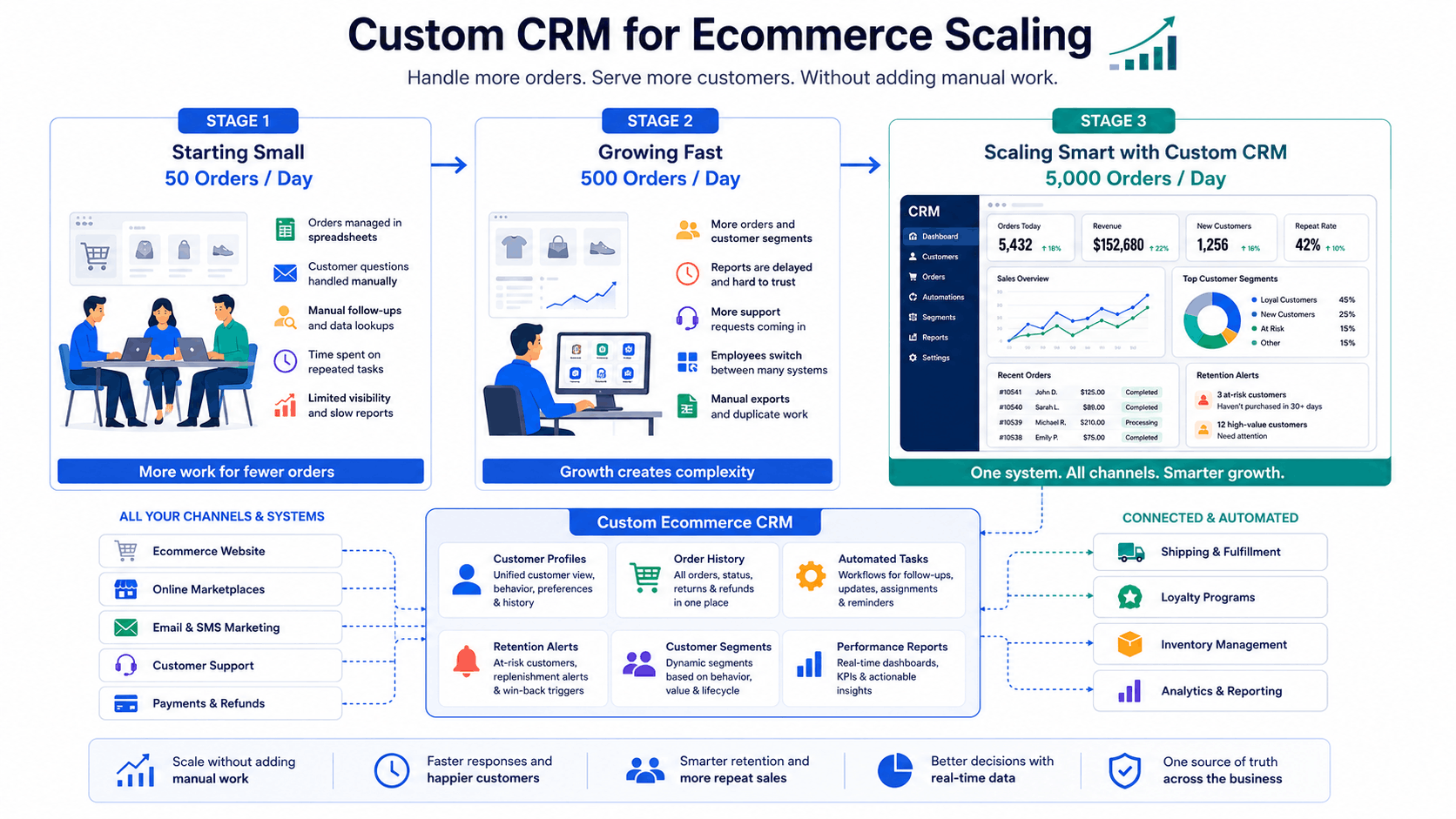
Scaling an ecommerce business usually isn’t limited by demand. It’s limited by how fast a team can respond to customers, act on sales patterns, and make decisions without waiting on manual reports. A business doing 50 orders a day can rely on a support agent’s memory and a marketing manager’s judgment. A business doing 5,000 orders a day cannot — the same manual habits that worked at a small scale start slowing everything down.
A custom CRM removes that ceiling. Instead of adding more staff to handle the same manual lookups, exports, and follow-ups, it automates the coordination between sales, support, and marketing so response times and decision-making stay fast even as order volume, channels, and customer segments multiply.
Quick Answer
A custom CRM helps an ecommerce business scale by removing the manual work that slows teams down as order volume grows — automating segmentation and follow-ups, giving support instant access to a customer’s full history, and surfacing retention signals like missed reorders or declining engagement before they cause lost revenue. Unlike a generic CRM, it’s built around the business’s actual order volume, sales channels, and customer types, so it keeps working the same way at scale that it did on day one.
What Is a Custom CRM for Ecommerce?
Customer relationship management software organizes information about customers and their interactions with a business. A custom CRM for ecommerce extends that idea around the specific needs of an online seller.
It may connect with:
- Shopify, WooCommerce, Magento, or a custom storefront
- Amazon, Walmart, eBay, and other marketplaces
- Email and SMS marketing platforms
- Customer support systems
- Payment gateways
- Shipping and fulfillment providers
- Loyalty and referral programs
- Inventory, ERP, and accounting software
The objective is not simply to store contact details. It is to help teams understand what each customer purchased, how they engaged, what problems they faced, and what action should happen next.
Businesses needing a broader explanation of system planning can review this ecommerce CRM development guide.
How a CRM for Ecommerce Supports Faster Scaling
1. It Creates a Unified Customer View
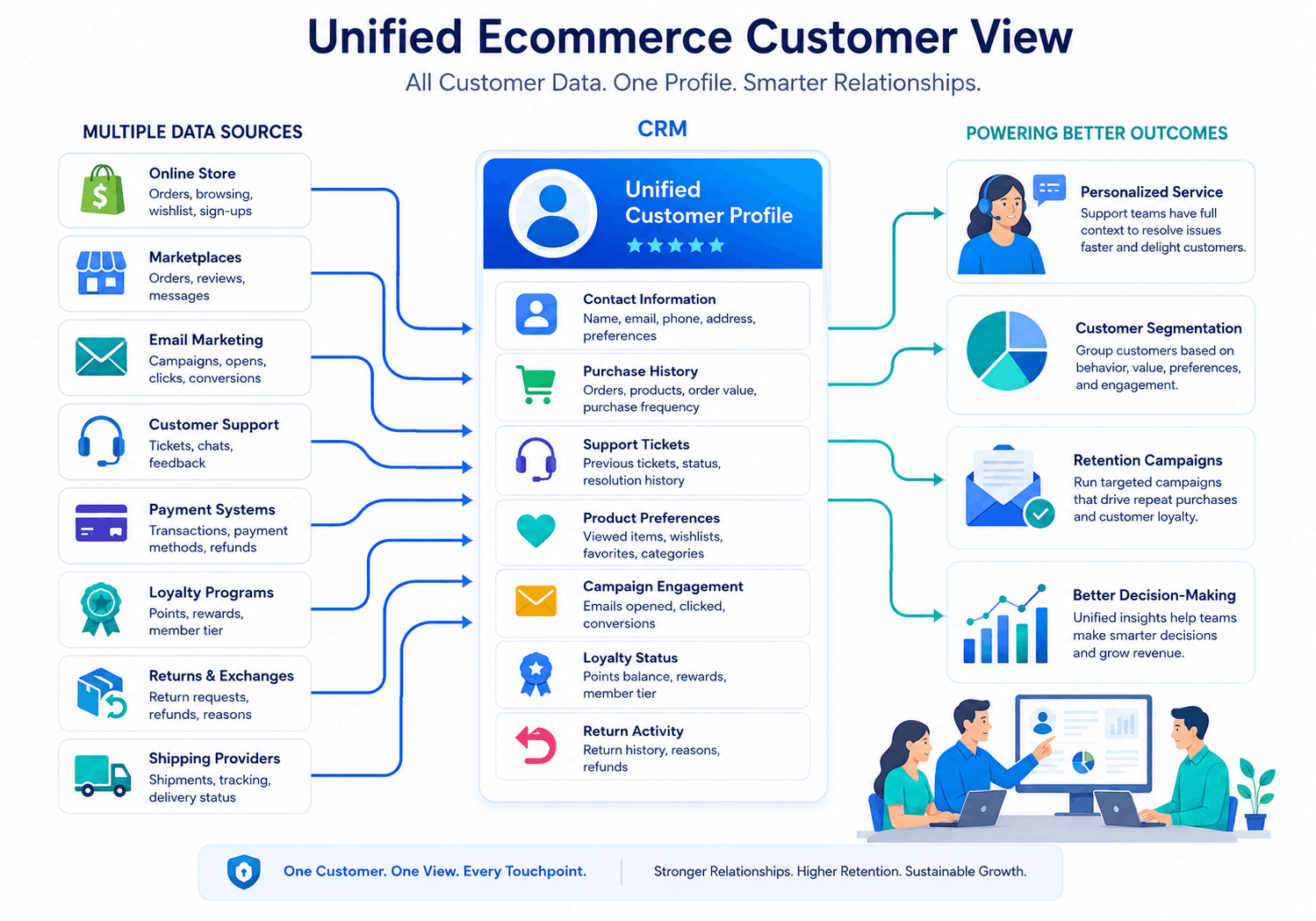
Customer data often becomes fragmented as an online store grows. Order details remain in the ecommerce platform. Campaign activity sits in an email tool. Support conversations stay in a help desk. Marketplace purchases may be stored separately.
A custom CRM can connect these records to create one customer profile.
For example, a support agent could see that a customer:
- Purchased three times during the past year
- Recently returned one product
- Opened a promotional email
- Has an unresolved delivery complaint
- Belongs to a high-value customer segment
This context helps the agent respond appropriately. It also prevents marketing teams from sending an aggressive promotion while the same customer is waiting for a refund.
2. It Automates Work That Becomes Expensive at Scale
Manual work may appear manageable when a store processes 50 orders per day. At 500 or 5,000 orders, the same process can create delays, mistakes, and unnecessary staffing costs.
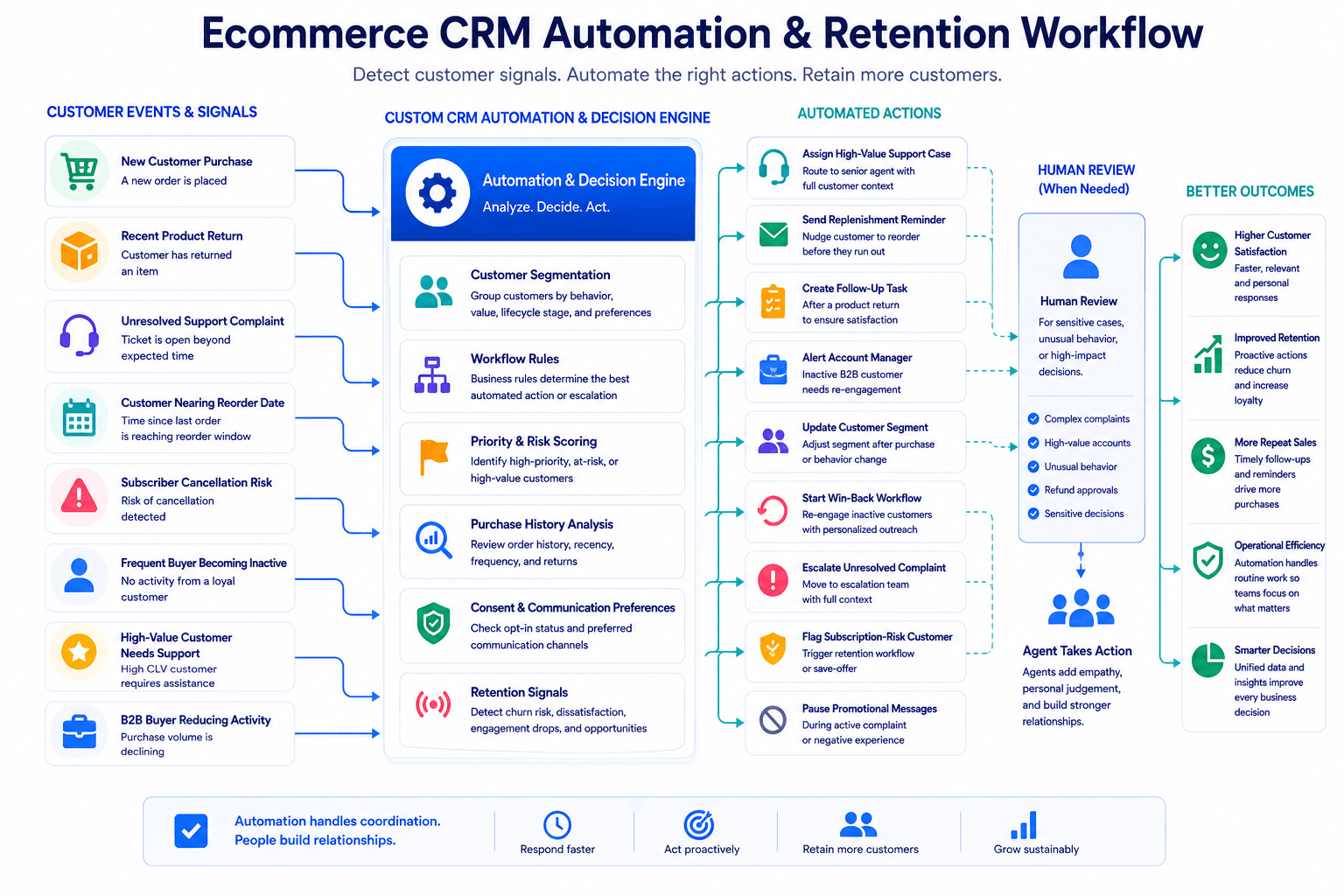
CRM automation can trigger actions when defined events occur. Examples include:
- Assigning high-value support cases to senior agents
- Sending replenishment reminders based on purchase cycles
- Creating follow-up tasks after a product return
- Alerting account managers when B2B buyers become inactive
- Starting a win-back workflow after a set period
- Escalating unresolved complaints
- Updating customer segments after new purchases
The system handles routine coordination while employees focus on exceptions and customer conversations.
3. It Improves Customer Segmentation
Basic ecommerce reports often group customers by simple measures such as total orders or total spending. A custom CRM can support more useful segments based on the company’s business model.
An online beauty retailer, for example, may segment customers by skin-care category, purchase frequency, preferred price range, subscription activity, product concerns, and return behavior.
A B2B ecommerce company may instead use industry, account size, credit terms, quotation history, purchase volume, and assigned sales territory.
Better segmentation supports more relevant campaigns and service workflows. However, personalization should remain transparent and compliant with applicable privacy rules. Businesses should involve legal or privacy specialists when designing consent, retention, profiling, and data-deletion processes.
4. It Connects Marketing, Sales, and Customer Service
Scaling becomes difficult when departments use separate customer records.
Marketing may consider a campaign successful because it generated clicks. Sales may see that the leads were poorly qualified. Support may discover that the promoted product has generated repeated complaints.
A connected CRM gives these teams access to the same operational context. Marketing can evaluate customer quality, sales can understand campaign history, and support can identify recurring issues by product or customer segment.
Kanhasoft’s custom CRM development services include customer management, workflow automation, reporting, support processes, and third-party integrations built around business-specific requirements.
5. It Makes Retention More Systematic
Growth does not depend only on acquiring new customers. Ecommerce companies also need repeat purchases, subscriptions, renewals, referrals, and strong post-purchase experiences.
A CRM can help identify:
- Customers approaching their normal reorder date
- Subscribers at risk of canceling
- Frequent buyers whose activity has declined
- Customers repeatedly returning the same product category
- High-value customers with unresolved service issues
- Buyers who may qualify for loyalty benefits
The CRM does not create loyalty by itself. It ensures that teams notice important signals and respond consistently.
6. It Gives Management Better Scaling Data
A custom CRM can align reports with the metrics that leadership actually uses.
Useful ecommerce CRM reports may cover:
- Repeat-purchase patterns
- Customer lifetime value
- Support volume by product
- Return reasons
- Campaign-to-purchase attribution
- Customer acquisition source
- Retention by cohort
- Average resolution time
- Marketplace versus direct-store behavior
- B2B account performance
Reliable reporting still depends on clear definitions. For example, teams must agree on what qualifies as an active customer, retained customer, high-value buyer, or recovered account. Otherwise, different dashboards may provide different answers.
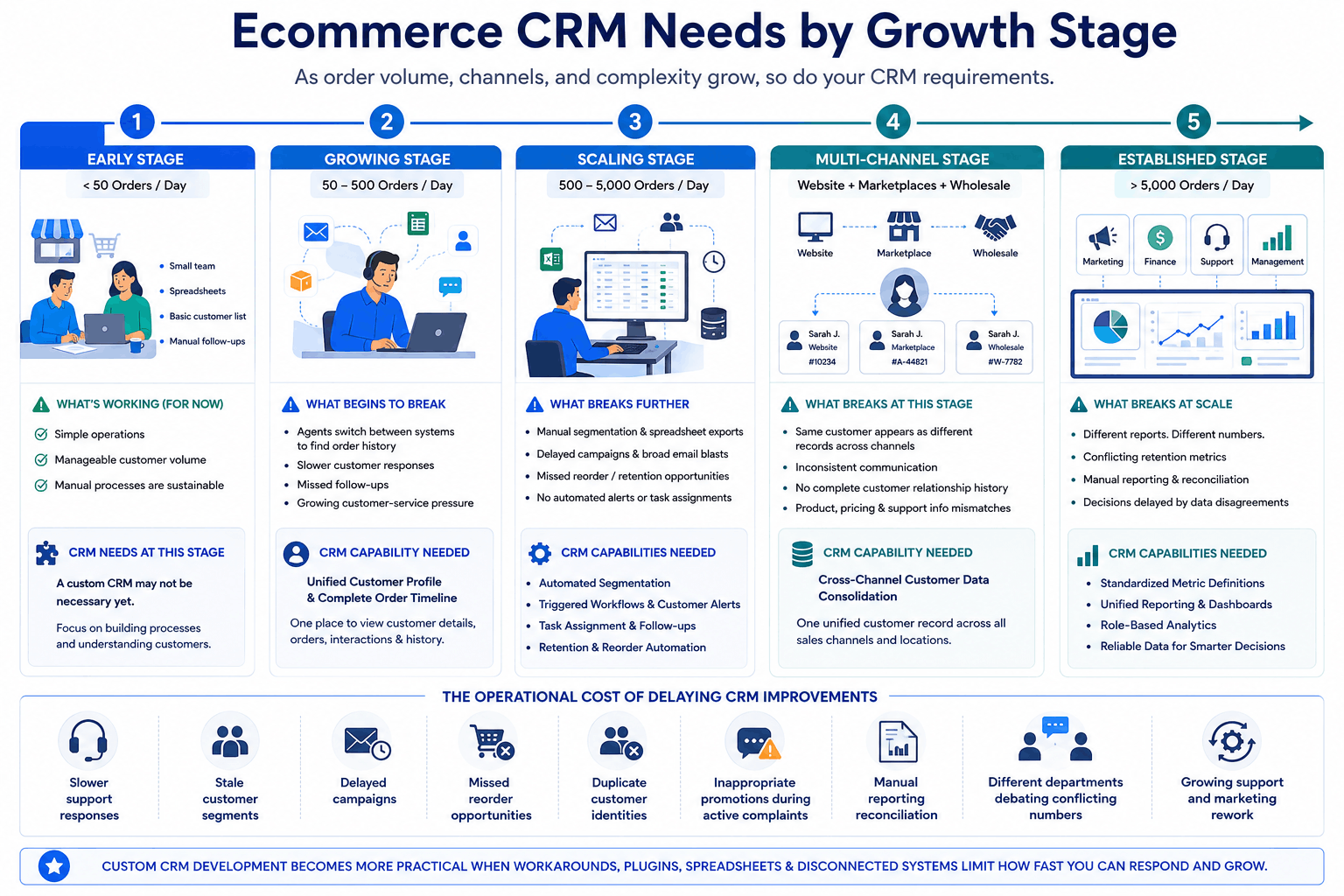
CRM Needs by Growth Stage
| Growth Stage | Order Volume | What Breaks First | CRM Capability Needed |
|
Early stage |
Under ~50 orders/day | Nothing yet — spreadsheets still work |
Basic customer list, manual follow-up |
|
Growing |
50–500 orders/day | Support can’t see order history fast enough |
Unified customer profile, order timeline |
|
Scaling |
500–5,000 orders/day | Manual segmentation and email blasts stop converting |
Automated segmentation, triggered workflows |
|
Multi-channel |
Any volume, 2+ sales channels | No one has a single view of a customer across channels |
Cross-channel data consolidation |
|
Established |
5,000+ orders/day | Reports contradict each other across teams |
Standardized definitions, unified reporting layer |
An established CRM platform is often enough for a store still in the early or growing stage — where order volume is manageable, and a basic customer list with manual follow-up still gets the job done. Custom development becomes more practical once a business enters the scaling or multi-channel stage, when workarounds, plugins, manual exports, or disconnected systems start limiting how fast teams can respond to customers.
The comparison between readily available and custom CRM systems provides additional guidance for evaluating both options.
A Practical Ecommerce Scenario
Consider a retailer selling through its website, Amazon, and wholesale accounts.
Its marketing team uses one platform, customer support uses another, and wholesale orders remain in spreadsheets. No one can easily see the complete relationship with a customer.
A custom CRM could combine direct orders, marketplace activity, support history, wholesale enquiries, and campaign engagement. It could then route retail support cases, assign wholesale opportunities, trigger replenishment reminders, and provide separate dashboards for marketing, service, and management.
The value comes from reducing operational friction, not merely adding another dashboard.
What It Costs to Wait Once You’ve Hit a Growth Stage?
The growth-stage table above shows where teams typically feel the strain. What it doesn’t show is what delaying past that point actually costs.
Each stage has a specific, measurable cost of staying on manual processes too long:
- At the growing stage, slower support responses start showing up in customer satisfaction scores before anyone connects it to the CRM gap.
- At the scaling stage, segmentation that used to take an hour now takes a day — by the time a campaign goes out, the customer behavior it was based on has already changed.
- At the multi-channel stage, a customer who complained on the website and then ordered again on Amazon gets treated as two separate people, and the second order gets the same aggressive upsell email as a brand-new customer.
- At the established stage, marketing reports 12% retention while finance calculates 8%, and both teams spend the next planning cycle arguing about whose number is right instead of acting on either one.
None of these are catastrophic failures. That’s what makes them easy to ignore — the business keeps running, just slightly slower and slightly less accurately than it could, and that gap compounds every time order volume grows again.
The more useful question isn’t “do we need a CRM eventually.” It’s: which of these costs is already showing up in this quarter’s numbers, and is fixing it worth more than what’s currently being spent working around it in support hours, marketing rework, or reporting reconciliation.
Before committing to development, it’s worth documenting which of these costs is actually happening today — not which one sounds the most urgent — since that’s what determines which capability from the growth-stage table should be built first.
Planning Your Next Step with Kanhasoft
Kanhasoft can review your ecommerce platforms, customer-data flows, support processes, marketing tools, and reporting needs before recommending a solution.
The goal of an initial discussion is to determine whether your business needs a custom CRM, an improved integration between existing tools, or a phased system that begins with the highest-value workflow. Businesses can contact Kanhasoft to discuss a practical CRM roadmap without committing to a full build immediately.
Final thoughts
A custom CRM for ecommerce helps businesses scale by turning fragmented customer information into coordinated action. It can automate repetitive work, connect departments, improve retention workflows, and provide clearer management reporting.
However, custom development is not automatically the best option. The right decision depends on workflow complexity, integration needs, growth plans, available budget, and the limitations of existing tools. A careful discovery process should come before any technology decision.