
The Web Scraping Services vs. Web Scraping Software decision is not only about buying software or hiring a provider. It is about deciding who will own setup, data quality, maintenance, compliance checks, and delivery.
Web scraping software is usually the better choice for small, predictable projects that an internal team can configure and monitor. Web scraping services often fit complex websites, high data volumes, frequent updates, custom integrations, or business-critical data. Some companies use both.
This guide explains the differences, hidden costs, risks, and practical criteria for choosing the best web scraping solution for your business.
This Article Is Especially Useful For:
- Ecommerce and retail teams tracking prices, stock, and products
- Market research and competitive intelligence teams
- Recruitment firms collecting public job data
- SaaS companies building data-driven features
- Operations and technology leaders comparing extraction options
Quick Answer
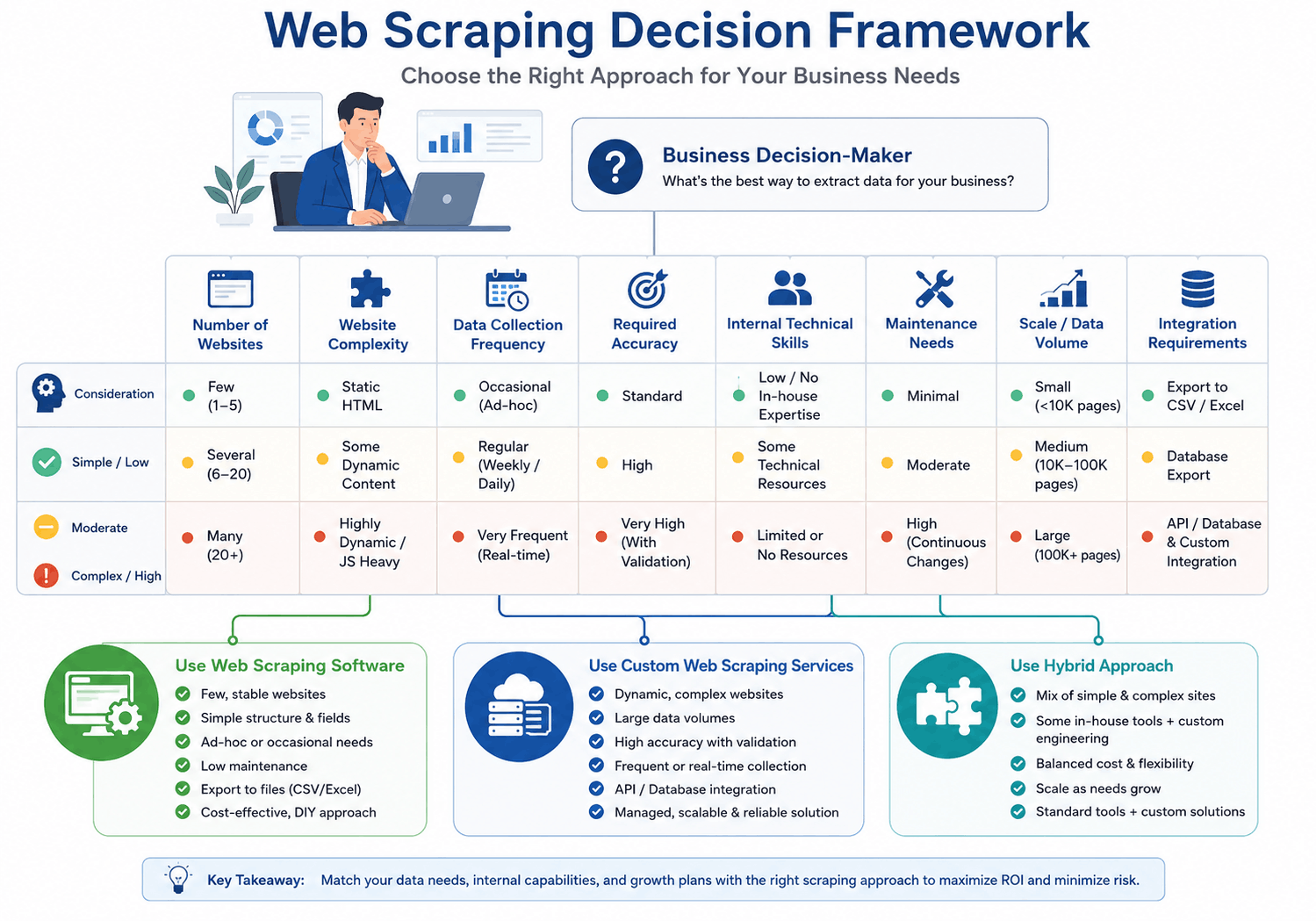
Choose web scraping software when target websites are stable, extraction rules are simple, the project is limited, and your team can maintain the workflow.
When choose web scraping services when data must arrive reliably, websites are dynamic, several sources require different logic, accuracy matters, or the results must connect with a database, dashboard, ERP, CRM, or API.
Choose a hybrid model when standard tools cover most sources, but difficult or high-value sources need custom engineering.
What Is the Difference Between Scraping Software and Services?
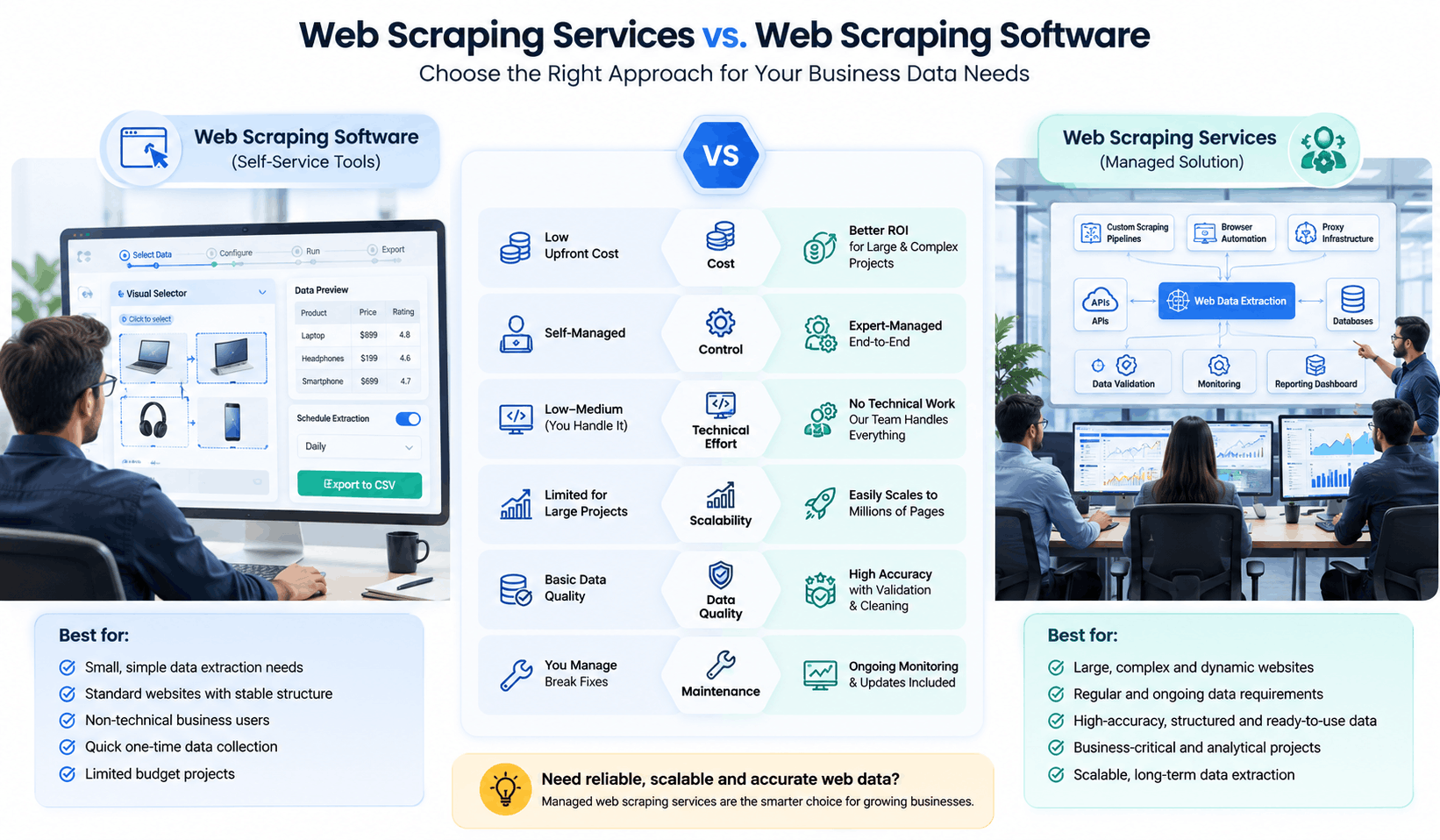
Web scraping software is a self-service product. It may be a browser extension, desktop application, no-code platform, cloud scraper, or extraction API. Users select fields, define rules, schedule runs, and export data.
Web scraping services provide a managed team that plans, builds, runs, and maintains the collection process. Custom web scraping services may include browser automation, proxy management, PDF extraction, API integration, normalization, deduplication, monitoring, and quality checks.
The practical difference is accountability.
With software, the buyer usually owns failed schedules, selector changes, duplicates, missing fields, and validation. With a service, these responsibilities can be included in the agreed scope.
Web Scraping Services vs. Web Scraping Software
|
Decision Area |
Web Scraping Software |
Web Scraping Services |
|
Setup |
Self-configured or template-based |
Designed around business requirements |
|
Technical effort |
Managed internally |
Lower internal workload |
|
Flexibility |
Limited by product features |
Custom logic for websites, APIs, and PDFs |
|
Maintenance |
Buyer handles source changes |
Usually included in the service scope |
|
Quality control |
Depends on internal checks |
Can include validation and manual review |
|
Scale |
Limited by platform capacity |
Architecture can match larger workloads |
|
Integrations |
Standard connectors |
Custom databases, APIs, CRM, and ERP |
|
Best fit |
Simple, predictable extraction |
Complex, recurring, business-critical data |
Neither choice is automatically better. The key question is how costly a failed run, incorrect field, or delayed dataset would be to the business.
When Web Scraping Software Is the Better Choice
The project is small or temporary
Software is useful for a one-time list, short research assignment, or proof-of-concept project.
For example, a retailer might track three competitors for two weeks before investing in a broader pricing intelligence system. A self-service tool allows the company to test whether the data supports useful decisions.
The website structure is stable
Template-based tools work best when page layouts, field labels, pagination, and URLs follow consistent patterns.
If the target website rarely changes and the required fields are clearly displayed, maintenance may remain manageable.
Your team can support the workflow
Someone still needs to monitor runs, check output, and update extraction rules. Software becomes practical when an analyst or developer clearly owns those tasks.
A common failure is not that the scraper stops working. It is that the scraper keeps running while silently returning incomplete or mismatched data.
That type of error can be more damaging because teams may make pricing, inventory, or sales decisions without realizing the dataset is unreliable.
When Web Scraping Services Are the Better Choice
The data supports daily business decisions
Pricing, inventory, lead generation, and market intelligence lose value when information arrives late or contains errors.
Managed web scraping services can include automated retries, failure alerts, audit logs, duplicate checks, and field-level validation. These controls become important when several teams depend on the same data.
Sources require different extraction methods
One website may expose simple HTML. Another may load its information through JavaScript. A third may publish important details inside PDFs. A fourth may offer an official API for only part of the required dataset.
A custom service can combine direct HTTP requests, APIs, browser automation, document parsing, and controlled human review. It does not need to force every source through the same extraction tool.
Scale and historical tracking matter
Large scraping projects require more than scripts. They need scheduling, queues, concurrency controls, storage, deduplication, monitoring, retries, and historical data models.
In one documented Walmart ranking project, a custom Python and Celery pipeline processed approximately 300,000 keywords daily. It tracked up to five pages per keyword, separated organic and sponsored results, and stored historical ranking data.
That workload required a purpose-built system rather than a basic point-and-click scraper.
Data must connect with existing systems
Raw CSV files often create another manual process.
A custom service can send validated information directly into a CRM, ERP, business intelligence dashboard, cloud database, data warehouse, or internal API.
This is where custom web scraping services can add practical value. The extraction method, data schema, validation rules, and delivery workflow can be planned as one system.
Which Option Costs Less?
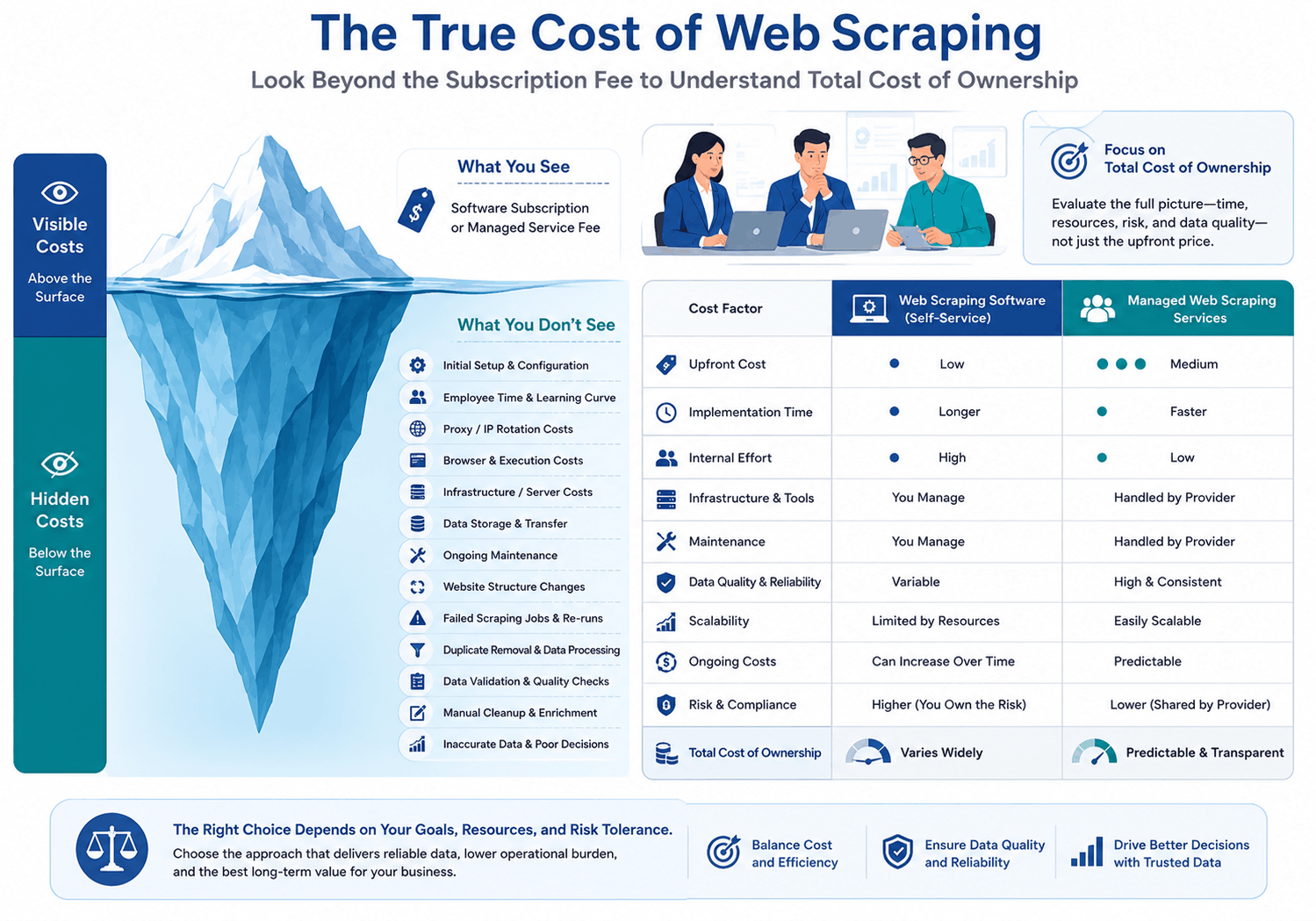
Software usually has the lower visible starting cost. However, the subscription fee is only one part of the total cost.
A more useful calculation is:
Total cost = software or development + setup + infrastructure + maintenance + quality control + failure impact
Software expenses may include:
- Monthly subscription fees
- Usage credits
- Browser execution charges
- Proxy traffic
- Data storage
- Premium connectors
- Internal employee time
- Manual data cleanup
Service expenses may include discovery, custom development, infrastructure, monitoring, maintenance, and change requests.
Consider a retail team that uses a low-cost tool but spends ten hours each week correcting product matches and filling in missing prices. The software is inexpensive. The complete process is not.
A managed service may cost more upfront but reduce internal effort. However, it offers better value only when outputs, responsibilities, quality rules, and maintenance expectations are clearly defined.
Risks, Ownership, and Compliance
Both options introduce risks.
Scraping software can create platform lock-in, unexpected usage charges, limited debugging, or silent data errors. Scraping services can create vendor dependency, unclear ownership, poor documentation, or disputes about what is included.
Before choosing either option, request:
- A representative sample dataset
- A documented field schema
- Accuracy and completeness rules
- Duplicate and product-matching rules
- Monitoring and retry procedures
- A process for handling source changes
- Security, storage, and retention controls
- Data and source-code ownership terms
- Pricing at the expected production volume
Publicly accessible data is not automatically free from privacy, contractual, copyright, or sector-specific obligations.
The Robots Exclusion Protocol gives website owners a standardized method for communicating crawler preferences. Responsible scraping teams should review these instructions during source assessment.
Privacy authorities have also highlighted the risks associated with scraping publicly accessible personal information.
For personal, regulated, copyrighted, or restricted data, consult qualified legal and privacy professionals. A technical development team should not make the final legal decision alone.
A Practical Decision Table
|
Question |
Choose Software When… |
Choose Services When… |
|
How many sources are involved? |
A few similar websites |
Many websites with different structures |
|
How often is data needed? |
Once or occasionally |
Daily, hourly, or on a fixed schedule |
|
How important is accuracy? |
Errors are easy to review manually |
Errors affect pricing, sales, or operations |
|
Who will maintain it? |
An internal owner is available |
Internal technical capacity is limited |
|
Is custom logic required? |
Standard fields and exports are enough |
Matching, PDFs, calculations, or integrations are needed |
|
What happens after a failure? |
A temporary pause is acceptable |
Fast detection and recovery are essential |
The more valuable the data becomes, the less sensible it is to treat extraction as a one-time setup task.
Is a Hybrid Model the Best Web Scraping Solution for Business?
In many cases, yes.
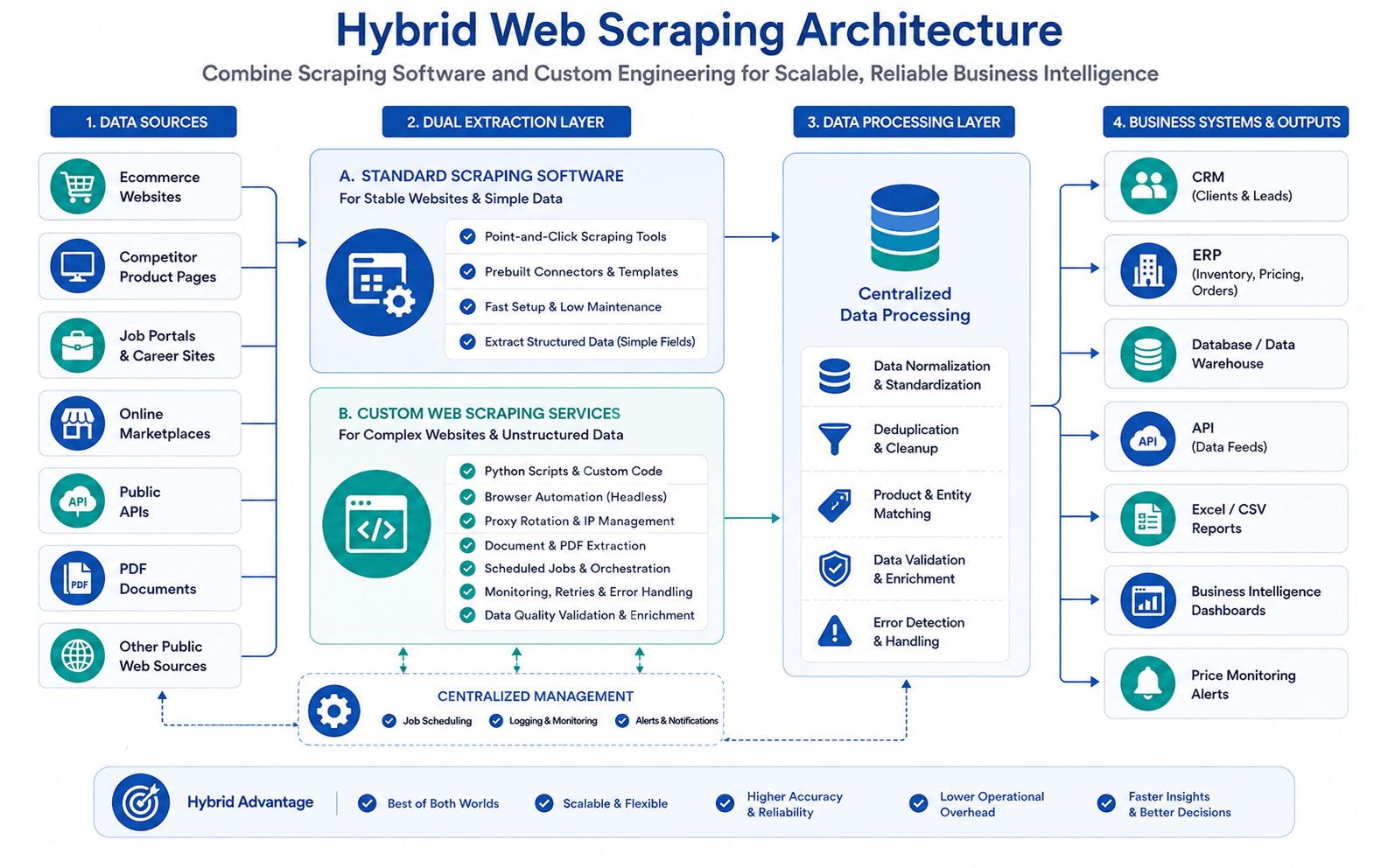
A hybrid model uses software for straightforward sources and custom engineering for difficult or high-value websites.
For example, an ecommerce company may use a standard scraping tool for five stable competitor websites. A custom pipeline could then handle marketplaces, seller-level prices, product matching, stock changes, and historical trends.
Both datasets could flow into one reporting dashboard.
This approach controls costs without forcing complex requirements into a rigid product. It also avoids building every technical component from scratch.
A hybrid setup may also use a commercial extraction API for page access while relying on custom code for validation, matching, storage, alerts, and reporting.
How to Test the Decision Before Committing
Run a small paid pilot using representative sources. Include at least one difficult website rather than testing only the easiest pages.
Measure:
- Field-level accuracy and completeness
- Duplicate and matching quality
- Handling of changed or missing content
- Delivery reliability and refresh speed
- Monitoring and failure alerts
- Internal cleanup and maintenance time
- Security, documentation, and ownership
- Cost at the expected production volume
Do not judge success only by the number of rows returned.
The real test is whether the data can support a business decision without extensive manual cleanup. A dataset containing thousands of records is not valuable when products are mismatched, prices use different formats, or important fields are missing.
A Consultative Next Step with Kanhasoft
Businesses comparing tools and services can begin with a source and workflow assessment instead of immediately committing to a full custom build.
Kanhasoft can review the target websites, required fields, collection frequency, output format, integrations, and expected maintenance effort. Based on that assessment, the practical recommendation may be to use an existing tool, develop a custom pipeline, or combine both approaches.
Explore Kanhasoft’s web scraping services and broader custom software development capabilities.
Final Words
The Website Scraping vs Scraping Tools choice should reflect operational risk, not only purchase price.
Software works well for simple, stable, and clearly owned projects. Web scraping services are better suited to complex sources, recurring delivery, strict quality requirements, and custom integrations.
For many businesses, a controlled hybrid model is the practical answer. Start with the simplest method that meets the requirement. Test it on real sources, measure maintenance and cleanup, and expand only when the business value is clear.
In short: Web scraping software is a self-service tool you configure and run yourself. Web scraping services are a managed team that builds, runs, and maintains the extraction process for you.