
Enterprise software was designed around screens. A salesperson opens the CRM. A purchasing manager signs into the ERP. A finance user opens another module. Every workflow assumes a person is clicking through an interface.
AI agents challenge that assumption.
A headless CRM and ERP for AI agents separates core business capabilities from a single user interface. The same governed services that power a web or mobile application can also serve AI assistants and agents. Model Context Protocol (MCP) can provide a standardized, AI-friendly way for those agents to discover approved tools and use them safely.
For businesses planning custom CRM development, this is becoming an important architectural question: should the next CRM be designed only for human users, or for humans, applications, and AI agents?
Quick Answer: What Is a Headless CRM or ERP for AI Agents?
A headless CRM or ERP keeps business data, rules, permissions, workflows, and integrations in backend services instead of tightly coupling them to one user interface.
Web applications, mobile apps, customer portals, integrations, and AI agents can then interact with those services through controlled interfaces.
MCP adds another useful interface. It allows AI applications to discover approved tools and context in a standardized way. However, MCP should not bypass the CRM or ERP business layer. The backend must still enforce permissions, validation, approvals, and audit rules.
Put simply:
Headless architecture makes enterprise capabilities reusable. MCP makes selected capabilities easier for AI agents to understand and use.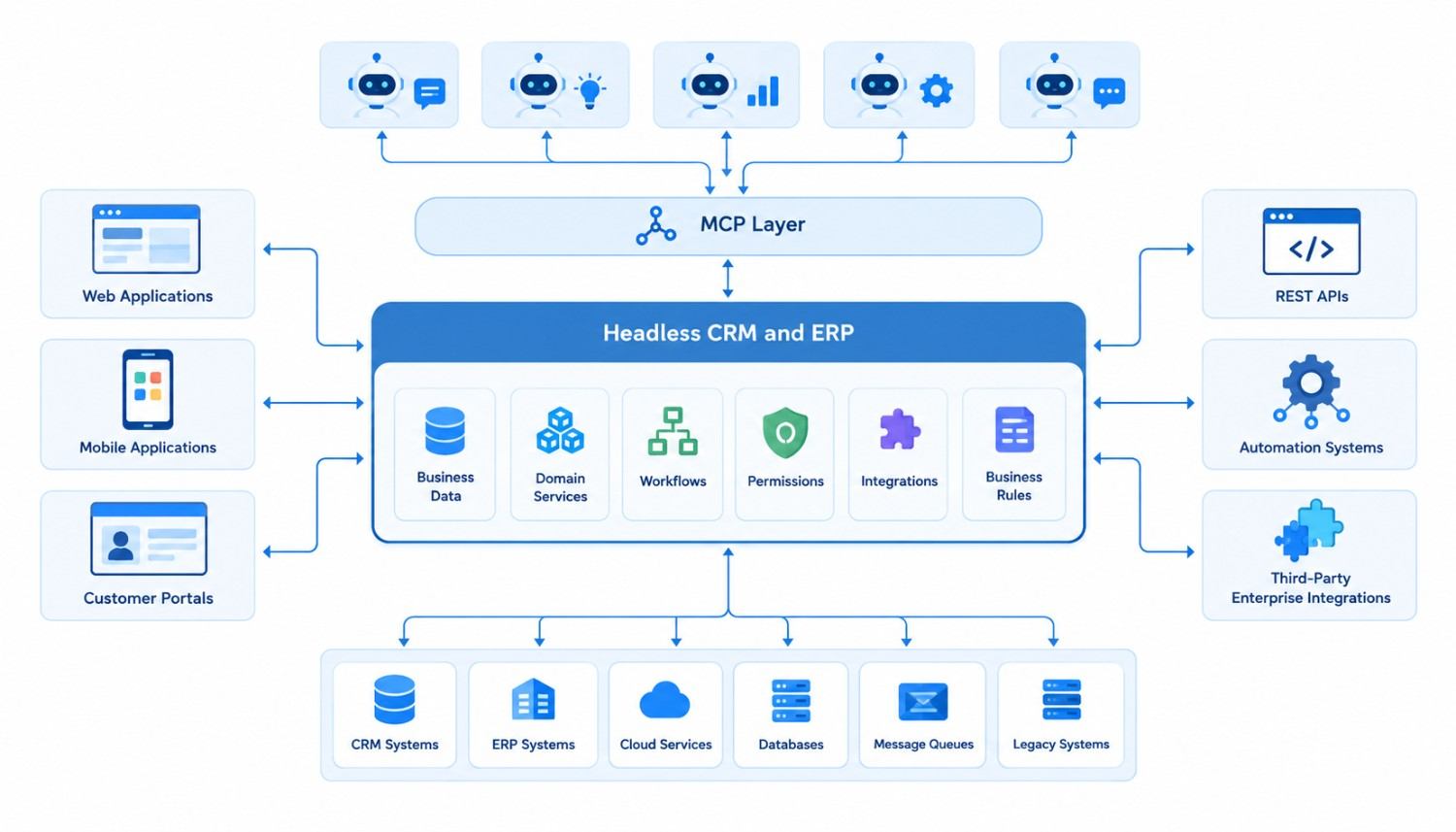
What Does “Headless” Mean for CRM and ERP?
Headless architecture is often associated with content management and commerce, but the same principle works well for enterprise applications.
In a tightly coupled CRM, the interface, workflow logic, and backend functions may be closely connected. A button might trigger code designed specifically for that screen.
A headless CRM takes a different approach.
Customer records, opportunities, quotations, activities, approvals, and other functions are exposed through reusable business services.
A headless ERP can do the same with inventory, purchasing, manufacturing, finance, logistics, projects, and other modules.
The architecture might look like this:
Business data → Domain services → APIs/MCP → Web, mobile, integrations, AI agents
Headless does not mean there is no user interface. It means the user interface is no longer the only doorway into the system.
That distinction matters when AI agents become another enterprise software consumer.
Why AI Agents Change CRM and ERP Architecture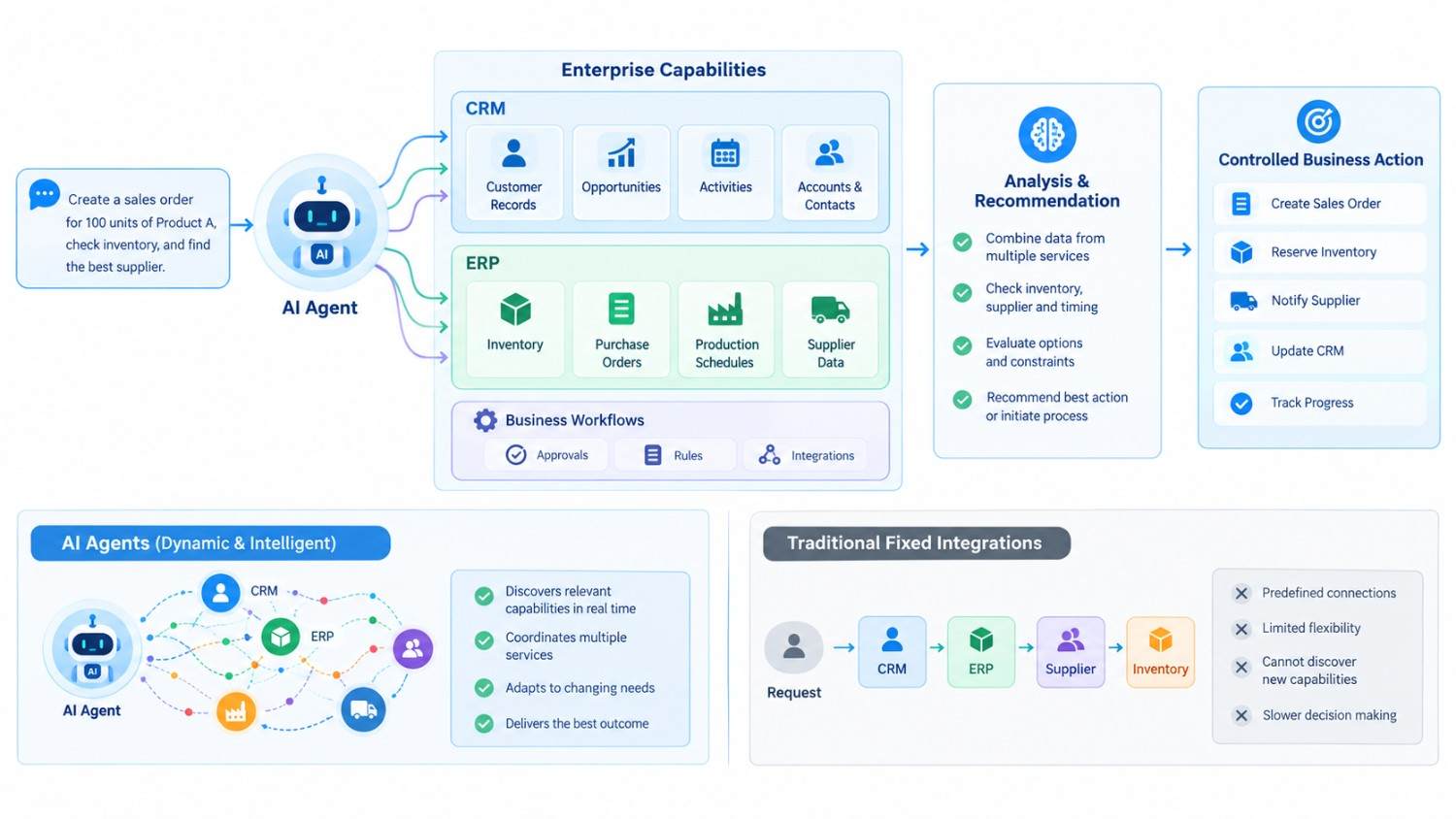
Traditional integrations are deterministic.
A mobile application knows which endpoint retrieves an order. An accounting integration knows which endpoint creates an invoice. Developers define that behavior in advance.
AI agents operate differently.
A manager might ask:
“Find customers with large opportunities that have had no meaningful activity this month and prepare follow-up tasks for the account owners.”
The agent must determine which information it needs. It may inspect opportunities, activities, account owners, tasks, and customer history before deciding what to do.
An ERP request can be even broader:
“Which production orders are at risk because of material shortages, and what purchasing actions should we consider?”
The agent may need inventory balances, bills of materials, purchase orders, supplier lead times, production schedules, and open demand.
This is where a headless architecture becomes useful. Business capabilities are already available independently of individual screens.
MCP can then give the AI agent a structured catalog of the capabilities it is allowed to use.
Where MCP Fits Into Headless Enterprise Software
Model Context Protocol is an open protocol designed to connect AI applications with tools and contextual information.
OpenAI, for example, supports remote MCP servers and describes MCP as a way for models to connect with external tools and services. Its current implementation also supports approval controls around tool execution.
An enterprise MCP server might expose tools such as:
find_customerget_opportunity_historycreate_follow_up_taskcheck_inventoryget_production_schedulefind_open_purchase_ordersprepare_purchase_request
The important word is approved.
The AI agent should not receive unrestricted database access simply because MCP makes tool connectivity convenient.
A safer architecture is:
AI Agent → MCP Server → CRM/ERP Business Services → Database and Integrations
Not:
AI Agent → MCP Server → unrestricted database access
This keeps business authority outside the model.
For a deeper protocol comparison, see Kanhasoft’s MCP vs REST API for AI-Powered CRM & ERP guide.
Headless CRM/ERP vs Traditional Architecture
| Area | Traditional CRM/ERP | Headless CRM/ERP |
|---|---|---|
| Primary access | Main application UI | Multiple channels |
| Business logic | Often tied closely to application workflows | Centralized in reusable services |
| Web/mobile support | Usually application-specific | Multiple interfaces can share services |
| Integrations | Added around the core application | API-first integration model |
| AI agent access | Often custom-built | Easier to expose selected capabilities |
| MCP readiness | Requires additional abstraction | Natural fit when services are already modular |
| Governance | User-centric | Must cover users, applications, and agents |
| Flexibility | Depends on platform design | Higher when boundaries are well designed |
Headless architecture does introduce more design work. Teams need stable service contracts, identity management, observability, API governance, and clear ownership of business rules.
For a simple internal CRM with ten users and few integrations, that complexity may not be justified.
MCP Does Not Replace REST APIs
One misconception is that MCP represents the next generation of APIs and REST will disappear.
That is not a useful way to design enterprise software.
REST APIs remain effective for web applications, mobile apps, portals, accounting integrations, payment providers, warehouse systems, webhooks, and predictable system-to-system communication.
MCP solves a different problem: giving AI applications a standardized way to discover and use permitted capabilities.
A practical enterprise architecture may therefore look like this:
Web/Mobile Apps → REST APIs
External Systems → REST APIs/Webhooks
AI Agents → MCP → Existing Business Services
The architecture preserves mature integrations while adding an AI-facing interface.
That is also why an existing API-first CRM or ERP may be easier to make agent-ready than a tightly coupled legacy application.
Real-World Scenario: Manufacturing ERP
Consider a manufacturer managing production, inventory, procurement, sales, and logistics.
In one documented Kanhasoft project, these processes had been fragmented across spreadsheets and disconnected tools. The implemented ERP centralized production, inventory, procurement, sales, and logistics while supporting BOM-driven production planning, real-time inventory tracking, and REST-based integrations.
That project was not an MCP implementation. However, it demonstrates the foundation an AI agent needs: structured records, clear workflows, reusable services, and defined business rules.
Once that foundation exists, an MCP interface could selectively expose functions such as:
“Show production orders affected by low material availability.”
The agent could retrieve production requirements, inspect inventory, check incoming purchase orders, and summarize shortages.
It might then prepare a replenishment request.
But the actual purchase approval should still follow ERP authorization rules.
The agent reasons. The ERP governs.
CRM Scenario: An Agent Working Across the Customer Lifecycle
A headless CRM creates similar opportunities.
Imagine a sales manager asking:
“Which enterprise opportunities need attention before Friday?”
Instead of reading one dashboard, an AI agent could inspect opportunity stage, recent communication, pending tasks, quotations, customer activity, and close-date changes.
It might identify three stalled deals, explain why they need attention, create internal tasks, and draft follow-up emails.
That is different from putting a chatbot beside the CRM.
The agent is using CRM capabilities to help move a workflow forward.
Kanhasoft’s existing agentic CRM architecture guide discusses the same underlying principle: AI reasoning should remain separate from business authority.
The Most Important Design Rule: Separate Reasoning From Authority
An AI agent can recommend an action. That does not mean it should automatically have permission to perform it.
Suppose an ERP agent decides that a purchase order should be created.
Before execution, the backend may need to check:
- user and agent permissions;
- purchasing thresholds;
- approved supplier status;
- budget availability;
- duplicate requests;
- approval hierarchy;
- mandatory supporting documents; and
- audit requirements.
The same principle applies to CRM actions involving discounts, contracts, customer deletion, refunds, or sensitive data.
MCP provides connectivity. It does not replace governance.
For higher-risk financial, privacy, employment, healthcare, or regulated workflows, security, compliance, and legal specialists should review the architecture and authorization model before autonomous actions are enabled.
What Should Become an MCP Tool?
Not every backend function should be available to an agent.
A useful starting point is to classify tools by risk.
| Tool Type | Example | Suggested Control |
|---|---|---|
| Read-only | Check inventory | Normal authorization |
| Analysis | Identify delayed orders | Normal authorization + logging |
| Low-risk action | Create internal task | Permission + audit log |
| External communication | Send customer email | Draft/approval depending on policy |
| Financial action | Approve refund | Human approval |
| Destructive action | Delete customer records | Strong restriction or no agent access |
Start narrow.
Read-only tools and reversible internal actions are usually easier to govern than financial, contractual, destructive, or compliance-sensitive actions.
OpenAI’s MCP documentation similarly allows developers to control whether tool calls can execute automatically or require explicit approval.
When Headless CRM & ERP for AI Agents Makes Business Sense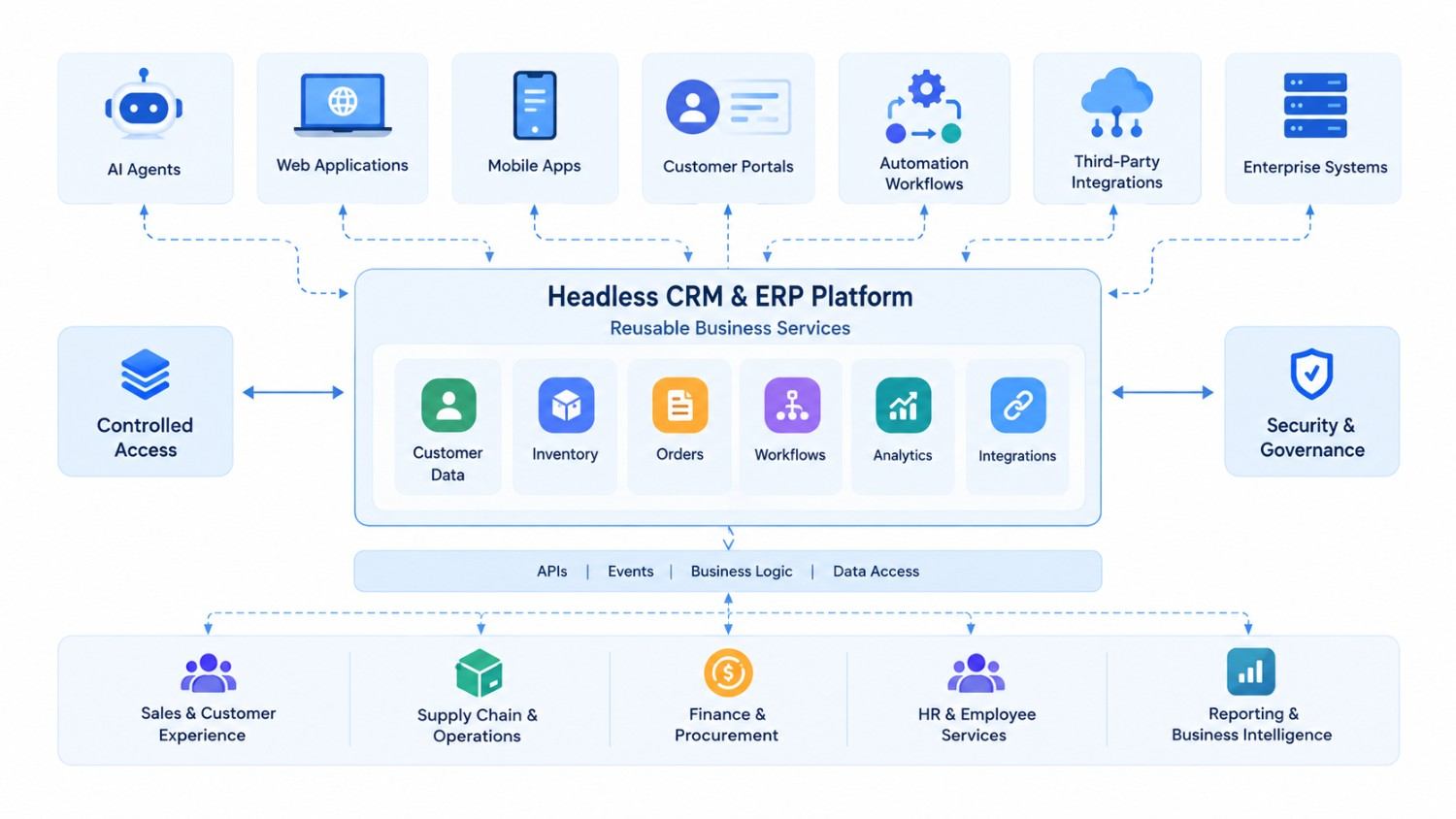
This architecture deserves consideration when an organization has several applications, many integrations, cross-department workflows, or serious plans for AI agents.
It becomes particularly useful when the same business capability needs to serve several consumers.
For example, getInventoryAvailability might support an ERP screen, customer portal, mobile warehouse application, e-commerce integration, and AI agent.
One governed capability serves several channels.
However, do not redesign a stable CRM or ERP solely because MCP is gaining attention.
If the current requirement is a simple AI assistant that retrieves a few records, existing APIs may be sufficient.
Architecture should follow the business requirement, not the protocol trend.
A Practical Migration Path
Businesses do not need to rebuild their enterprise systems from zero.
First, identify tightly coupled workflows and separate important business logic from interface code. Then establish stable domain services and APIs.
Next, map the AI use cases. Determine exactly what an agent needs to read, analyze, create, or update.
Only then expose selected capabilities through MCP.
Start with controlled use cases such as customer lookup, account summarization, inventory checks, document retrieval, or operational exception analysis. Add write actions gradually after permissions, approvals, logging, and monitoring are proven.
This approach also limits unnecessary architecture work.
Practical observation: AI readiness often exposes existing software design problems. If customer data is inconsistent, permissions are unclear, or business rules live inside scattered screens, adding MCP will not fix those problems. Clean service boundaries usually need to come first.
What Enterprise Leaders Should Evaluate Before Adopting MCP
The technology question is only part of the decision.
CTOs and product teams should ask whether the CRM or ERP has well-defined business services, reliable APIs, structured permissions, audit trails, and clear ownership of important workflows.
They should also decide which actions AI may perform autonomously, which require human approval, and which should never be exposed to an agent.
Finally, plan for change. MCP continues to evolve, so enterprise implementations should avoid unnecessary dependence on experimental features and maintain clear versioning and testing practices. The MCP project itself has continued work around scalability, server identity, extensions, and SDK standardization.
Headless CRM & ERP for AI Agents Is an Architecture Decision, Not an AI Feature
The shift toward AI agents changes a basic assumption about enterprise software.
Humans are no longer the only consumers of CRM and ERP capabilities.
Web applications, mobile apps, integrations, automation services, copilots, and autonomous or semi-autonomous agents may all need controlled access to the same business functions.
That makes headless architecture increasingly relevant.
MCP adds a standardized AI-facing doorway, but it should sit on top of strong business services rather than replace them.
The strongest headless CRM and ERP for AI agents architecture therefore combines modular services, conventional APIs, MCP where useful, strict permissions, human approval for sensitive actions, and complete auditability.
The goal is not an ERP without screens or a CRM run entirely by AI.
It is enterprise software designed so the right interface—human or AI—can use the right capability with the right level of authority.
Planning an AI-Ready CRM or ERP Architecture?
Kanhasoft works with businesses on custom ERP development, CRM platforms, API integrations, workflow automation, and AI-enabled business applications.
If you are evaluating MCP or agentic capabilities, a practical first step is to map your existing architecture, APIs, business rules, permissions, integrations, and high-value AI workflows.
From there, you can decide what should remain a traditional API, what makes sense to expose through MCP, and where human approval should remain mandatory.
The objective is not to add MCP everywhere. It is to make your enterprise software genuinely ready for controlled AI participation.