










-

Custom Software · USA
-

Custom Platform · USA
-

SaaS Platform · USA
-

Logistics ERP · USA
-

Healthcare Technology · USA
-

eCommerce Operations · USA
-

Enterprise Software · USA
-

Web Application · USA
-

Enterprise ERP · USA
-

Environmental ERP · France
-

Workflow ERP · Norway
-

Mobile Application · USA
-

SaaS Platform · Switzerland
-

Insurance Software · USA
-
Data Platform · USA
-

Custom Platform · Norway
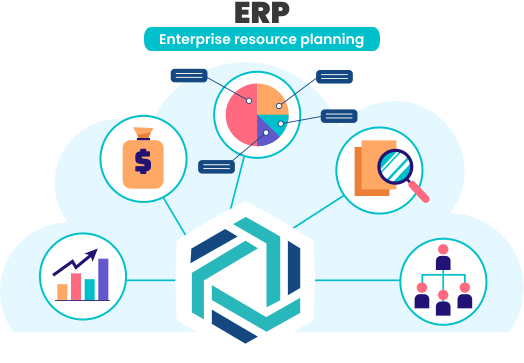
Why Choose Kanhasoft as Your Custom ERP Development Company?
Two companies working in the same industry can have completely different processes. One manufacturer might produce against confirmed orders, while another maintains stock based on demand forecasts. Their software needs won't be identical.
That's why we start by understanding how work actually moves through your business. We look at the people involved, the systems they already use, the information they need, and the problems they deal with every day.
Our custom ERP development work covers everything from a single operational module to an application connecting several departments. The aim is to deliver software that supports the business without making routine work more complicated.
What Sets Kanhasoft Apart

Global ERP Delivery Experience
50+ ERP systems delivered across the USA, UK, Canada, UAE, Europe, and Israel. We understand regional compliance, data regulations, GDPR requirements, and business practices specific to each market — not just the code.

ERP Software Built Around Your Workflows
We build ERP applications around your business requirements instead of forcing your team to work within a fixed template. Whether you need a complete system or selected custom modules, we focus on the features that matter to your daily operations.

Scalable ERP Architecture
Your ERP should support new users, departments, integrations, and business processes without unnecessary redevelopment. We design the architecture around expected workloads, security requirements, and future enhancements, with performance testing matched to each project's scope.

Transparent & Collaborative Engagement
Every project includes weekly progress reports, Asana-based task tracking, a dedicated project manager, and time-zone-aligned communication. No surprises — just clear, predictable delivery from scoping to go-live.


Partner with Kanhasoft to develop an AI-enabled custom ERP solution that works the way your business works, globally capable, locally compliant, and engineered to scale.
Innovate. Integrate. Inspire.
We innovate with AI-driven, cutting-edge technology, integrate seamless solutions, and inspire digital transformation across industries.

500+
Projects Completed

13+
Years of Experience

350+
Happy Client
85+
Specialist


5 star Rating Reviews


18,875 Working Hours $500K+ Earned
Let’s connect
How We Develop Custom ERP Software for Your Business
Building a custom ERP system is not about writing code — it's about understanding how your business moves before a single line is written. Our process starts with a structured discovery phase where we map your current workflows, identify bottlenecks, and define exactly which modules your ERP needs on day one versus which can be added as you scale.
From there, our architects design a modular ERP structure — typically built on Python/Django or Node.js with a React frontend — deployed on AWS or Azure with role-based access controls, audit logs, and enterprise-grade security built in from the ground up.
Development follows an agile sprint model with bi-weekly demos, so you see working software every two weeks rather than waiting months for a big reveal. Most mid-complexity ERP systems go from scoping to first deployment in 4–6 months. Enterprise ERP platforms with multiple integrations and high transaction volumes typically take 8–12 months.
After launch, every project includes 90 days of free support and warranty. We also offer long-term maintenance contracts for teams that want continuous improvements, new module development, and proactive performance monitoring.
What our clients say
Kanhasoft delivered a custom ERP system that transformed how we operate at Secro. They improved our efficiency by over 40% and reduced document processing time dramatically. Their team handled project management flawlessly and adjusted quickly to any changes we needed. Their technical skill and professionalism made the process smooth and exceeded our expectations.


Kanhasoft helped the client build a successful product, enabling them to record a client NPS of 75% with about 1,250 customers. They also supported the client to achieve a 100% growth rate. Moreover, the vendor delivered clean code and architecture, resulting in a reliable app with minimal downtime.

Working with Kanhasoft has been fantastic. They exceeded our expectations with fast responses, clear communication, and technical expertise. They handled last-minute changes with ease and delivered tailored solutions. Their automation skills helped us streamline processes and save time. Kanhasoft truly felt like part of our team. If you need reliable web developers, Kanhasoft is a partner you can trust.

Kanhasoft delivered the first full version of the MVP in less than four weeks. The team communicates seamlessly and responds to queries promptly. They know how to fill the blanks in a not-so-ideal specification with minimal direction.

The KanhaSoft team is readily accessible and good at translating ideas into fully-developed platforms. Whether it’s matchmaking or client and employee management, they created highly customized, user-friendly platforms that functioned well and reduced business costs.

ERP Software Development Services
Not every business comes to us looking for a complete ERP system. Some already have one but need changes their current vendor cannot provide. Others want to move away from spreadsheets or connect software that has been running separately for years.
Our ERP software development services cover new applications, existing systems, and the integrations needed to keep business information consistent.
Tell Us What You Need Your ERP to DoCustom ERP Software Development
A standard ERP can handle common tasks, but things become difficult when a business has its own approval rules, pricing methods, or operational workflows.
We develop custom ERP systems around those requirements. For a manufacturing company, that might involve production scheduling, raw material consumption, and order tracking. For a service business, it could mean project budgets, resource planning, and invoicing in one application.
ERP Application Development
Sometimes the requirement is more focused: a procurement portal, a warehouse application, or an internal system for tracking jobs across departments.
Our ERP application development services cover these standalone applications as well as larger platforms. When required, we connect them with existing databases, accounting tools, and other applications.
ERP Module Development
Replacing an entire system doesn't always make financial or operational sense.
If your current ERP handles accounting but struggles with inventory or production planning, developing a dedicated module may be a better starting point.
We build modules for purchasing, sales, inventory, finance, manufacturing, HR, project management, and reporting. Each module is planned around the data it needs and the systems it must work with.
ERP Integration Services
Consider what happens when a sales order is confirmed. The warehouse needs to know what to dispatch, finance needs the billing details, and purchasing may need to replenish stock.
When these systems don't communicate, someone has to move the information manually.
We develop ERP integrations using APIs and other appropriate methods to connect accounting platforms, warehouse applications, payment systems, and customer management tools.
If you're also planning to improve sales and customer operations, explore our custom CRM software development services.
ERP Migration and Modernization
Older ERP applications often contain years of valuable business records. Replacing them requires more than building new screens.
We review existing databases, identify records that need to move, check integrations, and plan how users will transition to the new system.
For some companies, improving an existing application is more practical than replacing it. Our ERP transformation services can include modernizing individual modules, updating interfaces, introducing APIs, and moving suitable workloads to the cloud.
Cloud ERP Development
Businesses operating across offices, warehouses, or countries often need their teams to work with the same information.
We develop cloud-based ERP applications that can run on AWS, Microsoft Azure, or Google Cloud. Infrastructure choices depend on how the application will be used, the volume of data, security requirements, and expected growth.
AI-Powered ERP Features
AI is useful when it solves a specific problem. Extracting invoice details, finding information across business records, or flagging unusual inventory movements are practical examples.
We can introduce AI capabilities into new or existing ERP applications, starting with processes where automation can reduce repetitive work or help employees make better decisions.
ERP Maintenance and Enhancements
ERP requirements rarely stay the same. Companies open new locations, introduce product lines, change approval processes, or adopt new software.
We support these changes through ERP maintenance, new module development, integration updates, and ongoing enhancements.
For businesses with broader application requirements, see our custom software development services.
Custom ERP Solutions — Built Around Your Workflows
Our custom ERP development services are designed around modular flexibility. You get exactly what your business needs — no bloated features, no unnecessary complexity. Every module works independently or as part of a fully integrated ERP platform, designed for your industry's real operational requirements.
- Fully customizable modules for your workflows
- Automated processes to cut downtime and errors
- Secure architecture to protect sensitive data
- Real-time insights and reporting dashboards
- Scalable custom ERP development for long-term growth
Fully Customized ERP Solutions
Choose only the modules your business requires on day one — inventory, finance, production, HR, or any combination. Add or expand modules as your operations grow, without rebuilding the entire system. Every module is purpose-engineered around your specific business logic, not adapted from a generic template.
Streamlined Business Processes
A well-designed ERP eliminates the spreadsheets, duplicate data entry, and inter-departmental delays that quietly drain productivity. We centralize your core business functions into one unified platform — giving every team real-time access to the data they need, when they need it, with role-appropriate permissions.
Secure Data & Improved Customer Service
Security is part of ERP development from the beginning. Based on project requirements, we implement role-based access controls, encrypted data storage, audit logs, and suitable authentication methods. We also design ERP features to support your organization's data protection policies and applicable compliance requirements, while helping teams work with accurate, up-to-date business information.
Advanced Reporting & Analytics
Static monthly reports don't drive fast decisions. Our ERP solutions include real-time dashboards, custom KPI tracking, and AI-assisted analytics that surface trends, flag anomalies, and generate compliance-ready reports on demand. Your leadership team gets the visibility they need — without waiting for IT to pull data.
Our Custom ERP Software Development Case Study
See how we design and deliver AI-enabled custom ERP, CRM, and enterprise software solutions that address real business challenges and generate measurable business outcomes.

8 Months

USA
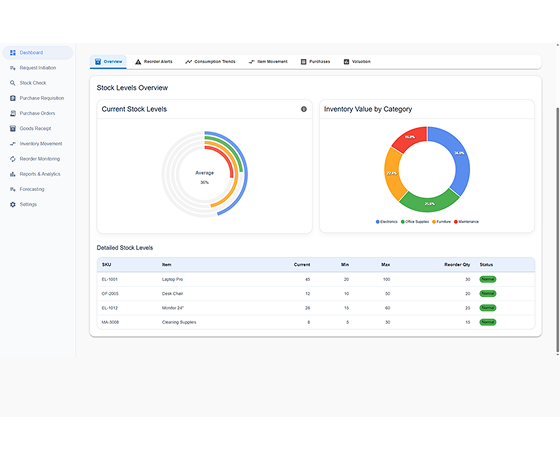
AI-Powered Production & Logistics ERP for Manufacturing Operations
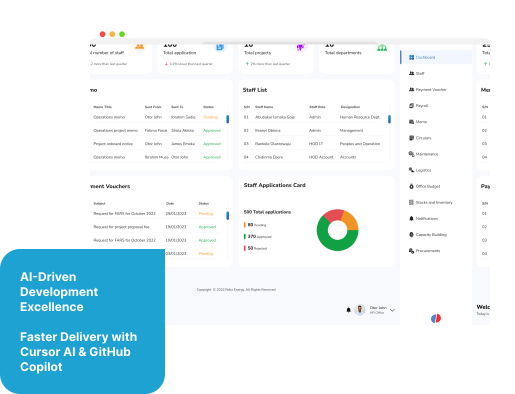
Developed for a mid-sized manufacturing business in the USA, this ERP platform brings production planning, inventory control, procurement, sales, and logistics into one connected operational system. Teams can manage BOMs, work orders, stock movement, supplier processes, and shipment coordination with better accuracy and real-time visibility across plants and warehouses. With role-based workflows, batch and serial tracking, and reporting dashboards, the solution reduces reliance on spreadsheets and disconnected tools while improving efficiency, control, and day-to-day decision-making.

Camila Hammes
USA
10 Months

Estonia
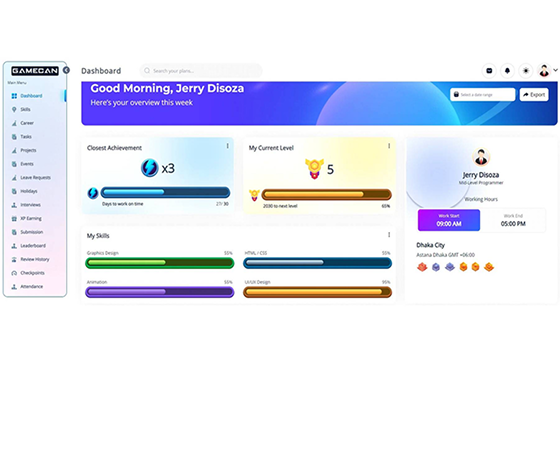
HR & Workforce Management ERP with AI and Employee Engagement
This ERP-driven HR management system is designed to handle workforce operations beyond traditional HR tools. It centralizes employee data, payroll, attendance, recruitment, and performance tracking into a single platform while introducing AI-driven insights and gamified engagement features. From automated salary processing and leave tracking to LinkedIn-based hiring and skill development tracking, the system enables HR teams to manage the entire employee lifecycle with greater efficiency. By combining HRMS capabilities with ERP-level control and reporting, it helps organizations improve accuracy, employee engagement, and workforce productivity.
Marten P
Estonia
12 Months

Canada
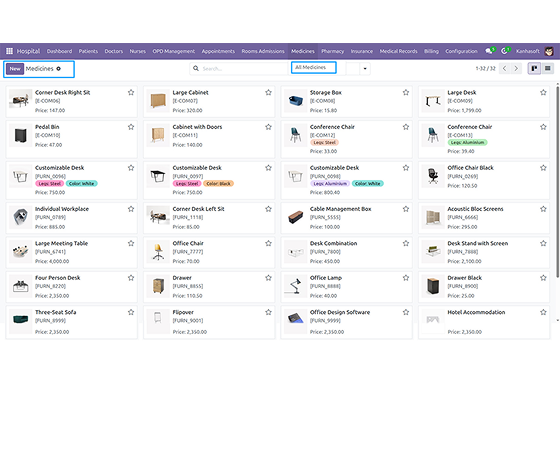
Hospital Management ERP for Patient, Billing & Operational Workflows
Developed for a mid-sized hospital in Canada, this ERP platform centralizes patient management, OPD/IPD workflows, billing, insurance claims, staff scheduling, and operational reporting into one connected system. Medical staff can manage patient admissions, track treatment histories, schedule procedures, and generate compliance-ready billing records — all in real time. With role-based access controls, department-level dashboards, and HIPAA-aligned architecture, the system reduces administrative bottlenecks and improves both staff efficiency and patient experience.
Russ Will
Canada
12 Months

France
Environmental Data & Compliance ERP for Soil Analysis and Reporting
Built for the soil and environmental industry, this ERP platform focuses on managing complex data workflows rather than traditional business operations. It brings together project planning, soil sampling, lab analysis, and pollutant tracking into a single structured system. Teams can visualize data through GIS mapping and 3D dashboards, generate compliance-ready reports, and manage multi-project workflows with role-based access. By transforming fragmented field and lab processes into a unified ERP system, it enables faster analysis, better decision-making, and improved regulatory compliance.
Dominique
France
10 Months

Norway
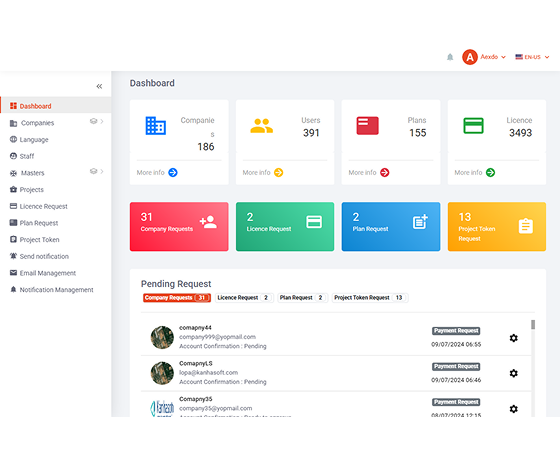
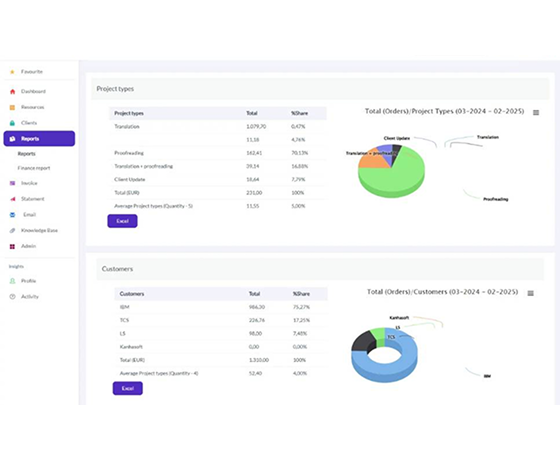
Translation Workflow & Project Management ERP for Service Businesses
Developed for the translation and localization industry, this ERP platform focuses on managing complex project workflows involving internal teams and external freelancers. It brings project tracking, task assignment, client management, and automated invoicing into a single system, allowing businesses to handle high volumes of translation jobs with better coordination. With real-time dashboards, structured workflows, and integrated communication, the platform improves visibility across project stages while reducing delays, manual effort, and operational gaps in service delivery.
Ingvild
Norway
10 Months

China
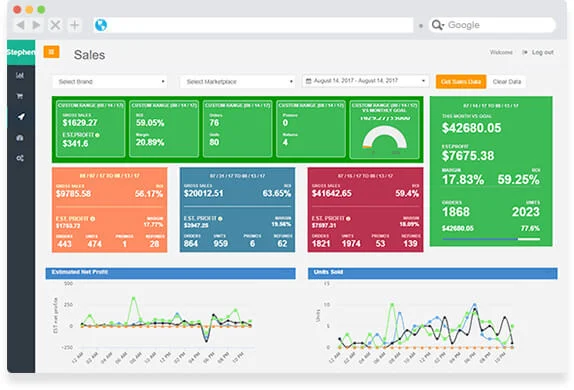
Amazon Seller ERP for Inventory, Orders & Marketplace Automation
Designed for eCommerce sellers, this ERP platform focuses on managing marketplace operations across inventory, orders, pricing, and performance tracking. It connects Amazon seller data with internal workflows, enabling businesses to monitor stock levels, automate order processing, analyze pricing trends, and track sales performance in real time. By replacing manual tracking and scattered tools with a centralized ERP system, it helps sellers improve accuracy, optimize operations, and scale efficiently across high-volume marketplaces.
James
China
See how businesses like yours are transforming operations with our ERP platform—real results, real impact.
Types of Custom ERP Software We Build for Different Industries
A logistics ERP looks nothing like a hospital ERP — and it shouldn't. We build industry-specific ERP systems that reflect the actual workflows, compliance requirements, and operational complexity of your sector. Here are the industries we serve most.

Manufacturing ERP
We develop custom manufacturing ERP software that connects production planning, bills of materials, procurement, inventory, work orders, and reporting. Each system is tailored to how the manufacturer schedules production, manages material availability, and tracks orders.

Logistics & Distribution ERP
Designed for fleet management, shipment tracking, multi-carrier dispatch, warehouse operations, and customer delivery portals. We build logistics ERP systems that integrate with third-party carriers, automate billing workflows, and give dispatch teams live visibility into every shipment — reducing manual coordination and delivery errors.

Healthcare ERP
Developed for hospitals, clinics, and healthcare providers to manage patient admissions, OPD/IPD workflows, billing, medical records, staff scheduling, and compliance reporting. Our healthcare ERP systems are built with strong data privacy controls, role-based access, and HIPAA/GDPR-aligned architecture.

HR & Workforce Management ERP
Built to handle end-to-end employee lifecycle management — from recruitment and onboarding to payroll, attendance, leave management, performance tracking, and offboarding. AI-driven features include automated payroll processing, LinkedIn-based hiring integration, skill gap analysis, and gamified employee engagement dashboards.

Environmental & Compliance ERP
Designed for soil analysis, environmental monitoring, regulatory reporting, and multi-project data management. Includes GIS mapping, 3D visualization dashboards, pollutant tracking, lab result import, and compliance-ready report generation — turning fragmented field and lab data into a structured, auditable ERP system.

Professional Services & Project ERP
Built for agencies, consultancies, translation firms, and service businesses to manage clients, projects, tasks, freelancers, invoicing, and reporting in one platform. Replaces disconnected spreadsheets and tools with structured ERP workflows, automated billing, and real-time project visibility.
Benefits of Custom ERP Software Development Services
Custom ERP development services are developed to address the operational, scalability, and security challenges of modern businesses. By combining custom ERP development architecture with AI-driven capabilities, businesses gain deeper visibility, smarter automation, and long-term operational value. Unlike off-the-shelf platforms, AI-enabled custom ERP solutions are designed around your workflows, delivering greater control, efficiency, and intelligence across operations.

Tailored ERP Solutions
- Developed around your unique workflows and business processes
- Eliminates unnecessary features and system complexity
- Fully aligned with organizational and operational requirements
Scalable Architecture
- Designed to grow alongside your business
- Add new modules, users, or AI capabilities without disruption
- Suitable for fast-growing companies and enterprise environments
Improved Operational Efficiency
- Centralized platform for managing core business functions
- AI-driven automation reduces manual data entry and errors
- Faster workflows and improved collaboration across teams

Competitive Business Advantage
- AI-powered features built for industry-specific challenges
- Greater flexibility than standard ERP solutions
- Faster response to market and operational changes through predictive insights
Advanced Reporting & Analytics
- Real-time dashboards and performance metrics
- AI-powered analytics for trend identification and forecasting
- Custom ERP reports aligned with business objectives
Long-Term Cost Efficiency
- Pay only for the features and AI capabilities your business needs
- Reduced operational overhead through intelligent automation
- Lower long-term customization and maintenance costs
Seamless System Integration
- Integrates with existing tools, platforms, and data sources
- AI-enabled data processing ensures consistency and accuracy
- Minimal disruption during ERP implementation

Enterprise-Grade Security & Compliance
- Security frameworks tailored to industry requirements
- AI-assisted monitoring for anomaly detection and risk prevention
- Role-based access controls and advanced data protection measures

User-Friendly Experience
- Interfaces designed for real business users
- AI-assisted workflows reduce training and adoption time
- Increased productivity through intelligent system guidance

Ongoing Support & Maintenance
- Continuous system optimization and performance tuning
- AI-driven system monitoring and proactive issue detection
- Long-term custom ERP support from experienced team
Custom ERP vs Off-the-Shelf ERP: Which Is Better for Your Business?
Buying an existing ERP product is often the easiest starting point. Platforms such as Odoo, NetSuite, and SAP Business One already cover many common accounting, sales, inventory, and purchasing requirements.
The decision gets harder when your business doesn't work the way the software expects.
You might have several approval stages, unusual billing arrangements, or manufacturing processes that depend on machine availability and material lead times. If employees need spreadsheets and manual workarounds to handle these tasks, the ERP isn't solving the whole problem.
| What matters |
|---|
| Business processes |
| Initial investment |
| Custom features |
| Implementation |
| Integrations |
| Ongoing cost |
| Custom ERP |
|---|
| Designed around your workflows |
| Usually higher |
| Greater flexibility |
| Requires development and testing |
| Built around the applications you use |
| Hosting, support and future development |
| Off-the-Shelf ERP |
|---|
| Uses existing workflows with available configuration |
| Often lower for standard requirements |
| Depends on the vendor and product |
| May launch faster with limited customization |
| Depends on existing connectors and APIs |
| Licensing, support and possible add-ons |
When Is Off-the-Shelf ERP the Better Choice?
- If your business needs standard inventory, accounting, purchasing, and sales functionality, an established ERP product may offer everything required.
- There's little reason to build software from scratch when an existing application already does the job well.
When Does Custom ERP Development Make More Sense?
- Custom ERP becomes worth considering when the missing functionality affects everyday operations.
- Imagine a manufacturer handling multiple production orders across machines with different capacities. The team needs to consider available raw materials, tooling, labor, order priority, and promised delivery dates.
- A generic scheduling module may not handle all these constraints. A custom ERP system can be designed to calculate and present production plans using the rules the business actually follows.
- The same applies to logistics businesses with specialized dispatch processes or service companies managing complex projects and billing arrangements.
- You can also combine custom software with existing tools. Keeping your accounting application while building a connected operational ERP is sometimes more sensible than replacing both.
Our Upwork Track Record
-

 Ahmedabad, India (UTC+5:30)
 -
 100% Job SuccessTOP RATED
-



-
 Total Earned
$500K+
-
 Total Jobs
90
-
 Total Hours
18,875
-
 Member Since
Apr 27, 2013
Our Custom ERP Development Process
As a custom ERP development company, our structured, business-focused ERP development process ensures your custom ERP solution is aligned with your operational goals, scalable for future growth, and ready for AI-driven optimization from day one.

Discovery & Business Analysis
We start by understanding how your business operates today, identifying inefficiencies, manual processes, and opportunities where automation and AI can deliver measurable value. This phase ensures the custom ERP software is designed around real business needs, not assumptions.
- Review existing workflows, systems, and pain points
- Identify automation, optimization, and AI opportunities
- Gather requirements from key stakeholders
- Define data sources, integrations, and system dependencies
- Understand user roles, access levels, and security needs

Custom ERP Development Architecture & Solution Design
Our experts design a scalable, secure ERP architecture aligned with your business goals, integration requirements, and long-term growth plans. AI-readiness is built into the architecture to support analytics, automation, and future enhancements.
- Define custom ERP modules, user journeys, and system interactions
- Plan third-party integrations and APIs
- Select the optimal technology stack
- Design custom ERP development architecture, workflows, and data models
- Estimate timelines, milestones, and development costs

Custom ERP Development & Testing
As a custom ERP development company, we developed high-performance, enterprise-grade ERP solutions using secure development practices and continuous testing. AI-enabled components are developed and validated to ensure accuracy, reliability, and performance.
- Develop custom ERP modules and user interfaces
- Implement AI-driven features and automation (where applicable)
- Integrate third-party tools and CRM enterprise systems
- Perform functional, security, performance, and usability testing
- Prepare and deploy the ERP solution for production

Deployment, Training & Ongoing Support
We ensure a smooth custom ERP development rollout with structured deployment, user training, and continuous system monitoring. Our long-term support model helps your ERP system evolve as business needs and AI capabilities grow.
- Custom ERP deployment and environment configuration
- User onboarding and role-based training sessions
- Post-launch support and issue resolution
- Performance monitoring and continuous optimization
- L1, L2, and L3 support services as required
Custom ERP Software Modules & Features
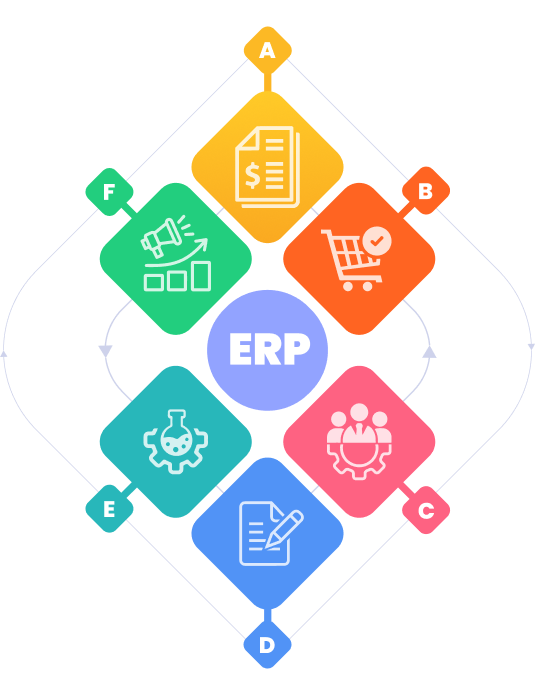
As a trusted AI-Driven custom ERP development company, we have successfully designed, developed, and deployed enterprise-grade custom ERP solutions across multiple industries. Our experience includes building scalable, secure, and AI-enabled custom ERP software that streamline operations, improve visibility, and support long-term business growth.
Our ERP solutions are developed with strong data governance and access controls, including role-based user management, multi-level permissions, audit trails, and centralized master data management for customers, vendors, products, and services. These foundations ensure accuracy, security, and consistency across the entire organization.
For sales and customer operations, we deliver robust modules covering lead management, opportunity tracking, quotations, order processing, and complete customer interaction histories. These capabilities help teams manage the full sales lifecycle efficiently while maintaining real-time visibility.
Our enterprise custom ERP solutions also include comprehensive procurement and vendor management features such as purchase approvals, purchase orders, goods receipt, supplier performance tracking, and spend visibility. For operations-driven businesses, we build inventory, asset, and resource management modules with real-time stock tracking, warehouse control, demand planning, and automated alerts.
On the financial side, our custom ERP software supports billing, invoicing, expense management, tax handling, payment reconciliation, and detailed financial reporting. We also develop project and task management, HRMS, document management, and customer support ticketing systems with SLA tracking and escalation workflows.
To further enhance efficiency, we integrate workflow automation, approvals, notifications, and cross-module triggers. Our AI-powered custom ERP solutions add predictive analytics, intelligent alerts, AI-driven insights, smart search, automated reporting, and decision-support dashboards, enabling faster, more informed decision-making.
All our custom ERP systems are mobile-friendly, API-driven, secure, compliance-ready, and built to scale, making Kanhasoft a reliable partner for custom ERP development and enterprise-grade custom ERP solutions.
ERP Data Migration and Legacy System Modernization
The biggest concern when replacing an ERP is often the information already stored inside it.
Years of customer records, invoices, purchase orders, stock movements, and financial transactions need to remain accessible. Some records may be incomplete, others duplicated, and certain processes may depend on applications that are no longer maintained.
Our ERP migration services begin with reviewing what you have today and understanding what needs to work on the new system.
Understanding the Existing System
- Before planning a migration, we examine the current database, important business workflows, integrations, reporting needs, and any technical restrictions.
- This helps identify the parts of the old ERP that can be retired, the functionality that needs to be rebuilt, and the information that must be preserved.
Preparing and Mapping Business Data
- Old data rarely fits perfectly into a new database structure.
- We identify the records needed for daily operations, map fields between systems, and review inconsistencies before migration.
- For example, product codes, customer identifiers, and financial records must be handled carefully because other business processes may depend on them.
Testing Before the Final Migration
- A successful import doesn't necessarily mean the migration is correct.
- Users also need to check that they can find customer records, process orders, view stock balances, and generate the reports they depend on.
- We plan trial migrations and validation checks so issues can be identified before the final transition.
Moving to the New ERP
- The deployment approach depends on how the business operates. A company handling continuous orders may need a phased transition, while another may be able to move during a planned period of low activity.
- We consider backups, dependencies, employee training, and rollback options as part of the cutover plan.
Modernizing an ERP Without Rebuilding It
- A complete replacement isn't always necessary.
- If the database and business logic are still reliable, it may be possible to improve the application with a modern interface, new reporting features, additional integrations, or cloud infrastructure.
- Our legacy ERP modernization work considers both options before recommending a development approach.
Is Your Existing ERP Holding Your Business Back?
Share which software you're using, what isn't working, and what you want to change. We can review whether migration, modernization, or a new ERP would be the most practical route.
Discuss ERP MigrationTechnology Stack for Custom ERP Software Development
The right technology depends on what the ERP needs to handle. A system used by one department may have very different requirements from an application supporting several warehouses, production sites, and finance teams.
Our ERP developers work with React, Angular, Next.js, Node.js, Python/Django, PHP/Laravel, and relational databases such as PostgreSQL and MySQL. We choose the architecture and infrastructure after considering existing systems, expected workloads, security, integrations, and maintenance needs.
-
 React.js
 -
 Next.js
 -
 Angular.js
 -
 Javascript
 -
 Tailwind
 -
 Bootstrap
 -
 CSS3
CSS3 -
 HTML5
HTML5 -
 Vue.js
 -
 Material UI
 -
 Redux
Redux
-
 Node.js
 -
 Python/Django
 -
 PHP
PHP -
 Laravel
 -
 Yii
Yii -
 CodeIgniter
-
 Open AI
 -
 Gemini
 -
 Claude
 -
 Grok
Grok -
 Docling
 -
 Milvus
 -
 Weaviate
 -
 LangSmith
 -
 LangFlow
 -
 LangChain
 -
 LangGraph
 -
 Codex
Codex -
 Whisper
 -
 LlamaIndex
 -
 AllenNLP
-
 AWS
AWS -
 Google Cloud
 -
 Azure
Azure -
 Digital Ocean
 -
 Linode
 -
 Tencent Cloud
-
 Postgre SQL
 -
 Mongo DB
 -
 MySQL
MySQL -
 Redis
Redis -
 Amazon RDS
 -
 OrientDB
-
 VS code
 -
 Slack
Slack -
 Asana
Asana -
 Jira
Jira -
 Github
 -
 Postman
 -
 Github Copilot
 -
 Docker
 -
 CI/CD
CI/CD -
 Atom
Atom -
 Kubernetes
 -
MySQL
-
 Sublime Text
Advanced ERP Architecture, Integrations, Security & AI Capabilities
Modern businesses need scalable and intelligent ERP software to manage operations efficiently. At Kanhasoft, we develop custom ERP software solutions using modern architecture, seamless integrations, enterprise-grade security, and AI-powered automation. Our ERP systems help organizations streamline workflows, centralize business data, and improve operational efficiency while supporting long-term scalability.
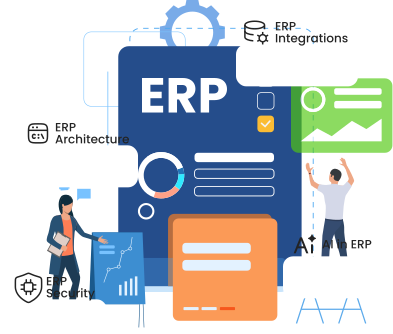
ERP Architecture
Microservices-Based ERP Architecture for Scalability
ERP systems can become difficult to maintain when every new feature depends on changing several unrelated parts of the application.
We organize ERP functionality so areas such as purchasing, inventory, production, finance, and reporting have clear responsibilities. For some projects, a modular application is sufficient. Larger or more complex systems may benefit from separating selected services.
Our ERP system development work also covers API design, database performance, access controls, audit records, backups, and cloud infrastructure. These decisions are made around actual system requirements rather than following one architecture for every project.
This architecture provides several advantages:
- Independent scaling of ERP modules
- Faster system performance and improved reliability
- Simplified updates and feature deployment
- Greater flexibility for customization and future expansion
With API-first development and cloud-based ERP infrastructure, our ERP platforms remain flexible and adaptable as business operations grow and evolve.
ERP Integrations
Seamless ERP Integrations with Business Applications
A modern enterprise ERP system should integrate smoothly with the business tools organizations already use.
Our ERP software supports integrations with platforms such as:
- Stripe for secure payment processing
- QuickBooks for accounting and financial synchronization
- CRM systems for customer and sales management
- Marketing automation tools for campaign tracking
- Inventory and warehouse management systems
- Google Workspace for document collaboration and storage and many more
Using secure REST APIs, webhooks, and middleware integrations, we enable real-time data synchronization between ERP software and external applications.
We also implement ERP workflow automation, allowing actions in one system to trigger processes in another, reducing manual tasks, improving data accuracy, and increasing operational efficiency across departments.
ERP Security
Enterprise-Grade ERP Security and Data Protection
Security is a critical component of any enterprise ERP platform, especially when handling sensitive business data such as financial records, operational data, and employee information.
Our ERP security architecture includes:
- Role-Based Access Control (RBAC)
- Token-based API authentication
- Encrypted data storage and secure data transmission
- Secure API gateways
- Comprehensive audit logging
- Session management and permission control
These security practices ensure ERP systems remain secure, compliant, and protected against unauthorized access or data breaches, helping businesses maintain data integrity and operational reliability.
AI in ERP
AI-Powered ERP for Intelligent Business Insights
Artificial Intelligence is becoming an essential capability in modern ERP software systems.
Our AI-enabled ERP solutions provide capabilities such as:
- AI-driven demand forecasting
- Predictive financial analytics
- Automated workflow optimization
- Smart inventory planning using machine learning
AI models analyze historical transactions, operational patterns, and business data to identify trends, predict demand, and optimize business performance.
AI-powered analytics, automated reporting, and intelligent recommendations help organizations improve decision-making, increase operational efficiency, and gain deeper insights into their business operations.
Key Features of Custom ERP Development
Success with Tailored Solutions – Unleash the Power of Your Business with Our Custom ERP Software Development Features!
Core System Capabilities
- User authentication & role-based access control
- Centralized dashboards & real-time analytics
- Customizable reporting & KPI tracking
- Audit trails & system activity logs
Business Operations Management
- Sales & order management
- Procurement & vendor management
- Inventory & supply chain management
- Billing, finance & accounting
- Production planning & resource allocation
Workforce & Project Management
- Human resources management (HRMS)
- Payroll, attendance & performance tracking
- Project & task management
- Time tracking & resource utilization
Automation, Integration & Mobility
- Workflow automation & approvals
- Third-party integrations (QuickBooks, Xero, DocuSign, Zapier, etc.)
- Mobile-friendly custom ERP development & responsive access
- Cloud deployment & scalability
Security, Compliance & Reliability
- Data encryption & security controls
- Compliance & regulatory support
- Custom ERP system monitoring & performance alerts
- Backup, disaster recovery & uptime management
Adoption & Support
- User training & onboarding
- Ongoing custom ERP support & maintenance
Frequently Asked Questions — Custom ERP Development
Start with the company's experience in business applications similar to yours. Ask how the team gathers requirements, handles integrations, plans data migration, and manages testing.
An ERP development company should be able to explain how it would handle your business processes, not simply provide a list of technologies.
Yes. Many businesses begin with the processes causing the most difficulty, such as inventory, purchasing, order management, or project tracking.
A modular custom ERP system can support future additions, provided the initial database and architecture account for expected integrations and dependencies.
Yes. Kanhasoft works on existing business applications as well as new ERP projects. Depending on the codebase and requirements, our developers can help with new modules, integrations, reporting, issue resolution, and maintenance.
If you need dedicated resources rather than a complete project team, see our ERP developers for hire.
ERP Insights
Latest articles on custom ERP development, technology, and business strategy.
Planning to Build or
Replace Your ERP Software?