

A CRM or ERP does not become secure simply because it runs on a modern framework. That point became especially clear during 2026, when several Next.js security updates addressed risks involving Server Actions, middleware authorization, caching, image processing, redirects, and server-side rendering. For companies using Next.js application development for business-critical software, the lesson is not to avoid the framework. It is to operate it with enterprise-level security discipline.
For CRM and ERP systems, the stakes are higher than on a typical public website. These applications may handle customer records, contracts, quotations, invoices, inventory, employee information, approvals, financial data, and integrations with other business systems.
That changes how security should be designed.
Quick Answer: Is Next.js Secure Enough for Enterprise CRM and ERP?
Yes, Next.js can be a strong platform for enterprise CRM and ERP applications, but framework security must be combined with disciplined patch management, server-side authorization, secure caching, input validation, dependency monitoring, request limits, and infrastructure controls.
The 2026 security updates reinforce one practical rule: never make a framework feature the only security boundary protecting sensitive business data or actions.
As of October 2026, the current stable Next.js 16 line includes version 16.3.8, which shipped several security fixes covering areas such as image optimization, caching, information disclosure, and Draft Mode behavior.

What the 2026 Next.js Security Updates Actually Taught Enterprise Teams
The important story is not that vulnerabilities existed. Mature frameworks will occasionally discover security issues.
What matters is where those issues appeared.
During 2026, official Next.js advisories covered Server Components, Server Actions, middleware, rewrites, image optimization, caching, and operating-system-specific behavior. That is almost a map of the same framework capabilities enterprise applications increasingly rely on.
| 2026 security issue | Enterprise concern | Practical lesson |
| React Server Components denial of service | Application availability | Resource-intensive requests need protection and prompt patching |
| Cache Components connection exhaustion | Service availability | Caching affects security as well as performance |
| Server Actions denial of service | CPU/resource exhaustion | Server Actions must be treated as public endpoints |
| Middleware/proxy authentication bypass | Unauthorized access | Do not make middleware your only authorization layer |
| SSRF through dynamic rewrites | Internal network exposure | Never build trusted destinations directly from user-controlled values |
| AVIF image optimization RCE | Server compromise | Media-processing dependencies are part of your attack surface |
| next/og ImageResponse RCE | Server compromise | User input entering generated SVG/image content must be controlled |
| Cache and Draft Mode issues | Cross-user data exposure | Sensitive or tenant-specific content requires careful cache boundaries |
The January 2026 Server Components advisory, for example, described specially crafted requests that could cause excessive CPU use, memory exhaustion, or server crashes in affected App Router environments.
By July, another advisory showed that crafted requests against App Router applications using Server Actions could consume enough CPU to block other requests. The affected Next.js 16 versions were patched in 16.2.11.
This is why enterprise security reviews should examine application architecture, not just login screens.
Lesson 1: Patch Management Is Now an Application Requirement
Enterprise applications often delay framework upgrades because teams fear regression.
That is understandable. An ERP with procurement, production, billing, reporting, and 20 integrations cannot be upgraded as casually as a brochure site.
However, delaying indefinitely creates another risk.
In August 2026, Next.js disclosed a critical issue affecting AVIF image optimization through an underlying image-processing dependency. Next.js 16 versions before 16.3.3 were affected, and the patched release was 16.3.3.
Another August advisory described unauthenticated remote code execution under certain Windows-hosted configurations, again patched in 16.3.3.
Then, in September, a critical next/og ImageResponse issue affected versions from 16.2.0 through versions before 16.3.6 when attacker-controlled values entered SVG content during server-side image generation.
For enterprise teams, this suggests a better policy than simply “upgrade Next.js occasionally”:
- Maintain an inventory of framework and runtime versions.
- Subscribe to official security advisories.
- Classify patches by application exposure.
- Test security updates through automated regression suites.
- Keep a defined emergency patch path outside the normal feature-release cycle.
NIST’s Secure Software Development Framework also treats vulnerability response as an ongoing software-development responsibility rather than a one-time pre-launch task.
Lesson 2: Middleware Should Not Be Your Only Authorization Layer
One of the most important 2026 lessons for CRM and ERP developers involved middleware.
A July advisory showed that certain Next.js App Router applications built with Turbopack could experience a middleware/proxy authorization bypass under a specific localization configuration. Next.js 16.2.11 contained the fix.
This matters because middleware is convenient for rules such as:
“Only authenticated employees can access /finance.”
That is useful, but not sufficient.
A secure finance page should also verify authorization when accessing the underlying data.
Consider this CRM scenario:
A salesperson can view their own opportunities. A regional manager can view opportunities from their region. The CFO can view revenue across the organization.
The URL may be the same for all three users. Therefore, protecting the route does not protect every record.
Next.js documentation recommends treating Server Actions and Route Handlers as public-facing endpoints and verifying whether the user is authorized to perform the requested action.
For enterprise systems, authorization should therefore exist close to the business operation and data layer.
Middleware asks: Can this person enter this area?
Business authorization asks: Can this person view or change this particular record?
You need both.
This is especially important when planning custom CRM development with multi-department, franchise, geographic, or customer-level permissions.
Lesson 3: Treat Server Actions Like APIs, Not Private Functions
Server Actions can simplify application development because frontend interactions can call server-side logic without creating conventional API endpoints for every operation.
That convenience can create the wrong mental model.
A Server Action is still reachable through HTTP.
Official Next.js guidance explicitly says Server Actions should receive the same security treatment as public API endpoints.
For a CRM, that means actions such as:
- changing opportunity values
- deleting contacts
- approving discounts
- exporting customer data
must independently verify authentication, authorization, input validity, and tenant ownership.
For an ERP, the same principle applies to purchase approvals, inventory adjustments, payment workflows, employee records, and financial postings.
Next.js also provides configuration for allowed origins and Server Action body-size limits. The framework documentation notes that the default body limit helps reduce excessive resource consumption.
The practical rule is simple: never assume a user cannot call an action merely because the interface does not show them the button.
Lesson 4: Caching Can Become a Data-Security Problem
Caching is normally discussed as a performance feature.
Enterprise developers should also treat it as a data-classification issue.
The September 30 Next.js 16.3.8 security release contained several fixes involving SSG, ISR, Cache Components, metadata routes, and cross-request caching behavior.
One advisory showed that overlapping Draft Mode and normal requests could, under affected conditions, expose unpublished cached content to a regular request.
For a marketing site, that could reveal an unpublished page.
Inside an ERP, the equivalent mistake could be far more serious.
Imagine caching a query such as:
getCustomerPricing(customerId)
If the cache key, tenant context, authorization context, or invalidation model is wrong, one customer’s information could theoretically appear in another request.
Therefore, teams should explicitly classify what may be cached.
| Data type | Recommended approach |
| Public product catalog | Often safe to cache |
| Public documentation | Usually safe |
| User dashboard | Cache only with clear user boundaries |
| Customer-specific pricing | Use strict tenant-aware controls |
| Payroll or financial records | Prefer conservative caching |
| Permission-dependent reports | Verify authorization before returning data |
| Draft or unpublished information | Separate clearly from public cache paths |
Teams building custom ERP software should make cache design part of security architecture reviews, not merely performance optimization.
Lesson 5: SSRF Risk Extends Beyond Traditional APIs
Server-side request forgery, or SSRF, happens when an attacker influences a server into sending requests to destinations the application did not intend.
A July 2026 Next.js advisory showed that dynamic values used within external rewrite or redirect hostnames could create SSRF or open-redirect behavior.
September brought another SSRF advisory involving remote image optimization under certain allow-listed URL conditions.
This is highly relevant to enterprise CRM and ERP applications because they connect to many external systems.
Examples include:
Salesforce, HubSpot, Stripe, QuickBooks, Xero, shipping APIs, supplier portals, document storage, analytics platforms, and internal microservices.
Do not accept an arbitrary URL and assume that checking part of the hostname makes it safe.
Where possible, use fixed integration endpoints or strict allowlists with validated identifiers.
A Practical Next.js Security Architecture for CRM and ERP
Framework patches are only one layer.
A stronger enterprise model combines several controls.
| Security layer | What to implement |
| Identity | SSO, MFA where appropriate, secure session handling |
| Authorization | RBAC/ABAC plus record-level checks |
| Server Actions | Authentication, authorization, input validation |
| APIs | Schema validation, rate limits, access checks |
| Database | Tenant isolation, least privilege, parameterized queries |
| Browser | CSP and secure HTTP headers |
| Integrations | Restricted endpoints, secret management, request validation |
| Caching | User/tenant-aware cache design |
| Infrastructure | WAF, network restrictions, monitoring, backups |
| Dependencies | Automated vulnerability scanning and patch workflow |
| Auditability | Logs for sensitive changes and administrative actions |
Next.js supports security headers such as Content Security Policy, Strict-Transport-Security, Permissions-Policy, and X-Content-Type-Options.
Its production guidance also recommends protecting environment variables and checking Server Action authorization.
The key point is defense in depth. OWASP specifically recommends avoiding reliance on a single framework, library, or technical control for authorization.
What This Looks Like in a Real Enterprise CRM
One Kanhasoft project involved a multi-location franchise CRM built with React, Next.js, Node.js, AWS Lambda, PostgreSQL, Twilio, HubSpot, and REST APIs. The platform combined centralized governance with local operational flexibility, automated communication, and multiple deal-management workflows.
Architectures like this illustrate why Next.js security cannot be reviewed in isolation.
Authentication may begin in the web application, but information travels through application services, databases, serverless functions, third-party APIs, messaging providers, and external CRM systems.
Every boundary needs its own trust decision.
The same principle applies to the architecture discussed in our guide to Next.js and Node.js for custom ERP development.
A Security Checklist Before Your Next Next.js Enterprise Release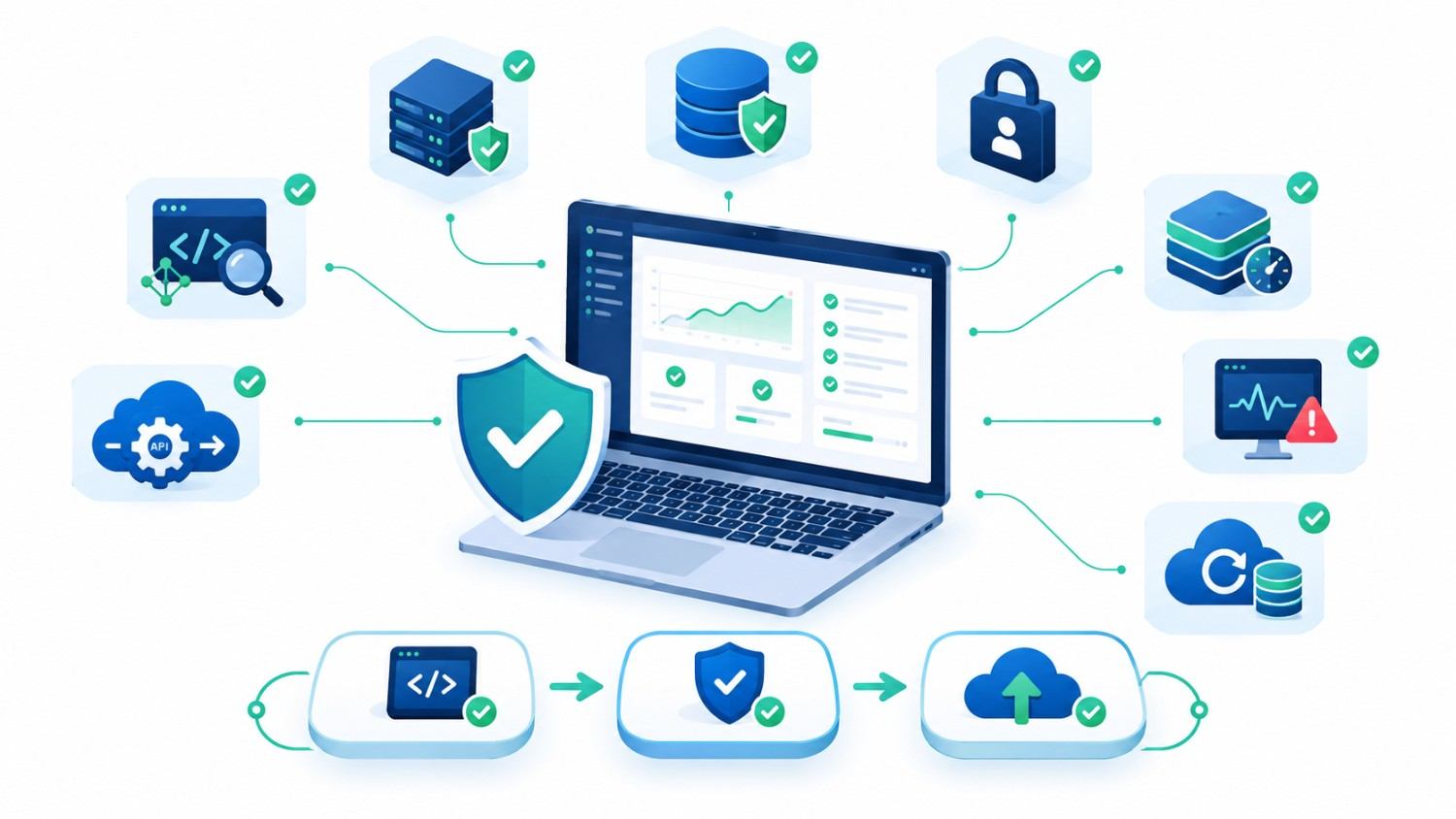
Before releasing a CRM or ERP update, security and engineering teams should confirm:
- The Next.js version is checked against current official advisories.
- Critical and high-risk dependency alerts have owners.
- Server Actions perform their own authorization checks.
- Route Handlers verify both identity and permissions.
- Middleware is not the sole access-control mechanism.
- Tenant or record ownership is validated server-side.
- Cache keys cannot cross customer, organization, role, or permission boundaries.
- User-controlled URLs cannot reach arbitrary backend resources.
- Uploads and image-processing paths have been reviewed.
- Secrets remain server-side and are not exposed through NEXT_PUBLIC_.
- CSP and other HTTP security headers are configured appropriately.
- Logging captures sensitive administrative and financial changes.
- Backup and incident-response procedures have been tested.
For regulated industries, a secure Next.js configuration is not the same thing as compliance. Healthcare, finance, insurance, and privacy-sensitive deployments may require additional legal, privacy, security, and compliance review based on applicable regulations and contractual obligations.
Should the 2026 Security Updates Stop Enterprises from Using Next.js?
No.
Security advisories are not automatically evidence that a framework is unsuitable for enterprise development.
The better question is whether your organization can maintain the framework responsibly.
A platform with an active disclosure process, published advisories, security fixes, and maintained release branches gives engineering teams information they can act on. The risk increases when organizations stop updating dependencies, rely on one access-control mechanism, or treat infrastructure and application security as someone else’s problem.
For enterprises already evaluating the broader platform changes, our article on Next.js 16.3 for enterprise CRM and ERP applications covers the performance and architecture side of the decision.
How Kanhasoft Can Help Evaluate Next.js Security
If you are planning a new CRM, ERP, SaaS platform, or Next.js modernization project, Kanhasoft can help review the application architecture before development or migration decisions are finalized.
That assessment can cover user roles, authorization boundaries, Server Actions, integrations, data flows, caching, deployment architecture, testing requirements, and upgrade strategy.
The goal is not to recommend Next.js simply because it is popular. It is to determine whether Next.js fits your workload and, if it does, how to use it without making framework convenience a substitute for enterprise security design.
Final Words
The biggest lesson from Next.js security for enterprise CRM and ERP in 2026 is not “keep your framework updated,” although that certainly matters.
The broader lesson is that modern framework features create new trust boundaries.
Server Actions are endpoints. Middleware is only one authorization layer. Caches can expose data when contexts are mixed. Image processing carries dependency risk. Dynamic URLs can create SSRF exposure. Framework dependencies need continuous monitoring.
Next.js remains a practical option for enterprise applications when those realities are built into architecture, testing, operations, and incident response from the start.