
Open-source ERP software can be a practical option for hospitals and healthcare providers that want more control over workflows, data, and long-term customization. But choosing the right platform is not as simple as picking the most popular name. Some tools are strong ERP systems. Some are mainly EMR platforms. Others work better as part of a larger hospital information system. So as per my recommendation custom ERP development is the best coz it’s developed based on your needs and you can scale in future if needed.
That distinction matters. For smaller clinics, appointment scheduling, patient records, and billing may be sufficient. Meanwhile, hospitals often require patient registration, EMR, lab, pharmacy, billing, inventory, procurement, finance, HR, dashboards, and compliance controls. In many cases, the best solution is a mix of open-source software, integration work, and careful ERP software development around real hospital workflows.
This article is especially useful for:
- Hospital administrators comparing open-source healthcare ERP options
- Clinic owners moving away from spreadsheets or disconnected tools
- CIOs and IT managers evaluating ERP, EMR, HIS, and billing systems
- Healthcare startups planning a custom hospital management platform
- Operations leaders trying to reduce manual work across departments
- Decision-makers who want flexibility without adding unnecessary risk
Which Open-Source ERP Software Is Best for Healthcare?
The best open-source ERP software for healthcare depends on what the provider needs.
ERPNext Healthcare is a good option for clinics and healthcare providers that need ERP-style workflows such as appointments, inventory, billing, accounting, and administration. ERPNext describes its healthcare product as open ERP software for hospitals, clinics, and dispensaries.
GNU Health is more suitable for hospitals, public health programs, and institutions that need electronic medical records, hospital management, and health information system capabilities. The project describes GNU Health as a Free/Libre system for health practitioners, health institutions, and governments.
Bahmni is useful when a provider needs a more connected hospital system. It combines OpenMRS for electronic medical records, OpenERP/Odoo for inventory, billing, and financial accounting, OpenELIS for laboratory management, and DICOM/PACS support.
OpenEMR and OpenMRS are strong clinical record platforms, but they are not complete ERP systems on their own. OpenEMR focuses on electronic health records and medical practice management, while OpenMRS is an open-source EMR system for patient, provider, and funder information.
What Does ERP Mean in a Hospital?
A hospital ERP system manages the operational and business side of healthcare. It may support:
- Patient registration
- Appointment scheduling
- Billing and invoicing
- Pharmacy stock
- Inventory and procurement
- HR and staff scheduling
- Finance and accounting
- Department-level reporting
- Role-based access and audit logs
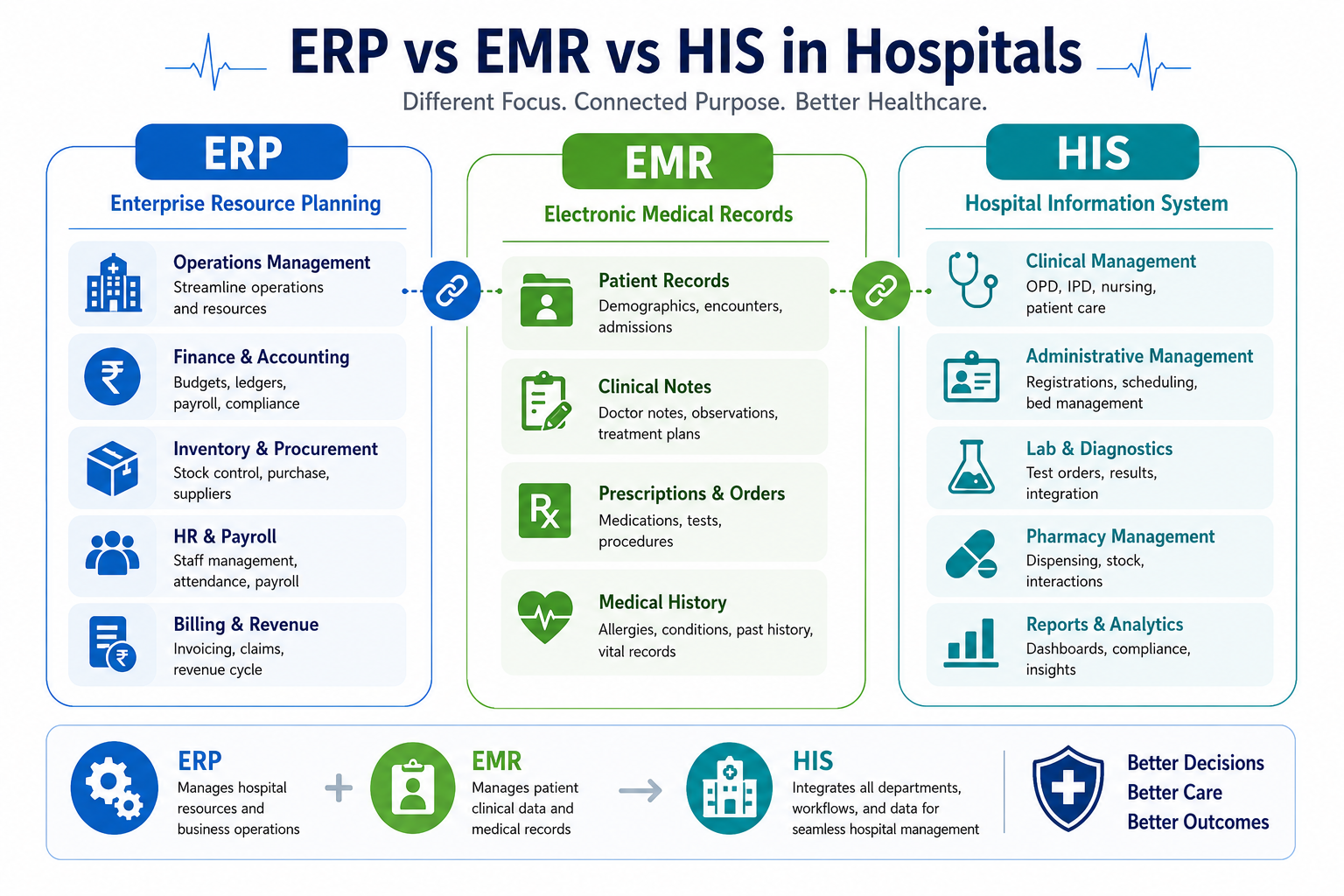
An EMR or EHR manages clinical records. A hospital information system, often called HIS, may combine clinical, operational, and administrative workflows.
This is where many hospital software discussions become confusing. A buyer may say, “We need ERP,” but the actual requirement may include EMR, lab, pharmacy, billing, and patient communication. That is not just ERP. It is a broader hospital technology ecosystem.
In practice, we have all seen this kind of setup: reception manages appointments in one tool, billing works from another, pharmacy keeps stock in a spreadsheet, and management waits for someone to prepare reports manually. The software stack may look “digital,” but the workflow is still manual.
Therefore, a good ERP plan starts by mapping the process. The software choice comes after that.
Top Open-Source ERP and Healthcare Management Software Options
1. ERPNext Healthcare
ERPNext Healthcare is one of the more practical choices for healthcare providers that want ERP-first functionality. The platform itself is a 100% open-source ERP system, and its healthcare module is designed for hospitals, clinics, and dispensaries.
It can be useful for organizations that need operational control across appointments, billing, stock, purchase, accounting, and reporting.
Best for: Clinics, diagnostic centers, outpatient centers, small hospitals, and healthcare providers that need a flexible ERP base.
Where it fits well:
- Appointment management
- Patient registration
- Billing and invoicing
- Pharmacy and inventory tracking
- Purchase and vendor workflows
- Accounting and reports
- Role-based operations
Where it may need customization:
Large hospitals may need deeper EMR, lab, radiology, insurance, claims, or regulatory workflows. ERPNext can still be a good base, but the implementation should be planned carefully.
Practical example:
A diagnostic center may need one system for appointments, patient billing, test packages, lab consumables, stock alerts, purchase orders, and daily revenue reports. ERPNext Healthcare can be a good fit if the clinical documentation requirements are not too complex.
2. GNU Health
GNU Health is a Free/Libre digital health ecosystem. It is designed for health practitioners, institutions, and governments, and its HIS component covers EMR, hospital management, and health information system functionality.
It is not the lightest option, but it is relevant for organizations with broader public health or institutional requirements.
Best for: Public health programs, hospitals, NGOs, academic health institutions, and healthcare networks with internal technical capacity.
Where it fits well:
- Electronic medical records
- Hospital management
- Public health workflows
- Health information systems
- Longitudinal patient data
Where it may need planning:
GNU Health may require stronger technical ownership than a simple clinic system. Before choosing it, teams should review hosting, usability, local support, integration needs, and compliance responsibilities.
Practical example:
A public health network may want to manage patient records across several facilities and support health reporting for administrators. GNU Health may be worth evaluating if the organization has the people and process maturity to maintain it.
3. Bahmni
Bahmni is an open-source EMR and hospital system designed for low-resource environments, clinics, NGOs, and governments. It combines several open-source systems into one hospital-focused solution.
That makes Bahmni different from a plain ERP. It is closer to a hospital system made from connected healthcare components.
Best for: Hospitals that need EMR, lab, pharmacy, billing, inventory, and hospital workflows in one ecosystem.
Where it fits well:
- Patient registration
- EMR and clinical workflows
- Lab orders and results
- Pharmacy and inventory
- Billing and accounting
- Low-resource healthcare settings
Where it may need planning:
Bahmni has more moving parts than a simple ERP platform. That can be useful, but it also means deployment, upgrades, integrations, backups, and support need proper planning.
Practical example:
A charitable hospital may need patient records, lab workflows, pharmacy stock, basic billing, and reports without buying a large proprietary hospital system. Bahmni can be a serious option in that situation.
4. Odoo Community with Healthcare Modules
Odoo Community is a strong open-source ERP base. It covers business functions such as CRM, accounting, inventory, point of sale, project management, and other operational needs.
For healthcare, Odoo usually needs community modules or custom development. The Odoo Community Association maintains Odoo Medical, a module that extends Odoo with base functionality for medical patients.
Best for: Healthcare providers that need strong back-office ERP and are ready to customize healthcare-specific workflows.
Where it fits well:
- Inventory
- Procurement
- Accounting
- CRM
- HR
- Facility operations
- Maintenance workflows
- Multi-location administration
Where it may need customization:
Odoo Community is not a complete hospital management system by default. Healthcare modules should be reviewed for maturity, version compatibility, security, and support.
Practical example:
A hospital group may already use a separate EMR for clinical records. In that case, Odoo can support procurement, finance, stock, HR, and reporting while integrating with the clinical system.
5. OpenEMR
OpenEMR is a free and open-source electronic health records and medical practice management solution. It includes EHR, practice management, scheduling, electronic billing, and community support.
It is better understood as an EHR and practice management platform, not as a full ERP.
Best for: Clinics, outpatient practices, and medical offices that need patient records, scheduling, and practice management.
Where it fits well:
- Patient records
- Scheduling
- Medical documentation
- Practice management
- Electronic billing
- Clinic workflows
Where it may need integration:
OpenEMR does not replace a full ERP for inventory-heavy, procurement-heavy, or multi-department hospital operations. It may need to connect with ERPNext, Odoo, accounting tools, or custom reporting systems.
Practical example:
A private clinic may need patient charts, appointments, billing, and basic practice management. OpenEMR may be more relevant than a heavy ERP rollout.
6. OpenMRS
OpenMRS is a global open-source EMR platform. Its official site describes it as an open-source EMR system built to provide quality information for patients, providers, and funders.
OpenMRS is not a full ERP. It works best as a clinical records platform.
Best for: Public health projects, hospitals, NGOs, and healthcare programs that need a flexible EMR foundation.
Where it fits well:
- Patient medical records
- Clinical data capture
- Public health deployments
- Configurable medical workflows
- EMR-based healthcare programs
Where it may need integration:
OpenMRS usually needs other systems for billing, inventory, finance, HR, analytics, and procurement. It can be a strong clinical backbone, but it should not be treated as a complete ERP.
Practical example:
A healthcare NGO may need a flexible patient record system across field locations. OpenMRS can support the clinical record side, while ERP functions are handled separately.
7. Ozone HIS
Ozone HIS is an integrated open-source health information system. Its documentation describes Ozone as bringing together OpenMRS 3 for electronic medical records, SENAITE for laboratory information, Odoo 14 for ERP, and Superset for analytics.
This is a good example of how hospital systems often need multiple tools working together.
Best for: Healthcare organizations that want an integrated HIS using open-source components.
Where it fits well:
- EMR
- Lab information
- ERP functions
- Analytics
- Integrated open-source healthcare architecture
Where it may need planning:
Ozone HIS is better suited for organizations with technical support or a strong implementation partner. It should not be treated as a quick plug-and-play clinic system.
Also Read: See how AI-powered ERP and CRM solutions help healthcare providers simplify everyday operations, improve patient experiences, and reduce administrative workload—all while supporting smarter, faster decision-making.
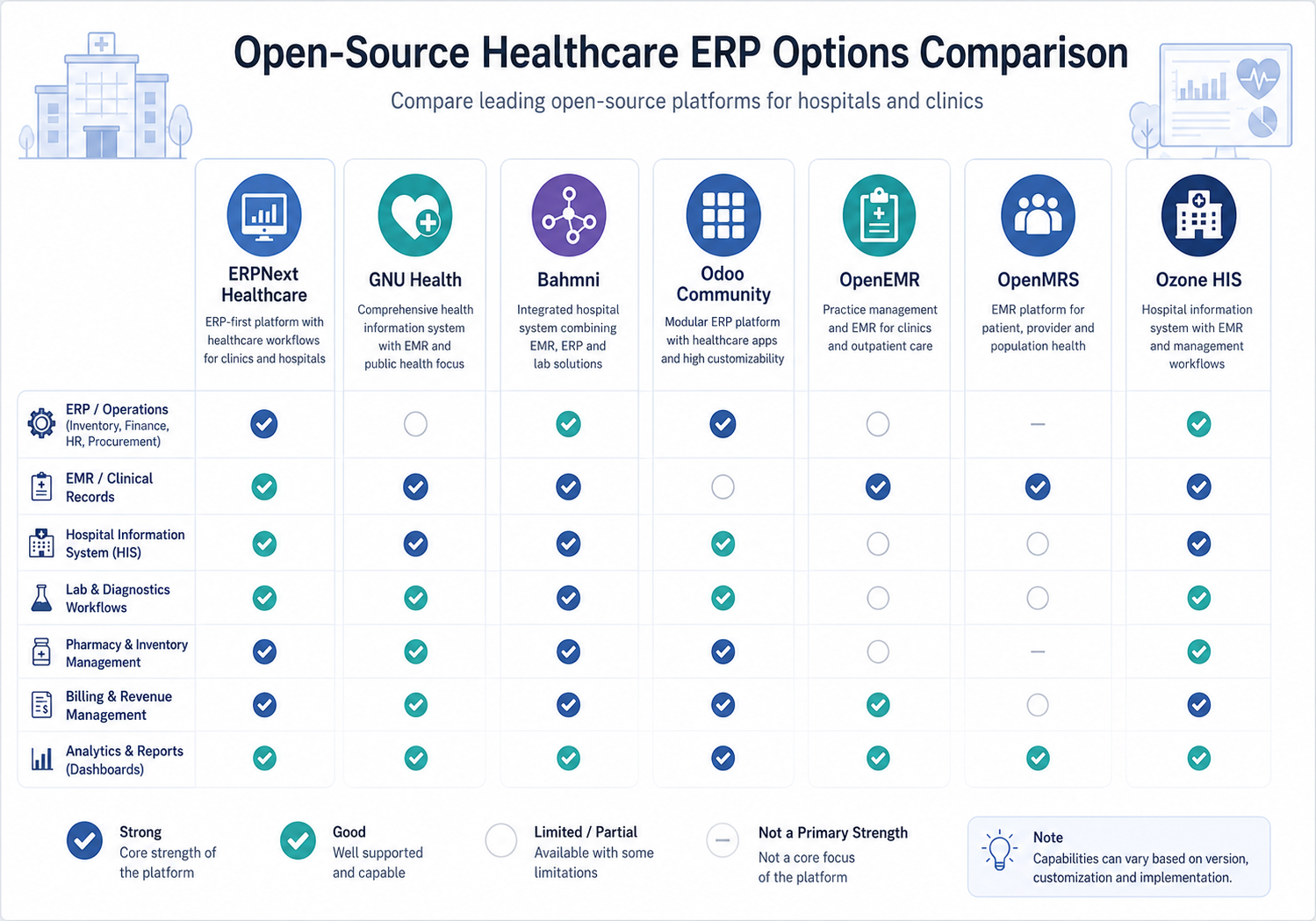
Open-Source Healthcare ERP Comparison Table
|
Software |
Best Fit | ERP Strength | Clinical Strength |
Main Caution |
|---|---|---|---|---|
|
ERPNext Healthcare |
Clinics, diagnostic centers, and small hospitals | High | Medium |
Advanced hospital workflows may need customization |
| GNU Health | Hospitals, public health, and institutions | Medium | High |
Needs skilled setup and long-term support |
|
Bahmni |
Hospitals need EMR, lab, pharmacy, and billing | Medium | High |
Multi-component architecture adds complexity |
|
Odoo Community + Healthcare Modules |
Back-office healthcare ERP | High | Low to Medium |
Healthcare modules must be reviewed carefully |
|
OpenEMR |
Clinics and outpatient practices | Low to Medium | High |
Not a full ERP |
|
OpenMRS |
Public health and EMR projects | Low | High |
ERP functions require integration |
|
Ozone HIS |
Integrated HIS projects | Medium | High |
Needs technical ownership |
Best Choice by Situation
|
Situation |
Best Option to Evaluate First |
Why |
|---|---|---|
|
Small clinic needs appointments, records, and billing |
OpenEMR or ERPNext Healthcare |
Practical for clinic-level workflows |
|
Diagnostic center needs billing, stock, and reporting |
ERPNext Healthcare |
Strong ERP base with healthcare workflows |
|
Hospital needs EMR, lab, billing, and pharmacy |
Bahmni or Ozone HIS |
More complete hospital ecosystem |
|
Public health program needs EMR and reporting |
GNU Health or OpenMRS |
Strong clinical and public health focus |
|
Hospital group needs procurement, HR, finance, and inventory |
Odoo Community or ERPNext |
Strong back-office ERP capabilities |
|
Provider has unique workflows |
Customized open-source ERP or custom ERP |
Better fit for process-specific needs |
Benefits of Open-Source ERP in Healthcare
Open-source ERP can also be useful if a healthcare provider wants more control over the way the system functions.
The main benefits include:
- Less dependence on proprietary vendors
- More flexibility for customization
- More control over hosting and data architecture
- Easier connection with selected tools
- Better fit for local workflows
- Community transparency
- Ability to build in phases
However, the real benefit is not “free software.” That idea creates wrong expectations. The real benefit is control.
A hospital may still need discovery, implementation, migration, training, support, and security review. Those costs do not disappear. They simply move from license dependency to implementation responsibility.
A useful example comes from hospital management work. One healthcare provider had disconnected processes for patient registration, appointments, medical records, billing, and reporting. The implemented system brought together patient registration, appointment scheduling, EMR, billing, pharmacy, lab reports, administrative dashboards, role-based access, secure storage, notifications, and analytics. The reported results included reduced manual administrative work, faster appointment scheduling, better billing turnaround, and improved operational visibility.
That is a grounded way to think about ERP value. The software is not valuable because it has a long feature list. It is valuable when it removes friction from real patient and staff workflows.
Limitations and Challenges
Open source gives control, but it also creates responsibility.
Healthcare providers should plan for:
- Deployment and hosting
- Workflow configuration
- Data migration
- User training
- Security hardening
- Backups and disaster recovery
- Version upgrades
- Compliance documentation
- Integration testing
- Long-term maintenance
A system may look affordable at the license level but still require a serious implementation budget. That is normal. The risk starts when teams assume internal staff will somehow manage hosting, upgrades, training, and support without clear ownership.
Common Mistakes When Choosing Hospital ERP Software
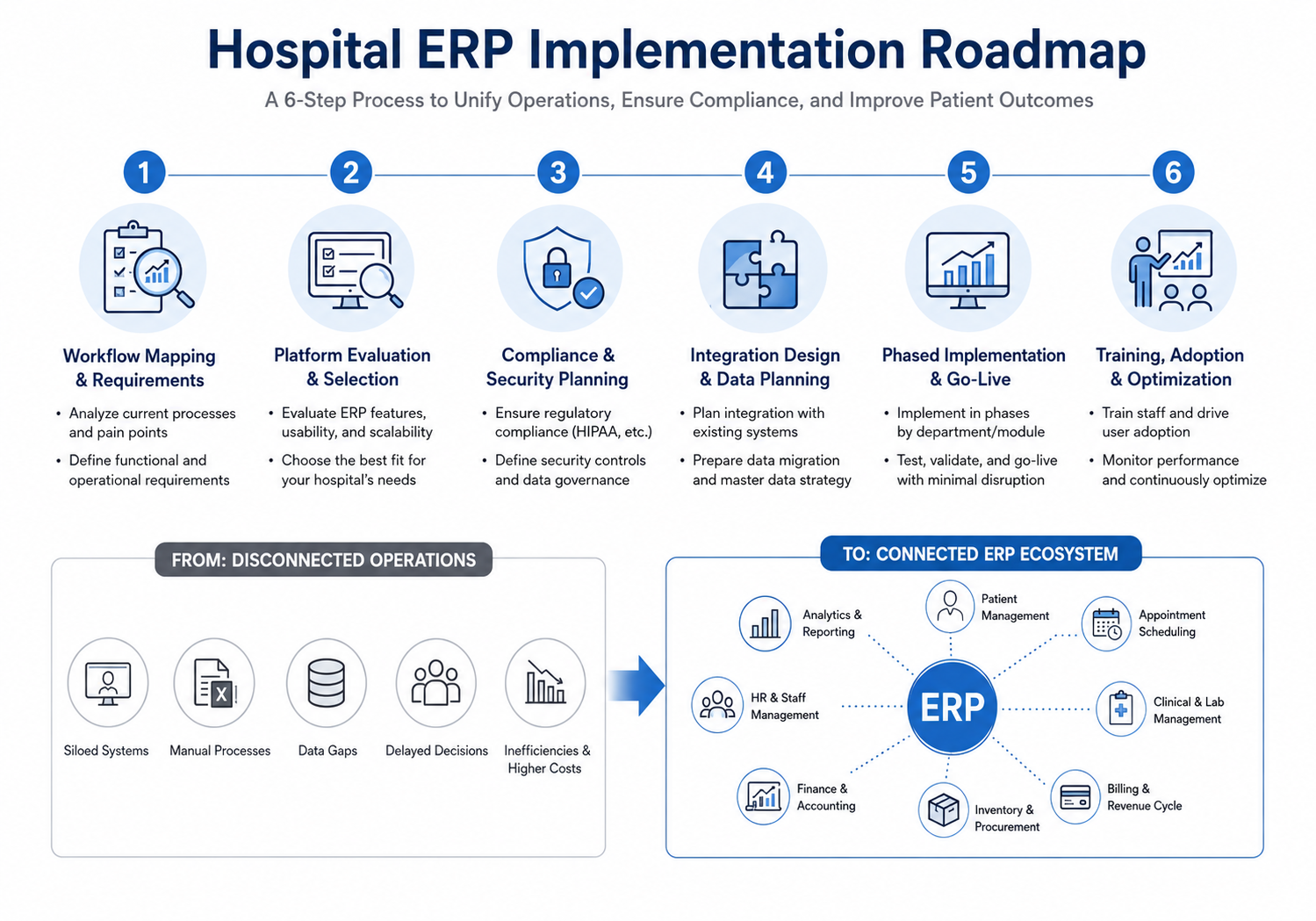
Mistake 1: Choosing software before mapping workflows
Software demos are useful, but they should not come first. Start with patient registration, appointment booking, consultation, lab, pharmacy, billing, discharge, insurance, inventory, and reporting workflows.
Mistake 2: Confusing EMR with ERP
An EMR manages clinical records. ERP manages operations such as finance, inventory, procurement, HR, and billing. Many hospitals need both.
Mistake 3: Ignoring integrations
A hospital ERP may need to connect with lab systems, pharmacy inventory, payment gateways, accounting tools, insurance systems, SMS providers, and analytics dashboards.
Mistake 4: Underestimating compliance
Healthcare systems handle sensitive patient data. In the United States, the HIPAA Security Rule sets national security standards to protect electronic protected health information through administrative, physical, and technical safeguards.
Mistake 5: Assuming open source means zero cost
Open-source software can reduce licensing pressure. It does not remove the cost of setup, customization, hosting, maintenance, staff training, and security review.
Practical Decision Checklist
Before choosing open-source ERP software for a hospital or clinic, answer these questions:
- Do we need ERP, EMR, HIS, or a combination?
- Which department should go live first?
- Which workflows are currently manual or duplicated?
- Do we need inpatient, outpatient, pharmacy, lab, and billing modules?
- Which compliance rules apply in our region?
- Do we need cloud, on-premise, or hybrid hosting?
- What legacy data must be migrated?
- Which third-party systems must integrate from day one?
- Who will own backups, upgrades, and security patches?
- Where do we need custom ERP software development?
If these answers are unclear, start with a discovery phase. It is usually cheaper to clarify workflows early than to rebuild modules later.
Need Help Evaluating Open-Source Healthcare ERP?
Choosing open-source ERP should start with workflow clarity, not software preference.
Kanhasoft is a custom ERP development company that helps healthcare providers compare ERPNext, Odoo, OpenEMR, OpenMRS, Bahmni, GNU Health, and custom ERP options against actual business needs. That can include workflow mapping, module planning, integration review, compliance considerations, data migration planning, and phased implementation.
The goal is simple: configure what already fits, customize what needs adjustment, and build only what standard tools cannot handle properly.
Final Words
Overall, Open-source ERP software can be a strong choice for hospitals and healthcare providers that want flexibility, control, and less dependence on rigid vendor systems. ERPNext, GNU Health, Bahmni, Odoo, OpenEMR, OpenMRS, and Ozone HIS all have value, but they solve different problems.
The safest path is to define the workflow first. For smaller clinics, appointment scheduling may be enough. Meanwhile, hospitals often require EMR, lab, pharmacy, finance, analytics, and access control. Healthcare groups may also need multi-location ERP operations with careful compliance planning.
That is why ERP software development should begin with discovery, not installation. When the workflows are clear, the right platform becomes easier to choose, easier to customize, and easier for staff to adopt.