
Agentic ERP is an enterprise resource planning environment where AI agents can understand goals, retrieve business context, plan multi-step work, use approved tools, take actions, and escalate exceptions. Unlike a chatbot that only answers questions, an agentic ERP system can move a process forward; for example, investigating an invoice mismatch or preparing a replenishment plan within defined permissions.
That shift matters because ERP work rarely stays on one screen. A late shipment may affect inventory, production, customer commitments, cash flow, and vendor performance. Traditional ERP automation follows predefined steps. AI agents can interpret the situation, select approved actions, and coordinate work across modules.
Quick Answer
Agentic ERP adds goal-driven AI agents to finance, procurement, inventory, production, HR, project management, and supply chain workflows. These agents can monitor business events, collect context from connected systems, complete several related steps, and request approval when a decision exceeds a policy or risk threshold.
The goal is not a self-running company. It is an ERP that handles routine coordination while people retain authority over material, sensitive, or unusual decisions.
What Is Agentic ERP? How AI Agents Are Changing Enterprise Operations
Agentic ERP is an emerging ERP design approach rather than a universally standardized software category. It applies agentic AI to structured enterprise workflows, combining ERP records and controls with AI agents that can reason, use tools, and pursue a defined business outcome.
By 2026, this direction is visible across major enterprise platforms. Microsoft describes agentic ERP capabilities for finance and supply chain. Oracle provides AI Agent Studio within Fusion Applications. SAP positions Joule agents and assistants as context-aware workflow coordinators. Workday is also extending governed agents across HR and finance.
The terminology differs by vendor. However, the underlying pattern is similar: connect AI reasoning to trusted enterprise data, business rules, APIs, approval workflows, and audit controls.
Agentic ERP vs. Traditional Automation and AI Copilots
| Capability | Traditional ERP | Rules-Based Automation | Generative AI Copilot | Agentic ERP |
|---|---|---|---|---|
|
Main role |
Records transactions | Executes fixed steps | Answers, summarizes, or drafts |
Pursues an operational goal |
|
Decision logic |
User-driven | Condition-driven | Prompt-driven |
Context-aware within guardrails |
|
Action level |
Mainly manual | Automatic when rules match | Usually assists users |
Can complete multi-step work |
|
Best suited for |
System of record | Stable, repetitive work | Knowledge and productivity tasks |
Exceptions and coordination |
|
Human role |
Operates the process | Handles exceptions | Reviews output |
Sets policy and approves risk |
A copilot might summarize overdue purchase orders. An agent could identify which orders threaten production, check alternate suppliers, draft revised requests, and route them to the correct manager for approval.
That difference between explaining and acting is central to agentic ERP.
How Agentic ERP Works
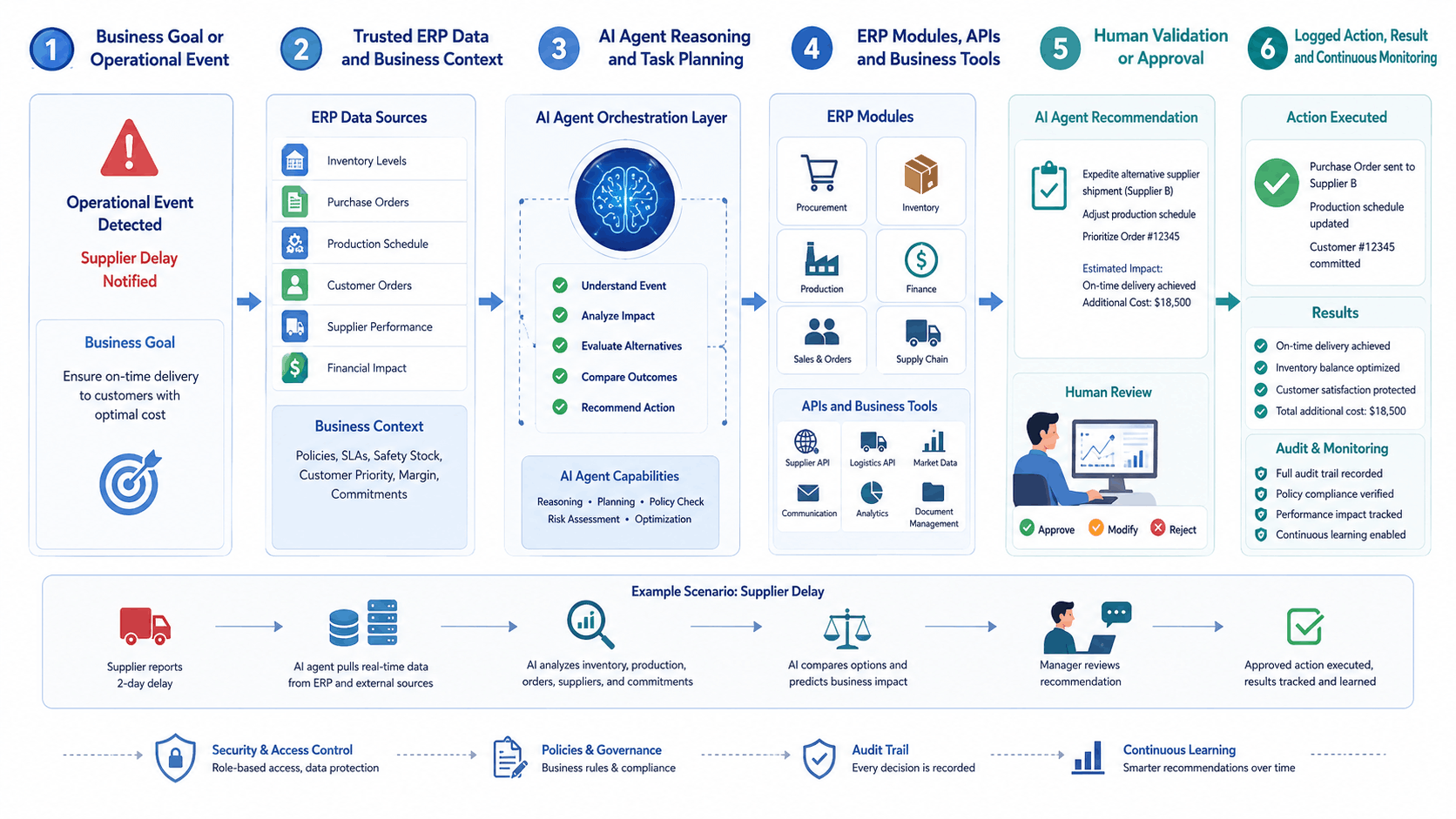
An agentic ERP solution normally needs six connected elements.
1. A Clear Business Goal
The agent needs a defined outcome, such as reducing invoice exceptions, preventing material shortages, or resolving delayed orders.
A vague request creates unpredictable behavior. Therefore, each goal should include scope, limits, success criteria, and escalation rules.
2. Trusted Business Context
The agent retrieves current information from ERP modules, policies, contracts, documents, email, and approved external systems.
Retrieval-augmented generation can help ground an agent in current internal knowledge rather than relying only on a language model’s training data. However, access should follow the same role and data restrictions applied to human users.
3. Planning and Reasoning
The agent breaks a goal into smaller tasks.
For a supplier delay, it may check available inventory, open production orders, alternative vendors, customer priorities, and contractual lead times before recommending an action.
4. Tools and Integrations
AI agents need controlled access to APIs, workflow engines, databases, document services, messaging tools, and ERP functions.
Without reliable integrations, an agent may provide useful advice but cannot safely complete work. This makes API readiness and integration stability essential parts of agentic ERP architecture.
5. Validation and Human Approval
Low-risk actions may proceed automatically. Higher-risk actions; such as changing a payment, supplier, payroll record, credit limit, or production plan; should require human approval.
The appropriate level of autonomy depends on business impact, regulatory exposure, process maturity, and the organization’s risk tolerance.
6. Governance and Auditability
The system should record what the agent accessed, recommended, changed, and escalated. Teams should also be able to identify which user, policy, model, or tool influenced the outcome.
NIST’s AI Risk Management Framework recommends managing AI risk throughout the system lifecycle in a way that reflects organizational goals, legal requirements, and risk tolerance.
Where AI Agents Can Change ERP Operations
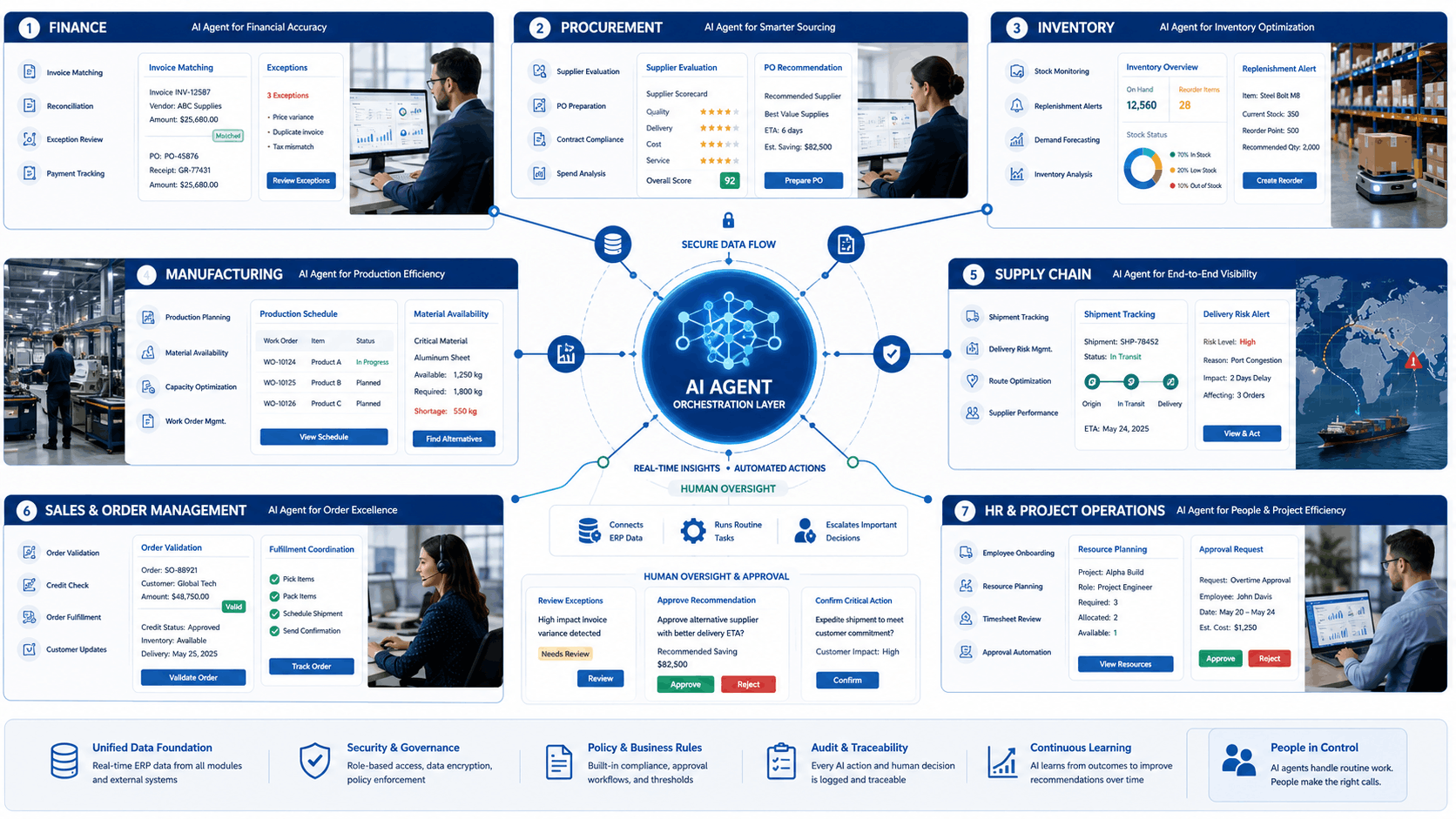
Finance: From Reporting to Exception Resolution
A finance agent can match invoices with purchase orders and goods receipts, identify discrepancies, request missing documents, and prepare a suggested resolution.
Finance teams can then review exceptions instead of manually tracing every routine transaction.
The same approach can support account reconciliation, expense review, collections, and financial close preparation. However, final posting rights and payment controls should remain tightly governed.
Procurement: From Alerts to Coordinated Action
A traditional ERP can alert a buyer when stock reaches a reorder threshold.
An agentic ERP can evaluate demand forecasts, current stock, production schedules, supplier lead times, pricing terms, minimum order quantities, and open orders. It can then recommend a quantity, draft the purchase order, and route it to the right approver.
The agent should not switch strategic suppliers or accept unusual commercial terms without human review.
Inventory and Production: From Reactive to Adaptive Planning
A production agent can monitor material availability, machine status, order priority, and delivery commitments.
When conditions change, the agent can compare schedule options and recommend the least disruptive plan. For example, it might suggest reallocating available material to a high-priority order while rescheduling a lower-priority production run.
In a production and logistics ERP project, Kanhasoft unified BOM-based production, inventory, procurement, sales, logistics, role-based access, and reporting. The platform was not automatically agentic, but it demonstrates the necessary foundation: consistent master data, connected workflows, defined roles, and current operational records.
Order-to-Cash: From Handoffs to Outcome Ownership
An order agent can validate customer information, check stock, identify credit or pricing exceptions, coordinate fulfillment, and alert account teams when delivery risk increases.
Instead of passing a case through several inboxes, the agent maintains context across the process. This can reduce delays caused by disconnected departmental handoffs.
HR and Project Operations: From Administration to Guided Execution
ERP AI agents can collect onboarding documents, answer policy questions, prepare resource plans, flag timesheet anomalies, and coordinate routine approvals.
However, sensitive decisions involving employment, compensation, performance, or termination require strong human oversight. Organizations should also involve qualified legal, HR, privacy, and compliance professionals where appropriate.
Benefits and Limits of Agentic ERP
The strongest value usually comes from reducing operational friction, not replacing entire departments.
Potential benefits include:
- Faster exception handling.
- Fewer manual handoffs.
- More consistent policy execution.
- Better visibility across connected processes.
- Reduced time spent collecting information.
- A simpler natural-language interface for ERP users.
- More timely responses to operational changes.
However, agentic ERP also introduces real risks:
- An agent may make a plausible but incorrect decision.
- Poor master data may produce confident but inaccurate actions.
- Excessive permissions can expose sensitive information.
- Weak integrations can cause incomplete or duplicated transactions.
- Multi-agent workflows can make accountability harder to trace.
- Model, monitoring, and transaction costs can increase with usage.
A practical rule is to increase autonomy only after the agent performs reliably at a lower level.
Start with recommendations. Then move to drafted actions, approval-based execution, and limited autonomous activity within tested thresholds.
Is Your Business Ready for Agentic ERP?
|
Readiness Area |
Positive Signal | Warning Sign |
Practical First Step |
|---|---|---|---|
|
Process maturity |
Teams follow a defined workflow | Cases are handled differently by each user |
Map one process and its exceptions |
|
Data quality |
Master data is current and owned | Duplicate vendors, SKUs, or customers |
Clean data and assign ownership |
|
Integration readiness |
Stable APIs expose ERP functions | Critical work depends on manual exports |
Build an integration layer |
|
Governance |
Roles and approvals are clear | Shared accounts or broad access |
Add role-based access controls |
|
Business volume |
Repetitive work causes measurable delay | Volume is low or highly unique |
Begin with an AI copilot |
|
Risk tolerance |
Low-risk work can be delegated safely | Errors could cause major harm |
Keep human approval mandatory |
Agentic ERP fits best when a process is frequent, measurable, cross-functional, and slowed by information gathering or coordination.
It is a weak candidate when data is unreliable, the workflow changes constantly, or nobody owns the final decision.
A Practical Agentic ERP Implementation Roadmap
Start With One Narrow Outcome
Choose a visible problem with manageable risk.
Supplier follow-up, invoice exception triage, inventory monitoring, document collection, and report preparation are usually safer pilots than autonomous payments or unrestricted production rescheduling.
Define Decision Rights
Document what the agent may read, recommend, draft, change, and approve.
Also define monetary limits, data restrictions, escalation triggers, prohibited actions, and the person responsible for reviewing unusual outcomes.
Prepare the ERP Foundation
Clean master data, document business rules, stabilize APIs, and assign transaction ownership.
An AI agent cannot compensate for an ERP in which three departments maintain different versions of the same supplier record. For more detail, see how AI-powered custom ERP development works.
Test Before Adding Autonomy
Create test cases using normal transactions, edge cases, incomplete records, conflicting policies, and attempted unauthorized actions.
Measure accuracy, task completion, escalation quality, user correction, latency, and cost. Do not judge the agent only by how convincing its answers sound.
Pilot With Human Review
Let users review recommendations and proposed actions.
Their corrections will expose missing rules, weak context, and usability problems. A pilot should demonstrate operational value before the organization expands permissions or adds more agents.
Scale Through Reusable Controls
Reuse identity, permissions, logging, monitoring, policy checks, and integration components.
This approach is safer and easier to maintain than building disconnected agents for every department.
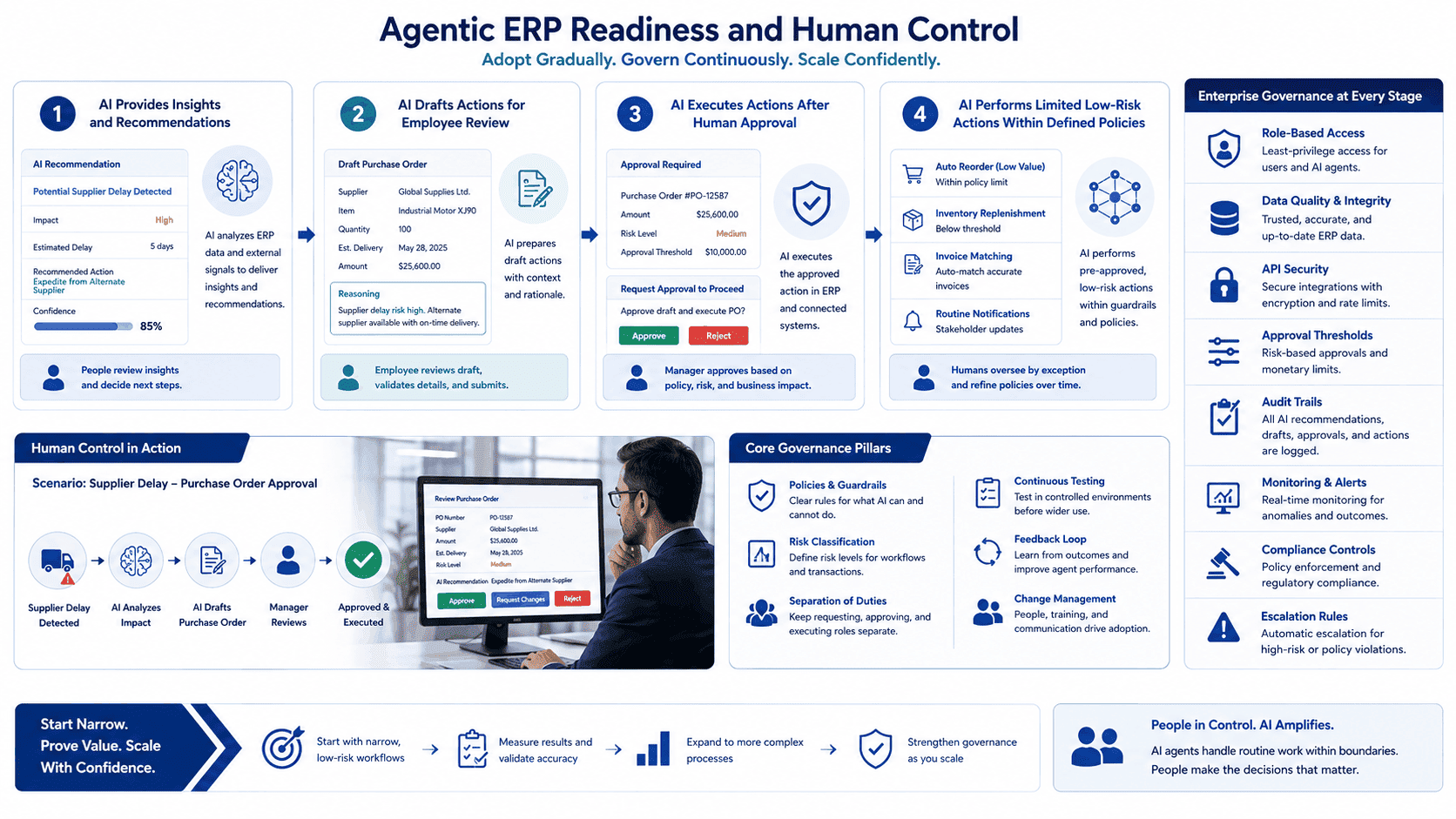
Native ERP Agents or a Custom Agentic Layer?
Native ERP agents work well when a process follows standard vendor workflows and the required data remains inside one ERP ecosystem. They may reduce integration effort and inherit existing permissions and audit controls.
A custom agentic layer is more suitable when work spans several systems, workflows are proprietary, or the organization needs greater control over models, orchestration, hosting, and approval logic.
Many businesses will use a hybrid approach. Native agents may handle standard finance or HR tasks, while custom agents coordinate differentiated production, logistics, customer, or industry-specific processes.
Before choosing an approach, review:
- Data residency and privacy requirements.
- ERP and AI licensing terms.
- Integration and API limitations.
- Auditability and explainability.
- Model and infrastructure costs.
- Vendor lock-in.
- Security and support responsibilities.
For regulated or high-impact workflows, involve qualified legal, compliance, privacy, financial, and cybersecurity specialists.
Final Words: Agentic ERP Should Expand Control, Not Remove It
What Is Agentic ERP? How AI Agents Are Changing Enterprise Operations is ultimately a question about responsible delegation.
Agentic ERP allows enterprise software to understand goals, coordinate multi-step work, and take approved actions. Yet strong implementations do not chase maximum autonomy. They combine reliable ERP data, clear decision rights, controlled integrations, human oversight, and measurable outcomes.
Start where coordination is expensive but mistakes remain containable. Prove value in one workflow, strengthen governance, and then expand.
A Practical Next Step With Kanhasoft
Kanhasoft can help assess your workflows, ERP architecture, data quality, integrations, and approval controls to identify a realistic agentic ERP pilot.
Explore our custom ERP development services, review our production and logistics ERP case study, or discuss an agentic ERP roadmap.