
A composable ERP is an enterprise resource planning strategy that combines independent business capabilities—such as finance, inventory, procurement, manufacturing, CRM, and analytics—through APIs, shared data rules, and workflow orchestration. Instead of replacing one large ERP with another, a business can retain useful systems, add specialized components, and modernize operations in controlled stages.
Gartner describes composable ERP as an adaptive strategy for responding to fast business change through gradual, continuous value delivery.
Quick Answer
Composable ERP lets a company build its operating system from interchangeable business capabilities instead of depending on one tightly coupled suite. A manufacturer might keep its finance platform, add a specialized production module, connect warehouse software, and introduce AI forecasting. APIs and events allow these components to work as one governed system.
The approach supports phased modernization, but it requires disciplined integration, data governance, security, and ownership. It is not simply a collection of connected apps.
What Does Composable ERP Mean?
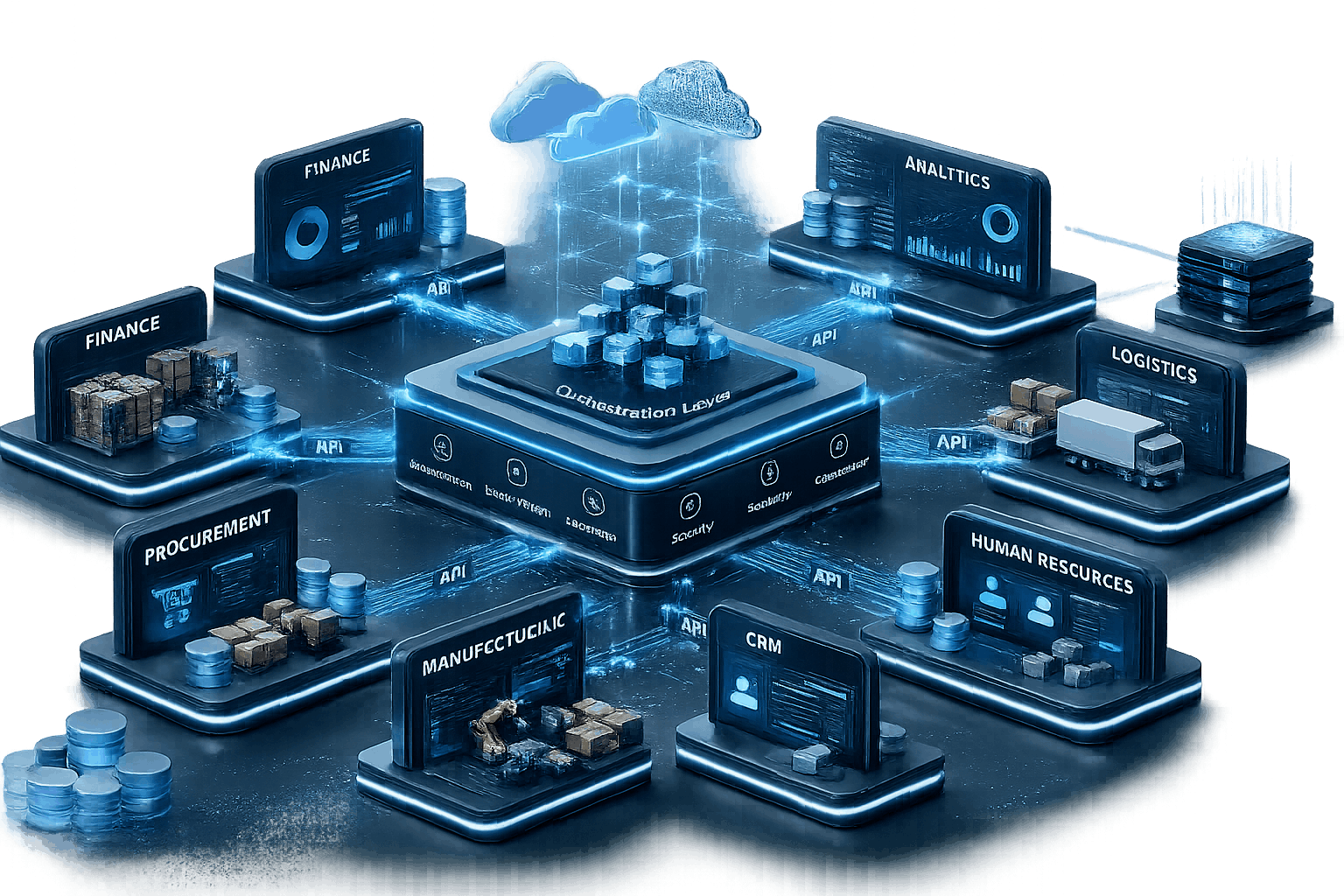
Traditional ERP suites place most functions inside one platform. Composable ERP treats each major function as a building block that can be selected, connected, improved, or replaced independently.
These building blocks are often called packaged business capabilities, or PBCs. Each PBC delivers a recognizable outcome, such as inventory reservation, invoicing, supplier onboarding, or production planning.
The MACH Alliance defines composability as the ability to assemble, replace, and evolve capabilities independently. It links the model with modular components, consistent interfaces, API-first connectivity, and event-driven integration.
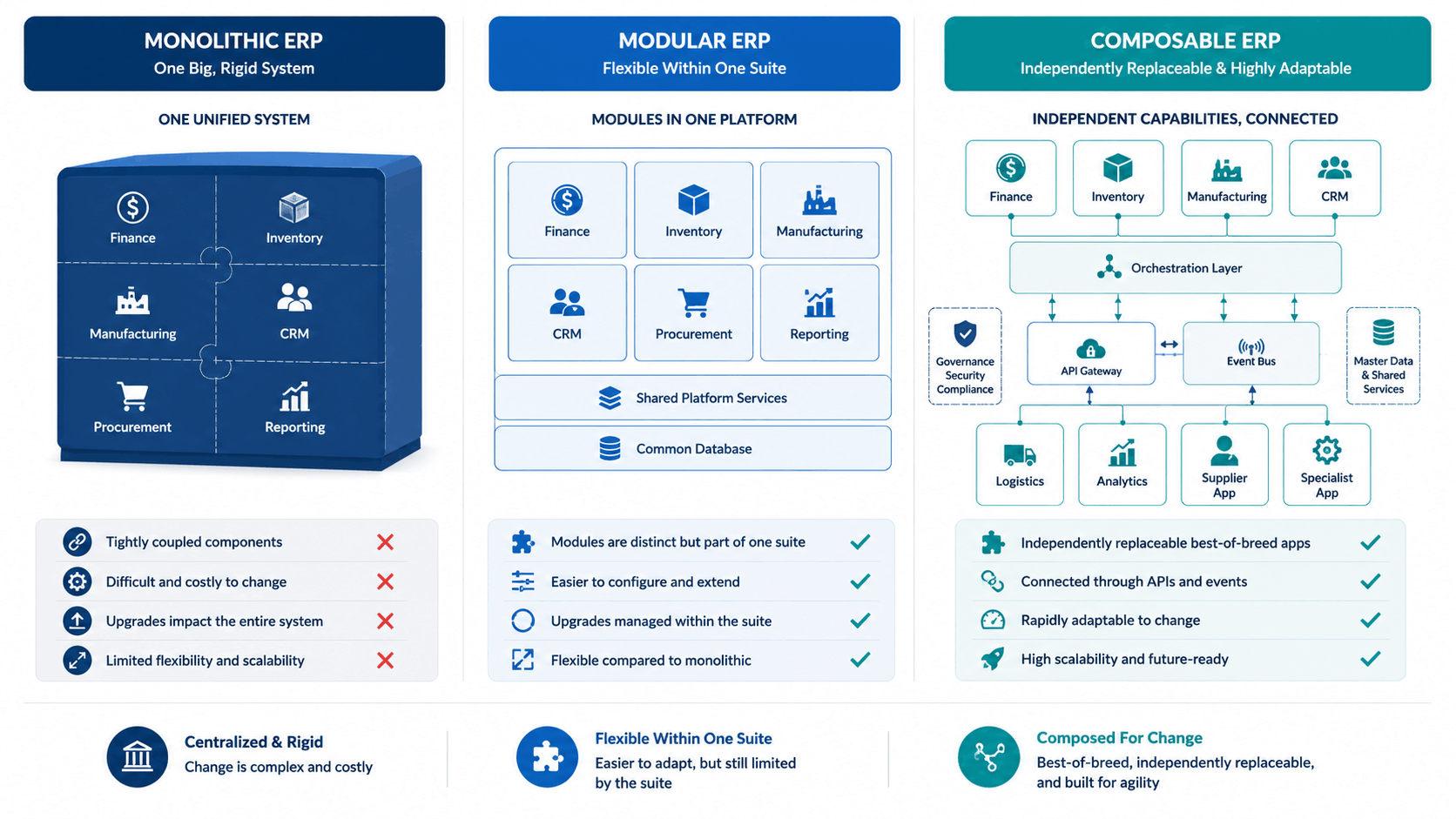
Modular ERP and composable ERP are related, but they are not the same. A modular ERP may offer separate modules while tying them to one vendor, database, release cycle, and interface. A composable enterprise architecture goes further by creating technical and operational boundaries that let one capability change without forcing a full-system rebuild.
Composable ERP vs. Modular ERP vs. Monolithic ERP
|
Area |
Monolithic ERP | Modular ERP |
Composable ERP |
|---|---|---|---|
|
Structure |
One tightly integrated suite | One suite with selectable modules |
Independent capabilities connected through defined interfaces |
|
Vendor choice |
Usually one primary vendor | Mainly one vendor ecosystem |
Vendors, custom modules, and existing systems can coexist |
|
Change impact |
Changes may affect the wider suite | Partly isolated by module |
Capabilities can evolve independently when well designed |
|
Data approach |
Common internal database | Shared suite data model |
Governed APIs, events, and master-data rules |
|
Best fit |
Stable, standardized operations | Suite consistency with some flexibility |
Changing, differentiated, or multi-system operations |
|
Main risk |
Rigidity | Hidden module dependencies |
Integration and governance complexity |
A monolithic ERP can still suit standardized organizations that value one support model and consistent controls. Modular ERP is often the middle ground. Composable ERP becomes more attractive when business units change at different speeds, acquisitions add systems, or specialized processes do not fit a standard suite.
 For a related model, see Kanhasoft’s guide to two-tier custom ERP and modular architecture. It explains how headquarters and regional systems can remain connected without forcing every location into the same design.
How Composable ERP Architecture Works
A reliable composable ERP is not simply a collection of SaaS subscriptions. It needs an architecture that makes independent components behave like one controlled operating environment.
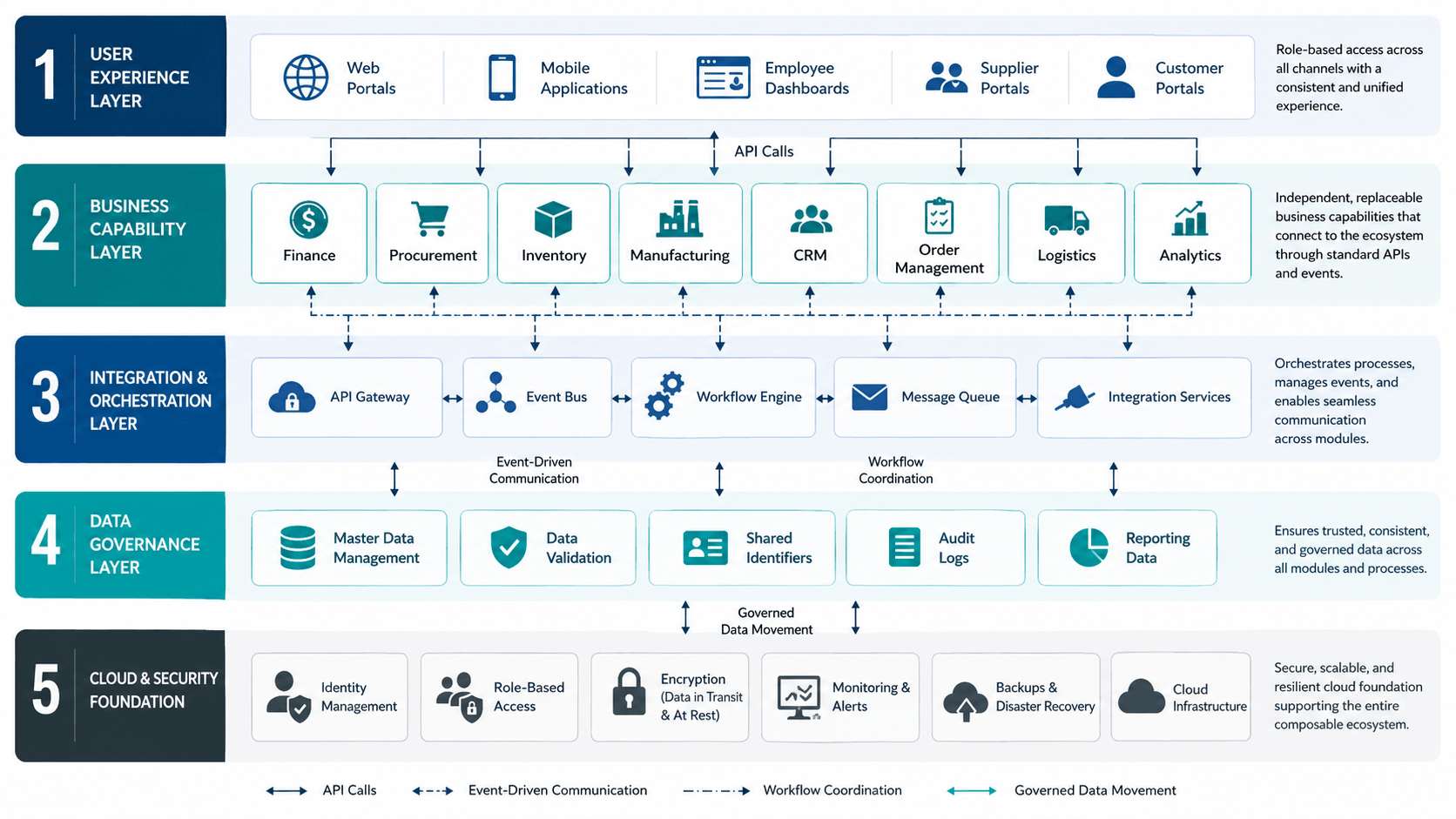
Business Capability Layer
Each component owns a defined responsibility, such as inventory, procurement, production, or billing. Boundaries should reflect business ownership, not only technical convenience.
For example, an inventory capability may own stock availability and reservations. A separate warehouse capability may manage picking, packing, bin locations, and dispatch tasks.
Clear boundaries reduce duplicated logic and make it easier to replace or improve individual components later.
API, Event, and Workflow Layer
APIs request data or trigger actions. Events notify other systems that something happened. A workflow engine coordinates processes such as order-to-cash across CRM, inventory, shipping, invoicing, and payments.
For example, when an order is confirmed:
- The CRM or ecommerce platform sends the order.
- The inventory capability reserves available stock.
- The warehouse system receives a fulfillment task.
- A shipment event triggers invoicing.
- The customer receives a notification.
- Analytics dashboards update operational metrics.
These interactions must be traceable when failures occur. Operations teams should be able to identify which service failed, what data was affected, and whether the transaction can be retried safely.
Data and Master-Data Governance
The organization must decide which system owns customer, supplier, product, employee, and inventory records. Data contracts should define formats, identifiers, validation, and update timing.
For example, one system should remain responsible for creating and updating product codes. Other systems may consume that information, but they should not independently create conflicting versions.
Otherwise, flexibility becomes multiple versions of the same customer, supplier, or gross-margin calculation.
Experience Layer
A portal, mobile application, or role-based dashboard can provide one user experience across several backend capabilities.
A sales representative may see customer history, available stock, quotations, and outstanding payments on one screen, even though the data comes from several systems.
The MACH pattern—microservices, API-first, cloud-native SaaS, and headless delivery—is one way to implement composability. However, a company does not need to rebuild everything as microservices. A modular application with well-designed APIs may be more practical for a mid-sized business.
Security and Observability
Identity, access control, audit logs, encryption, monitoring, and recovery must operate across the ecosystem.
Every capability should have:
- A clearly assigned owner
- Role-based access rules
- Logged user and system activities
- API authentication and authorization
- Backup and recovery procedures
- Performance and failure monitoring
- Version and dependency documentation
- Defined service expectations
Qualified security, privacy, tax, and compliance specialists should review requirements involving regulated data, financial records, employee information, or cross-border operations.
Main Business Benefits of Composable ERP
Faster, Lower-Risk Modernization
Companies can replace one capability while retaining stable systems. This lowers big-bang implementation risk and lets leaders measure value before funding the next phase.
For example, a distributor may modernize inventory visibility first. Finance, payroll, and customer service systems can remain unchanged until there is a clear reason to replace them.
This phased approach can also make testing, employee training, and data validation more manageable.
Better Fit for Differentiated Processes
Basic accounting may fit a packaged application, while a unique pricing or production workflow may justify a custom capability.
A manufacturer with unusual material-planning rules may keep a standard finance package but develop a specialized production module. A distributor may need a custom pricing engine based on territory, volume, customer agreements, and stock position.
The goal is not to customize everything. It is to invest where process differentiation creates real business value.
Greater Technology Flexibility
A company can add analytics, automation, AI, ecommerce, or specialist software without replacing the complete ERP.
For example, an organization might add:
- AI-assisted demand forecasting
- Supplier risk monitoring
- Document-processing automation
- IoT-based equipment monitoring
- A customer self-service portal
- Mobile applications for field teams
- A specialist transportation-management system
This reduces some vendor dependence. However, the business must retain integration knowledge and architecture ownership. Replacing one vendor lock-in problem with ten undocumented integrations is not progress.
More Adaptable Scaling
Independent capabilities can scale according to demand. Ecommerce order processing may need additional capacity during a seasonal peak, while HR administration remains stable.
The same architecture can help connect acquired systems, support regional tax or language requirements, and introduce new business models without redesigning every core process.
Composable enterprise architecture is particularly relevant for organizations with multiple subsidiaries, regions, product lines, or operational models.
Practical Composable ERP Example
Consider a multi-location manufacturer with an established accounting package, spreadsheets for production planning, a basic warehouse tool, and a separate CRM.
Replacing every system at once would create unnecessary cost and operational risk. A practical roadmap could:
- Retain the accounting platform as the financial system of record.
- Introduce production-planning and inventory capabilities.
- Connect customer demand and forecasts from the CRM.
- Publish production, stock, and shipment events to dashboards.
- Add supplier collaboration or predictive maintenance later.
A documented Kanhasoft manufacturing project used a related modular approach. It unified production, inventory, procurement, sales, and logistics through a role-based ERP built with React, Node.js, PostgreSQL, REST APIs, AWS S3, and Docker. The case shows how clear modules and integrations can replace fragmented tools while leaving room for phased growth.
Businesses considering a tailored system can review Kanhasoft’s custom ERP development services, which cover workflow analysis, module design, APIs, testing, deployment, and support.
Composable ERP Implementation Roadmap
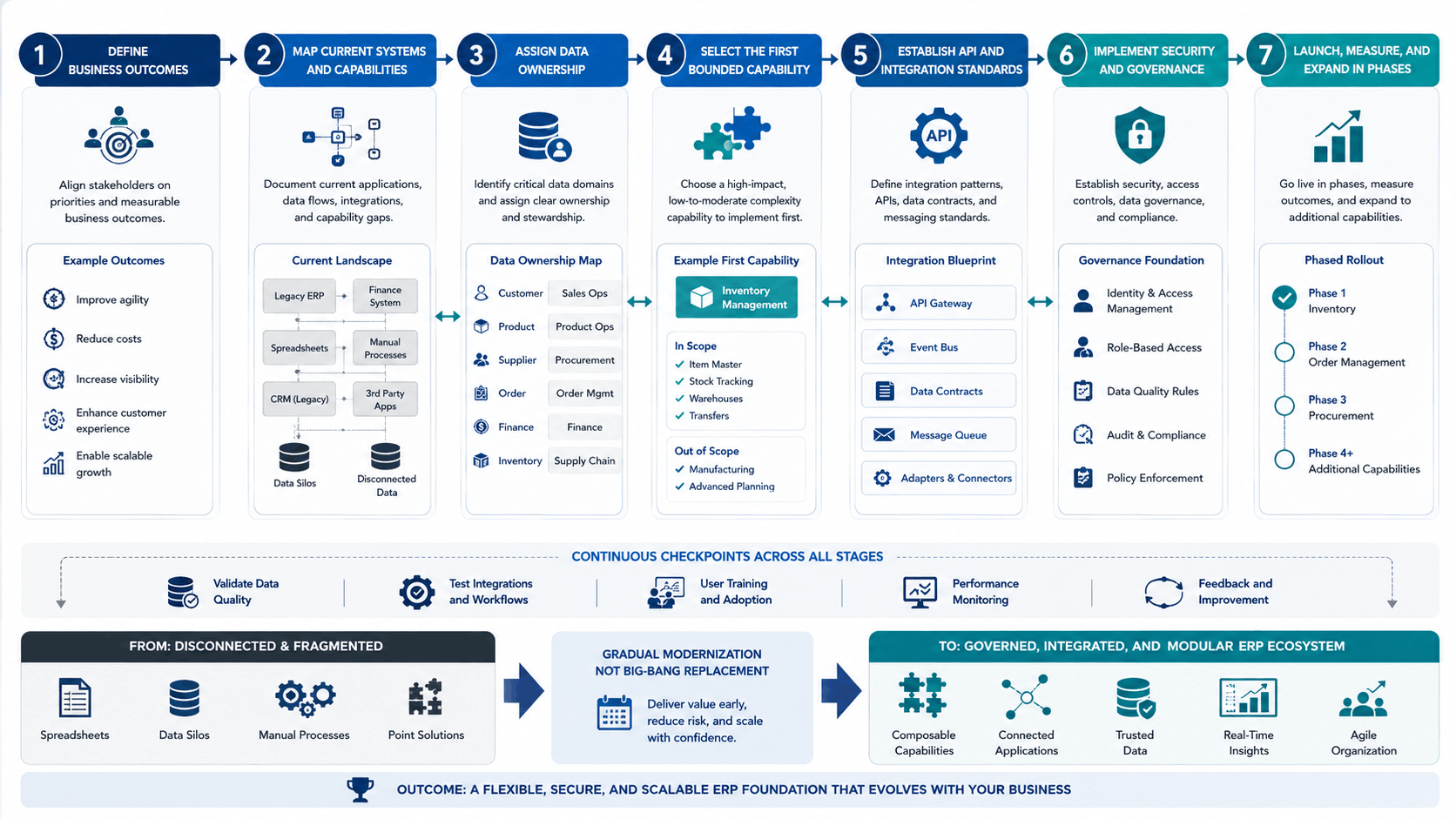
1. Define the Business Outcome
Start with a measurable problem, such as inaccurate stock, slow order release, manual reconciliation, or delayed production planning.
Do not begin with “we need microservices.” Architecture should serve the business case.
Useful success measures may include order-processing time, inventory accuracy, approval turnaround, reconciliation effort, production delays, or employee adoption.
2. Map Capabilities and Dependencies
Map applications, spreadsheets, integrations, owners, and data flows. Group them into business capabilities and identify what is stable, duplicated, risky, or ready for replacement.
This assessment should also reveal manual workarounds. Those hidden spreadsheets often contain business rules that never appeared in the original ERP documentation.
3. Assign Data Ownership
Assign ownership for customer, product, supplier, inventory, and financial records before migration or synchronization.
Document who can create, update, approve, archive, and correct each type of record. Also define how duplicate or conflicting information will be resolved.
4. Prioritize One Bounded Capability
Choose an area with clear value and manageable dependencies. Inventory visibility, supplier onboarding, or approval automation may be better starting points than rebuilding the finance core.
Release a minimum viable capability, test it with actual users, and measure the result before expanding the scope.
5. Establish Integration Standards
Define API, event, authentication, error-handling, logging, and versioning standards for purchased and custom components.
Standards should answer practical questions:
- How will systems identify the same customer or product?
- What happens when an API is unavailable?
- Can a transaction be safely retried?
- How are changes to an API communicated?
- Which events require immediate action?
- How long should audit information be retained?
6. Build Governance Into Delivery
Set capability ownership, vendor assessment, architecture decisions, and change-control processes.
Composable ERP increases local freedom. Governance prevents that freedom from creating duplicate software, uncontrolled data movement, or overlapping capabilities.
7. Roll Out in Stages
Use reconciliation reports, user training, fallback procedures, and post-launch monitoring.
Kanhasoft’s article on how cloud and AI are reshaping ERP also identifies migration and employee training as major modernization challenges.
Is Composable ERP Right for Your Business?
|
Business situation |
Likely direction |
|---|---|
|
Processes are stable and standard |
A unified ERP suite may be simpler |
|
You want phased deployment from one vendor |
Modular ERP may be sufficient |
|
Specialized systems already perform well |
Composable ERP can connect around them |
|
Unique workflows create real business value |
Custom capabilities may be justified |
|
Your team lacks integration ownership |
Start smaller or use an experienced partner |
|
Acquisitions or regional operations create diversity |
Composable or two-tier ERP deserves evaluation |
|
The main issue is poor process discipline |
Fix governance before adding technology |
A useful decision question is:
Does the organization need independent change more than platform uniformity?
Composable ERP favors independent evolution. A traditional suite favors standardization, shared controls, and centralized ownership.
Neither option is always better. Kanhasoft’s custom ERP vs. SAP comparison provides a broader framework for comparing tailored flexibility with enterprise-suite standardization.
Common Composable ERP Implementation Mistakes
One common mistake is treating composability as permission to buy more software. Every new component adds contracts, access rules, monitoring, integrations, and support responsibilities.
Another mistake is dividing the architecture too aggressively. Hundreds of small services can create significant operational overhead without improving business agility.
Data ownership is another frequent weakness. APIs move bad data faster; they do not decide which record is correct.
Companies may also focus heavily on backend flexibility while neglecting the employee experience. The architecture provides little value when staff must copy information between multiple screens.
Finally, do not replace a stable ERP core simply because composable architecture is receiving attention. Preserve what works and modernize the capabilities that limit growth, control, customer service, or decision-making.
Practical expert note: Strong composable ERP programs usually begin with capability mapping, not product selection. Once leaders agree on process ownership, data authority, and the first measurable outcome, technology choices become much clearer.
Conclusion
Composable ERP builds enterprise operations from modular, connected, and independently evolving capabilities. It can support gradual modernization, specialized workflows, acquisitions, regional operations, and new technologies without repeatedly replacing the entire system.
Its value depends on disciplined APIs, data ownership, security, governance, monitoring, and user experience.
Stable businesses with highly standardized processes may still prefer traditional or modular ERP. Organizations that need continuous change across diverse systems may gain more from a composable ERP foundation.
Planning Your ERP Architecture
Kanhasoft can assess current applications, map business capabilities, identify integration and data risks, and compare unified, modular, two-tier, and composable options.
A focused architecture review can produce a phased roadmap without committing the organization to a full rebuild.
You can discuss your ERP modernization requirements with Kanhasoft when you are ready to evaluate the practical options.