
APIs are usually the better data collection method when they provide the required information, permit the intended use, and offer dependable access. Web scraping is often more practical when no suitable API exists or when the required public information appears only on websites. In many real-world projects, the best solution is a hybrid system that uses APIs for structured data and scraping for missing or supplementary information.
The right choice depends on more than development cost. Data coverage, update frequency, reliability, legal obligations, security, and long-term maintenance all affect the decision.
This article is especially useful for:
- Business owners evaluating automated data collection
- CTOs and engineering leaders planning data pipelines
- E-commerce teams monitoring prices, stock, and promotions
- SaaS companies building data-driven products
- Market research and competitive intelligence teams
- Product managers comparing API integration with web scraping
- Data teams replacing manual collection processes
Quick Answer
Choose an API when an authorized interface provides the data, usage rights, capacity, and update frequency your business needs.
Choose web scraping when important public information is available through web pages but not through a suitable API, provided the collection complies with applicable laws, contractual terms, and privacy requirements.
And choose a hybrid approach when the API is reliable but incomplete. For example, an e-commerce API might provide product identifiers and inventory while scraping captures public search rankings, visible promotions, or competitor prices.
This recommendation assumes the business has a legitimate purpose and does not bypass authentication, CAPTCHAs, paywalls, or other access controls without authorization.
What Is an API?
An application programming interface, or API, is a defined way for software systems to exchange information.
A business sends a structured request to an API endpoint. The API then returns data, commonly in JSON or XML format. Authentication keys, access tokens, rate limits, and documentation usually control how the interface can be used.
For example, a marketplace API may return:
- Product identifiers
- Order information
- Inventory levels
- Advertising performance
- Shipment status
- Account-specific sales data
APIs can be public, private, partner-only, or available through a paid subscription. Access to an API does not automatically permit every possible use of its data. The API agreement still matters.
What Is Web Scraping?
Web scraping is the automated collection of information displayed on websites.
A scraper requests or opens a web page, identifies the required elements, extracts their values, and converts the results into structured data. Depending on the website, the system may process HTML, embedded JSON, JavaScript-rendered content, or downloadable documents.
A scraping system might collect:
- Public product prices
- Discount information
- Stock availability
- Search result positions
- Property listings
- Job vacancies
- Business directory records
- Public event information
Static pages can often be processed through standard HTTP requests and HTML parsers. Dynamic websites may require browser automation. However, technical feasibility does not replace the need for legal and compliance review.
Web Scraping vs APIs: Key Differences
| Decision factor | APIs | Web scraping |
|---|---|---|
| Data structure | Usually returns structured JSON or XML | Often requires parsing, cleaning, and normalization |
| Data coverage | Limited to fields exposed by the provider | Can collect relevant information visible on permitted web pages |
| Reliability | Generally stable when supported and versioned | Can break when layouts, selectors, or page behavior change |
| Access | May require approval, credentials, or a paid plan | Depends on website accessibility and applicable restrictions |
| Rate limits | Usually documented and enforced | Must be controlled responsibly to avoid excessive server load |
| Setup effort | Often lower with clear documentation | Varies based on site complexity and required scale |
| Maintenance | Usually predictable until an API changes or is retired | Requires monitoring for page and anti-automation changes |
| Historical data | Available only if the provider exposes it | Can be built gradually through scheduled snapshots |
| Compliance | Governed by API terms and data-use agreements | Requires review of terms, privacy, intellectual property, and access rules |
| Best suited for | Approved, structured, system-to-system data exchange | Public web data not available through an adequate API |
Neither method is universally better. An API can be stable but too limited. A scraper can offer broader visibility but require more engineering and compliance oversight.
When Is an API the Better Choice?
An API should generally be the first option when it provides the required data under acceptable terms.
The data is available and complete
If the API exposes every required field, scraping the same information may add unnecessary complexity. Structured API responses also reduce data-cleaning work.
For example, an accounting platform’s API may provide authorized invoices, payments, and customer records. Scraping the user interface would be less reliable and could create avoidable security risks.
You need account-specific or private information
APIs are the appropriate route for information behind authenticated business systems, such as:
- Customer transactions
- Internal inventory
- Advertising accounts
- Shipping records
- Financial data
- User-authorized profile information
The integration should use approved authentication methods such as OAuth 2.0 or provider-issued access tokens.
Stability is more important than maximum coverage
Supported APIs often have versioning policies, documentation, error responses, and change notices. These features make production planning easier.
However, companies should still prepare for endpoint changes, deprecated API versions, rate-limit adjustments, and provider outages.
The provider prohibits alternative collection methods
An approved API may be the only permitted way to access a platform’s information. In that situation, technical convenience should not override contractual restrictions.
When Is Web Scraping the Better Choice?
Web scraping becomes a practical option when a business needs public web information that an API does not provide.
No suitable API exists
Many manufacturer websites, local directories, retailers, and industry portals do not offer public APIs. Manual copying may be possible for a few pages, but it does not scale.
A carefully designed scraper can automate collection while applying request limits, validation, monitoring, and data-quality controls.
The available API has incomplete coverage
An API may exclude useful information such as:
- Competitor prices
- Public discounts
- Search rankings
- Product badges
- Seller-specific offers
- Delivery estimates
- Page-level availability messages
Scraping can fill these gaps when collection and use are permitted.
You need data from many unrelated sources
A market intelligence project may involve hundreds of websites with different technologies and data formats. Few industries offer one API that covers every competitor or supplier.
Web scraping can bring this information into a common schema. However, the project should budget for source-specific maintenance and data normalization.
You need to preserve visible market conditions over time
Websites frequently show only the current price, listing, or availability. Scheduled scraping can create historical snapshots for trend analysis.
For example, a retailer could record daily competitor prices and stock states. Over time, the dataset can reveal promotion patterns, frequent stockouts, and pricing changes.
Why a Hybrid Data Collection Strategy Often Works Best
A hybrid system uses APIs and web scraping together rather than treating them as competing technologies.
For example, a marketplace analytics platform might use:
- An official API for account sales and advertising data
- Public page collection for organic search positions
- Embedded page data for product attributes
- Scheduled snapshots for historical comparisons
- Internal databases for reporting and alerts
This approach preserves the stability of APIs while filling legitimate data gaps through web collection.
Practical implementation observation
In one Kanhasoft marketplace intelligence project, the system used Walmart’s Search API alongside HTML responses containing embedded JSON. The resulting pipeline distinguished organic and sponsored rankings, processed about 300,000 keywords daily, and maintained historical records.
The important lesson was not simply that scraping could operate at scale. It was that different sources served different purposes. The API supported structured access, while page-level processing supplied the ranking context required by the product.
Best Choice by Business Situation
| Business situation | Recommended method | Reason |
|---|---|---|
| Syncing authorized customer or order data | API | Secure, structured, and designed for system integration |
| Monitoring public competitor prices | Web scraping or licensed data feed | Competitor information is rarely exposed through an official API |
| Collecting internal SaaS account data | API | Supports authentication and approved access |
| Tracking public search rankings | Web scraping or hybrid | Rankings often depend on visible page context |
| Building a multi-marketplace analytics tool | Hybrid | APIs and public pages usually provide different data fields |
| Creating a one-time small dataset | Manual collection or simple scraper | A full integration may not justify its cost |
| Collecting sensitive personal information | Usually avoid unless strictly necessary and lawful | Privacy and security risks may outweigh the business value |
| Integrating with a strategic platform partner | API | Partner access offers clearer permissions and support |
| Capturing public listings from sources without APIs | Web scraping | Useful when terms and applicable laws allow collection |
| Requiring a formal uptime commitment | Commercial API or licensed data provider | Service-level commitments are uncommon for public web pages |
Benefits of Using APIs
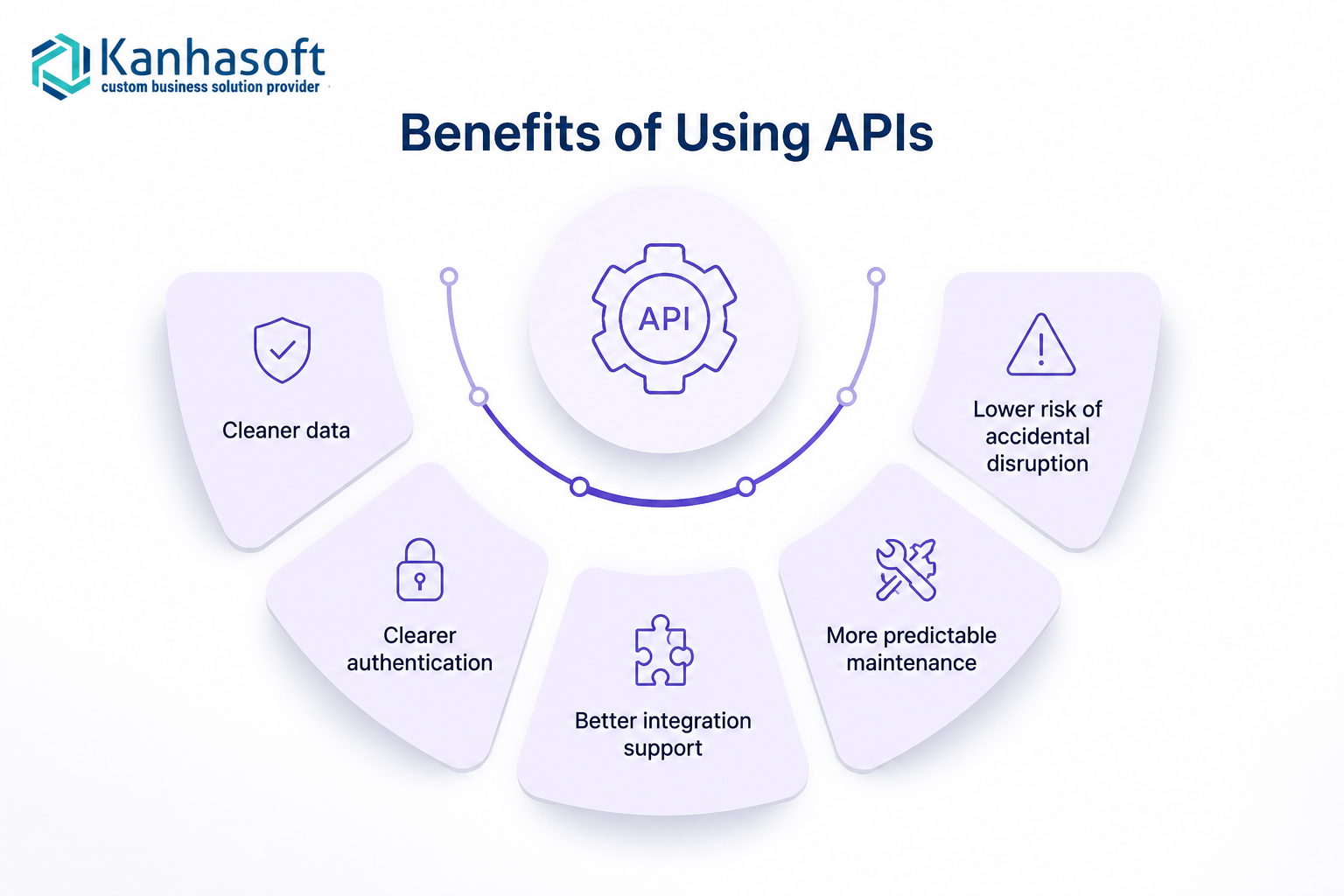
Cleaner data
APIs usually return structured fields with predictable names and data types. Therefore, teams spend less time parsing page layouts.
Clearer authentication
API keys, OAuth tokens, and permission scopes make access easier to manage and audit.
Better integration support
Documentation, software development kits, sandbox environments, and error codes can reduce implementation time.
More predictable maintenance
A supported API can remain stable for long periods. Version announcements also allow teams to plan migrations.
Lower risk of accidental disruption
API usage limits define how systems should interact with the provider. This helps prevent excessive requests and operational conflicts.
Benefits of Web Scraping
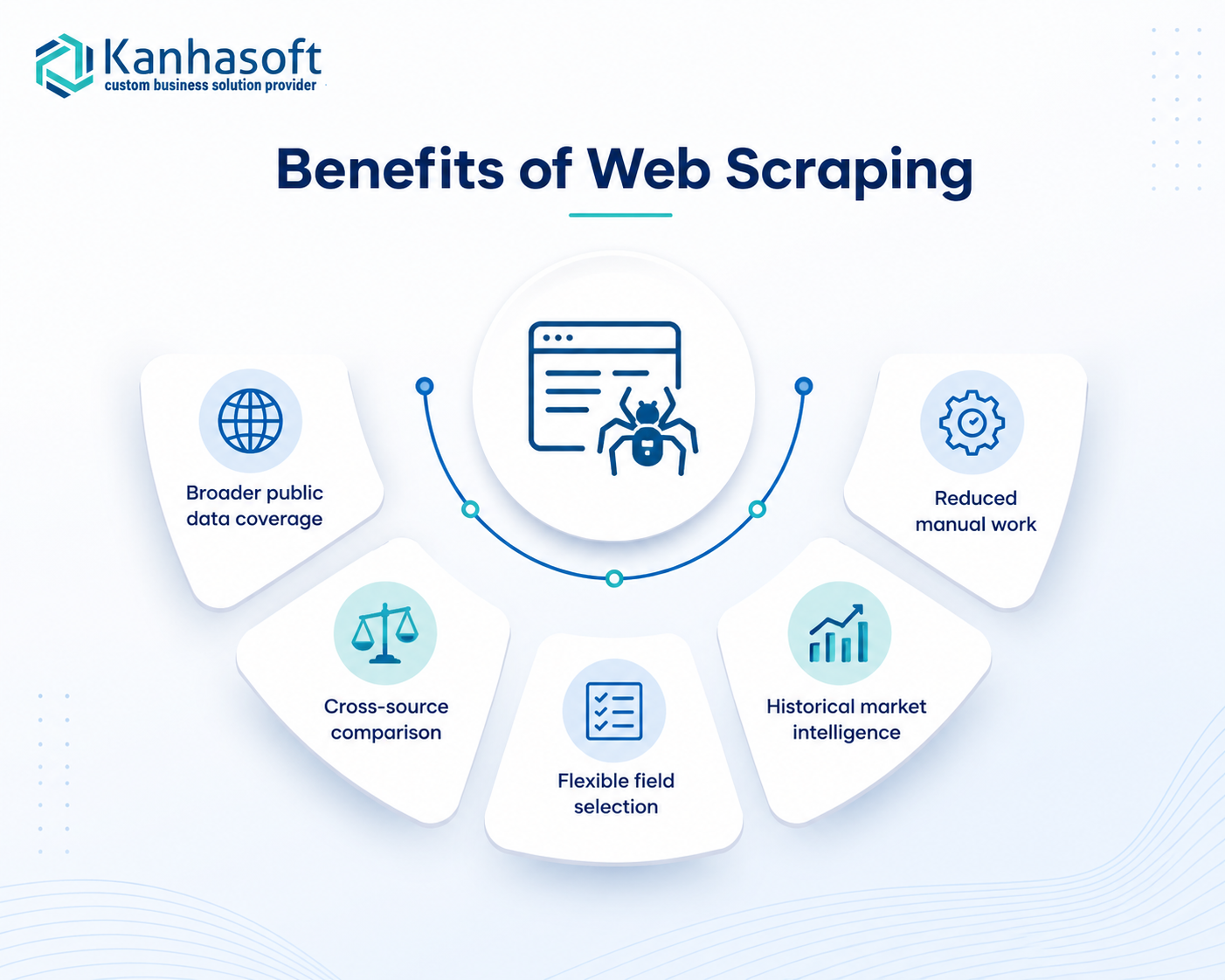
Broader public data coverage
Scraping can capture information that websites display but do not expose through an API.
Cross-source comparison
Businesses can normalize data from competitors, suppliers, directories, and marketplaces into one reporting system.
Flexible field selection
A collection pipeline can focus on specific attributes such as prices, stock states, seller names, discounts, and ratings.
Historical market intelligence
Scheduled collection creates a record of how public information changes over time.
Reduced manual work
Automation can replace repetitive copying and checking. Teams can then focus on analysis, validation, and decisions.
Limitations and Challenges
API limitations
APIs may create challenges such as:
- Strict rate limits
- Expensive access tiers
- Limited fields or historical records
- Approval requirements
- Geographic restrictions
- Sudden policy changes
- Endpoint retirement
- Dependence on one provider
An API is not automatically reliable simply because it is official. Teams should still use retries, caching, logging, schema validation, and outage handling.
Web scraping limitations
Scraping systems may face:
- Frequent layout changes
- JavaScript-heavy pages
- Inconsistent product names and units
- Duplicate or missing records
- Location-specific results
- Higher maintenance at scale
- Contractual or privacy restrictions
- Blocking when collection behavior is excessive or unauthorized
The development estimate should include ongoing monitoring. A scraper that works during a demonstration may still need significant work to operate reliably across thousands of pages.
How to Choose the Right Data Collection Method
1. Define the exact business question
Do not begin with “We need all competitor data.” Define the decision the data must support.
For example:
- Which competitors changed prices today?
- Which products went out of stock?
- How does our search position change by location?
- Which suppliers added new products this month?
A clear question prevents unnecessary collection.
2. Create a field-level data requirement
List each required field, update frequency, acceptable delay, target sources, and quality threshold.
Then check whether an official API, licensed feed, or existing export already provides it.
3. Review usage rights before development
Evaluate API agreements, website terms, privacy obligations, intellectual property concerns, and sector-specific rules.
Legal treatment varies by jurisdiction and circumstance. Therefore, businesses operating across the USA, UK, European markets, Israel, Switzerland, or the UAE should seek qualified legal advice for material or high-risk projects.
4. Estimate total cost, not only initial development
Include:
- API subscription fees
- Proxy or infrastructure costs
- Data storage
- Monitoring and alerts
- Data cleaning
- Engineering maintenance
- Compliance review
- Failure recovery
- Quality assurance
The lowest-cost prototype may not be the lowest-cost production solution.
5. Test data quality with a pilot
A small pilot can reveal missing fields, localization issues, inconsistent identifiers, duplicate records, and unexpected restrictions.
Compare pilot results against manually verified samples before scaling.
6. Design for source changes
Use modular collectors, versioned schemas, validation rules, retry policies, and source-level health monitoring.
This makes it easier to repair one source without interrupting the full pipeline.
Compliance, Security, and Ethical Considerations
Data collection should begin with purpose and permission, not just technical possibility.
Review terms and contractual restrictions
API agreements may limit storage, redistribution, analytics, or commercial use. Website terms may also govern automated access.
Do not treat robots.txt as legal permission
A robots.txt file communicates crawler preferences. It does not grant ownership, override website terms, or settle privacy and intellectual property questions.
Avoid bypassing access controls
Do not bypass authentication, paywalls, CAPTCHAs, or technical restrictions without clear authorization. Public visibility does not always mean unrestricted reuse.
Minimize personal data
Collect only the fields needed for the defined business purpose. Personal data may trigger obligations under laws such as the GDPR, UK GDPR, state privacy laws, and other regional regulations.
High-risk projects should involve qualified privacy and legal professionals.
Protect credentials and collected data
Store API keys and tokens in a secure secrets manager. Encrypt sensitive information, restrict access by role, maintain logs, and define retention rules.
Use responsible request rates
Collection should avoid creating unnecessary load on source websites. Use scheduling, caching, incremental updates, and bakeoff rules.
Maintain data provenance
Record where and when each item was collected. Provenance supports quality reviews, dispute handling, audits, and deletion requests.
Real-World Use Cases by Industry
E-commerce and retail
Retailers use APIs for their own orders, advertising, and inventory. They may use permitted scraping for public competitor prices, stock availability, seller offers, and promotions.
A hybrid pipeline can trigger alerts when a competitor lowers a price or a popular product becomes unavailable.
Recruitment and staffing
Recruitment platforms can use job board APIs where available. Public career pages may require separate collectors when no integration exists.
The data must be checked for duplicates, expired vacancies, location differences, and personal information.
Travel and hospitality
APIs can provide approved booking and property information. Web collection may support public rate comparison, room availability research, and market analysis where permitted.
Location, dates, taxes, and occupancy assumptions must be normalized before prices are compared.
Real estate
Property platforms may offer partner feeds or APIs. Broker and agency websites can contain additional public listings unavailable through those feeds.
Deduplication is essential because the same property may appear under different agents, prices, or identifiers.
Financial and market research
Licensed APIs are usually preferable for time-sensitive financial data because they offer clearer rights and structured delivery.
Scraping may support public filings or research pages, but accuracy, licensing, timeliness, and compliance require close review.
Healthcare and life sciences
APIs can connect authorized clinical, product, or event systems. Public web collection may support approved research on medical events, publications, or provider directories.
Because healthcare data can be sensitive, collection should exclude unnecessary personal or patient information.
Manufacturing and distribution
Manufacturers can use supplier APIs for inventory and order synchronization. Scraping may monitor public distributor catalogs, part availability, or market pricing when no feed exists.
Product matching should consider SKU, brand, specification, pack size, and unit of measure—not only product names.
Common Mistakes to Avoid
Choosing scraping before checking for an API
A supported API may already provide cleaner and more dependable access.
Assuming an API contains everything
Teams sometimes commit to an API before testing its field coverage, history, regional results, and rate limits.
Ignoring data-use restrictions
Technical access does not automatically create the right to store, analyze, republish, or sell data.
Building one fragile scraper for every source
Each source may need different extraction, validation, and recovery logic. A modular architecture is easier to maintain.
Scaling before validating accuracy
Collecting millions of incorrect records only creates a larger data-quality problem.
Comparing products by title alone
Reliable matching may require brand, SKU, model, size, ingredients, specifications, and packaging details.
Failing to budget for maintenance
Websites and APIs both change. Production systems need monitoring, documentation, testing, and ownership.
Collecting more data than the business needs
Excess information increases storage, compliance, security, and quality-management costs without necessarily improving decisions.
Need Help Evaluating Your Data Sources?
Kanhasoft can help assess whether an API, web scraping system, licensed feed, or hybrid architecture fits your use case. The process can begin with a small feasibility review covering data availability, field coverage, source complexity, compliance considerations, expected scale, and maintenance.
A pilot using a limited set of approved sources can provide evidence before you commit to a full data collection platform.
Conclusion
The web scraping vs APIs decision should be based on data coverage, reliability, permission, cost, and maintenance, not on a preference for one technology.
Use an API when it offers approved, structured, and sufficient access. Use web scraping when necessary public information is unavailable through a suitable interface and collection can be performed responsibly. When neither option provides a complete answer alone, a carefully designed hybrid pipeline often delivers the strongest business result.