
Traditional web scraping works well when a page has stable HTML, predictable fields, and clear selectors. Real business data is rarely that cooperative. Product descriptions change, job listings use different labels, event details hide inside PDFs, and websites describe the same concept in several ways.
AI web scraping adds large language models to the extraction pipeline so software can interpret meaning, not only locate page elements. An LLM can identify a product feature, speaker, contract date, job requirement, or event location from inconsistent text and return it in a defined structure. However, it does not replace crawling, validation, or responsible data governance.
Quick Answer: What Is AI Web Scraping?
AI web scraping combines conventional crawlers with machine learning or large language models to collect, understand, normalize, and classify online data. The crawler fetches pages, API responses, or documents. The LLM handles difficult interpretation tasks, such as extracting fields from changing layouts, mapping varied terms to one schema, and processing unstructured PDFs.
The most dependable design is usually hybrid: deterministic code handles access and stable fields, while an LLM handles ambiguity.
What AI Web Scraping Actually Means
An AI scraper is a controlled data pipeline:
- A crawler collects HTML, JSON, API responses, or documents.
- Parsing logic removes irrelevant content.
- An LLM maps useful content to a requested schema.
- Validation approves, rejects, or routes each record for review.
Modern model platforms support structured outputs based on JSON Schema, which makes responses easier to validate and integrate. Still, a structurally valid response can contain the wrong meaning. Schema enforcement must therefore be paired with source evidence and business rules.
In practical terms, LLM web scraping moves part of the logic from “find the third <span> in this card” to “identify the monthly price and return the amount, currency, billing period, and supporting text.”
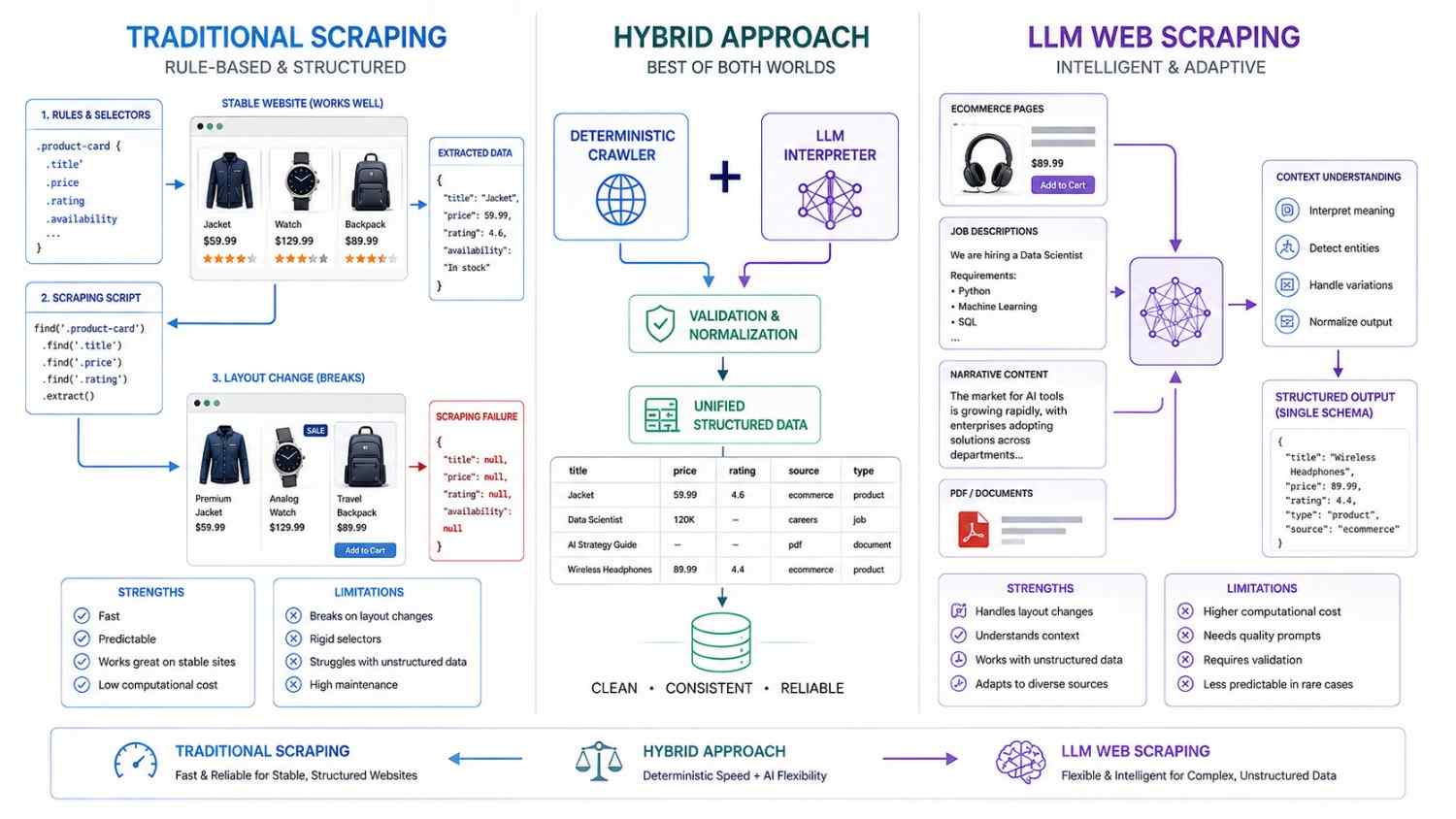
Traditional Scraping vs. LLM Web Scraping
| Approach | Best for | Main strength | Main limitation |
|---|---|---|---|
| Rule-based scraping | Stable pages, APIs, tables, and repeated cards | Fast, inexpensive, and predictable | Breaks when layouts or labels change |
| LLM-only extraction | Small tests and highly varied text | Flexible interpretation | Higher cost and harder verification |
| Hybrid intelligent web scraping | Production systems with mixed sources | Balances reliability, context, and scale | Needs careful architecture and monitoring |
Rule-based extraction remains best for stable selectors and machine-readable values. A product ID already present in JSON should not be sent to an expensive model merely because AI is available.
The LLM becomes useful when the same fact appears in different forms. “Out of stock,” “temporarily unavailable,” “back soon,” and a disabled purchase button may all need to map to one availability status. The model interprets these signals; deterministic rules verify the result.
How LLMs Are Changing Data Extraction
Extracting Meaning from Inconsistent Pages
Traditional scrapers depend on page structure. LLMs can work from cleaned text and understand relationships between words. For example, property websites may express rent by year, month, or square foot. An LLM can normalize these variations into amount, currency, period, and unit.
This reduces source-specific rules, but the crawler must still reach the correct page and capture complete content.
Processing PDFs and Document-Heavy Sources
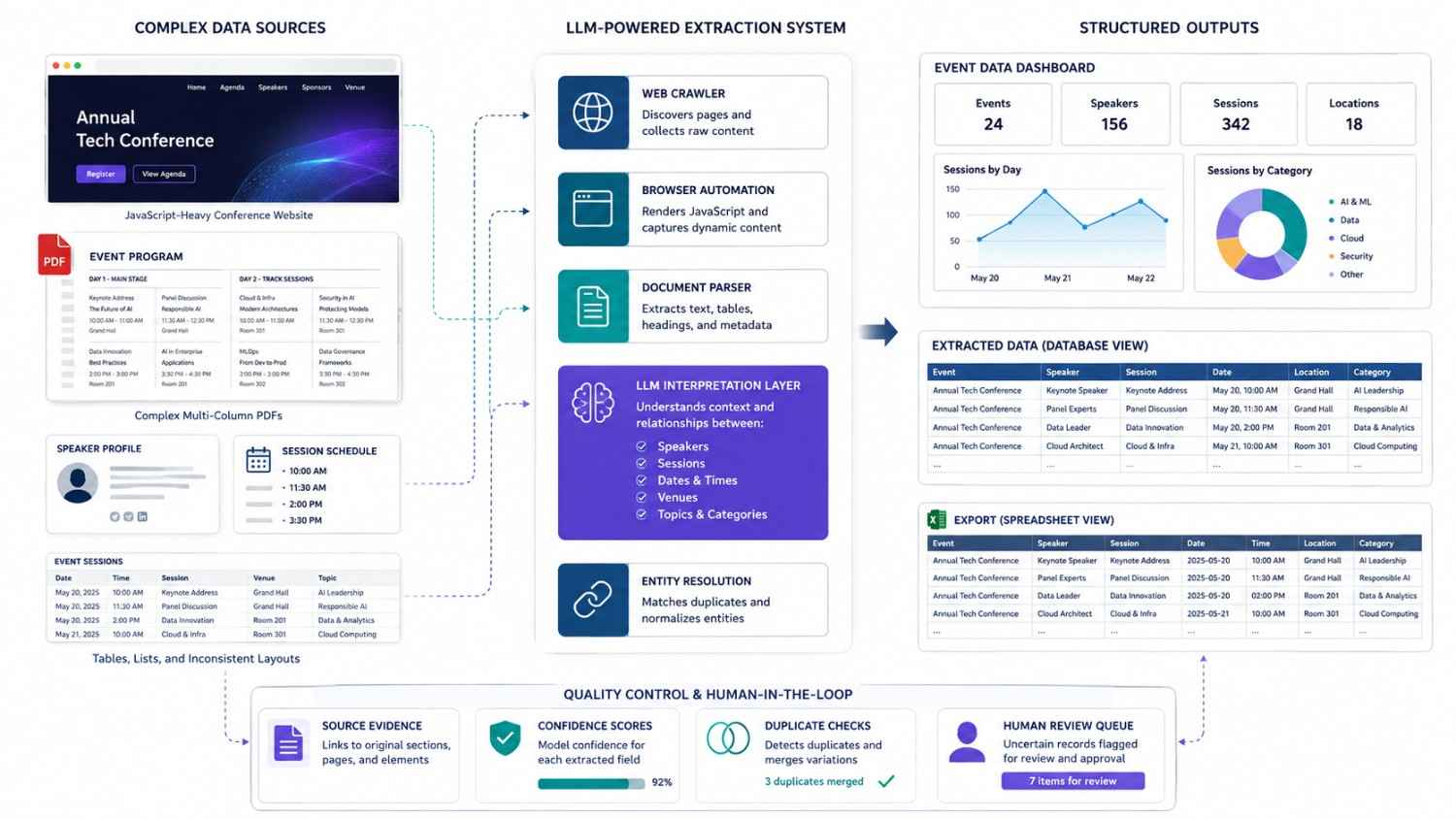
PDF extraction is where intelligent web scraping often provides clear value. Conference programs, catalogs, tenders, and reports may mix tables, columns, images, and narrative text.
A parser may recover the words but lose their relationships. An LLM can map event names, dates, speakers, sessions, and locations to a common schema.
In one Kanhasoft case study, a medical-events pipeline used conventional scraping tools for dynamic websites and Gemini GenAI for unstructured PDF interpretation. The reported results included faster document processing and less manual cleaning.
The same collection describes a Walmart rank tracker processing about 300,000 keywords daily through deterministic Python, Celery, and PostgreSQL. The lesson is simple: use LLMs for interpretation, not every high-volume task.
Normalizing and Classifying Records
Raw web data is rarely analysis-ready. Job titles, product sizes, currencies, dates, and categories vary across sources.
An LLM can map these variations to controlled values, classify products, identify review themes, or extract skills. The output should still pass through dictionaries, allowed-value checks, and confidence thresholds.
Keep source facts separate from model-generated interpretations. A price copied from a page is evidence. A category selected by a model is an inference.
Adapting to Moderate Layout Changes
LLMs can reduce maintenance when labels or layouts change, but they cannot fix missing input. Pages that require clicks, geographic sessions, JavaScript events, or API calls still need a capable collection layer.
Teams should inspect network activity and choose between HTTP requests, API extraction, browser automation, or a hybrid method. Kanhasoft’s guide to dynamic website data extraction explains this technical decision in more detail.
Where an AI Scraper Adds the Most Value
| Business scenario | Good LLM tasks | Keep deterministic |
|---|---|---|
| Ecommerce monitoring | Attribute mapping, product matching, and review themes | Prices, SKUs, stock flags, and timestamps |
| Medical or business events | Speaker, session, topic, and PDF extraction | URLs, file hashes, and crawl dates |
| Job aggregation | Skill and seniority classification | Employer, location, and posted date |
| Real estate intelligence | Amenity and property-type normalization | Listing ID, price, and coordinates |
| Tender monitoring | Requirement extraction and summaries | Source, publication date, and exact fields |
The strongest use cases share three traits: content is text-heavy, formats vary across sources, and people currently spend significant time interpreting or cleaning records.
What LLMs Do Not Solve
Access and Anti-Bot Controls
An LLM does not automatically access a protected website. Crawling still involves browsers, sessions, rate limits, and source restrictions.
The Robots Exclusion Protocol communicates crawler preferences, but it is not access authorization. Responsible collection also requires reviewing website terms, data type, privacy, intellectual property, and intended use.
Hallucinations and Silent Errors
A model may return a plausible value that was not in the source. A reliable system should retain the source excerpt, URL, retrieval time, model version, and validation result.
High-risk or low-confidence records need human review. This is especially important for prices, dates, medical information, financial data, legal terms, and compliance-related records.
Cost, Latency, and Privacy
Sending full pages to a large model is wasteful. Remove boilerplate, route only difficult records to the LLM, cache repeated work, and use smaller models when suitable.
Public visibility does not remove privacy obligations. Minimize personal data, define retention periods, restrict access, and obtain qualified legal or privacy advice for sensitive projects.
A Reliable AI Web Scraping Architecture
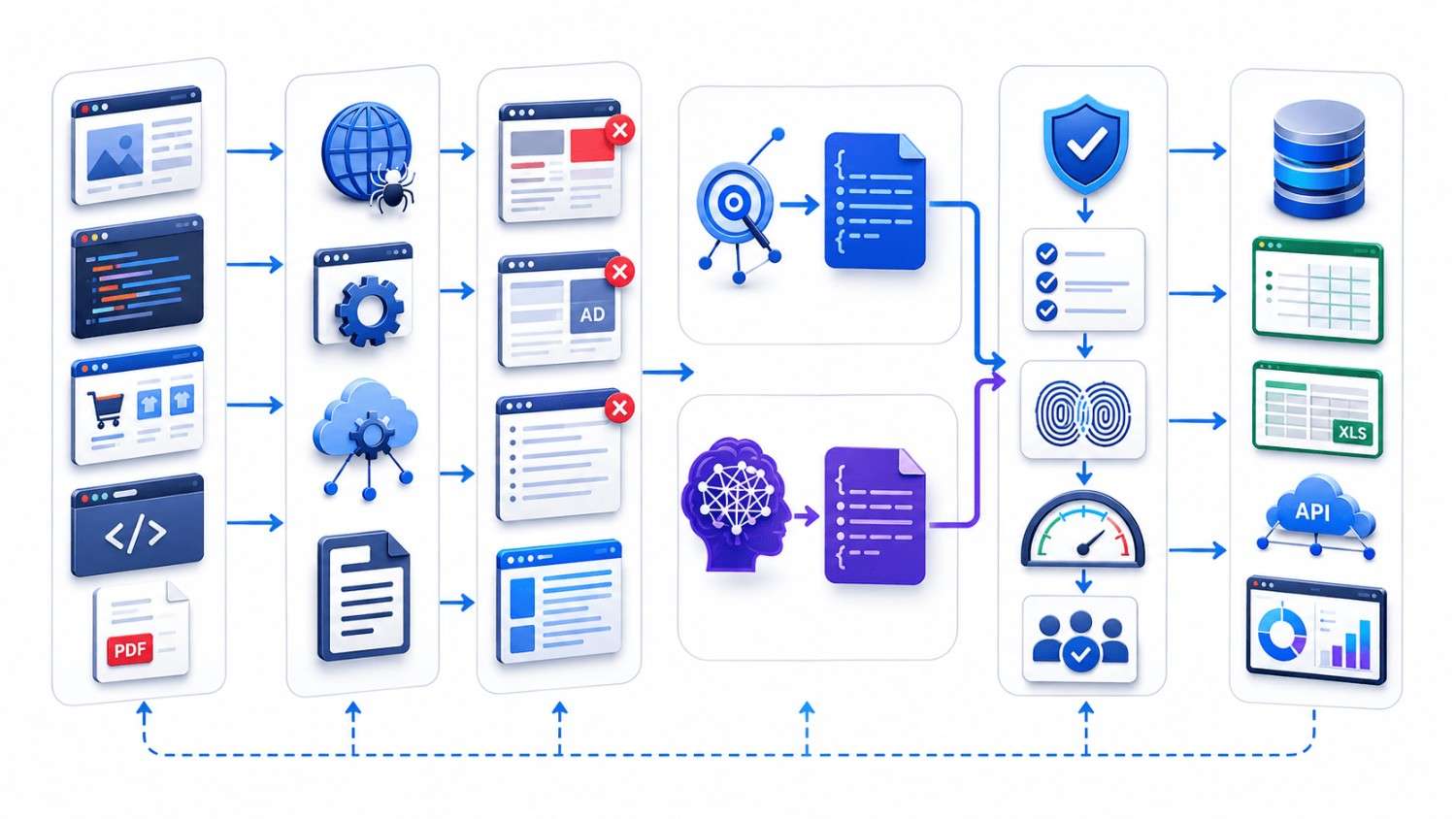
A practical production pipeline follows six steps.
1. Define the Decision and Schema
Specify the business outcome before collecting data. The goal may be repricing, supplier discovery, lead qualification, competitor research, or market analysis.
Then define fields, data types, required values, controlled categories, and examples. Without a clear schema, even a capable model will produce inconsistent records.
2. Choose the Source Method
Prefer an authorized API, licensed feed, or export when it meets the requirement. Scraping may be appropriate when required, permitted information is unavailable through a suitable interface.
Review the differences between web scraping and APIs before defaulting to direct scraping.
3. Separate Collection from Interpretation
Use Scrapy, requests, Playwright, Selenium, or APIs to fetch the data. Send only relevant content to the LLM.
This separation makes the pipeline easier to debug. It also prevents the model from processing menus, advertisements, scripts, and unrelated page content.
4. Require Structured Output
Use a strict JSON schema with defined field types, descriptions, allowed values, and null-handling rules.
Structured output reduces formatting failures. However, valid JSON does not prove that a price, date, category, or name was extracted correctly.
5. Validate and Route
Check required fields, ranges, duplicates, controlled values, cross-field logic, and source evidence.
Clear records can move forward automatically. Recoverable failures can be retried. Ambiguous or high-impact records should enter a review queue.
6. Monitor Quality and Cost
Track more than crawl success.
A production dashboard should monitor:
- Missing-field rates
- Semantic extraction errors
- Source layout changes
- Duplicate records
- Model and infrastructure spending
- Records requiring manual review
- Processing time by source
- Validation failure reasons
Monitoring shows whether the AI layer is reducing work or simply moving manual effort to another stage.
Decision Table: Should You Use LLM Web Scraping?
| Situation | Practical recommendation |
|---|---|
| Stable HTML and a few fixed fields | Use rule-based extraction |
| Many websites with different labels | Use a hybrid pipeline |
| Long PDFs or narrative documents | Add LLM interpretation |
| Millions of simple records | Keep the main path deterministic |
| Regulated or high-impact decisions | Add strict validation and human review |
| An official API covers the requirement | Prefer the API |
The right question is not, “Can an LLM extract this?” The better question is, “Can the full system extract it repeatedly, prove where it came from, detect mistakes, and operate at an acceptable cost?”
Conclusion
AI web scraping is changing data extraction by making inconsistent and unstructured content easier to interpret. LLMs are especially useful for documents, classification, normalization, and text-heavy pages. They are less useful for stable fields that conventional parsers can collect faster and more predictably.
A trustworthy system combines crawling, deterministic rules, structured LLM outputs, source evidence, validation, monitoring, and responsible data practices.
This hybrid approach delivers the flexibility of intelligent web scraping without treating probabilistic output as unquestioned fact.
Planning an AI-Assisted Data Extraction Project?
At Kanhasoft, we treat LLMs as one component inside a wider data engineering system. Discovery starts with source access, fields, sample records, expected volume, refresh frequency, quality rules, and delivery needs.
Businesses can review Kanhasoft’s web scraping and data extraction services or begin with a limited feasibility exercise. A focused pilot can compare rule-based and LLM extraction on real sources before a larger commitment.