

Choosing a web scraping vendor is not only a technical or pricing decision. The provider may access target websites, process sensitive business information, operate cloud infrastructure, store extracted records, and send data directly into your internal systems.
A scraper that works during a sales demonstration can still create serious problems if the vendor has weak access controls, unclear data-retention practices, aggressive collection methods, or no incident-response process.
This guide provides a practical 10-point checklist for evaluating a web scraping service provider before signing a contract.
This guide provides a practical web scraping vendor checklist for security and compliance you can use before signing a contract.
Quick Answer: How Do You Choose a Secure Web Scraping Vendor?
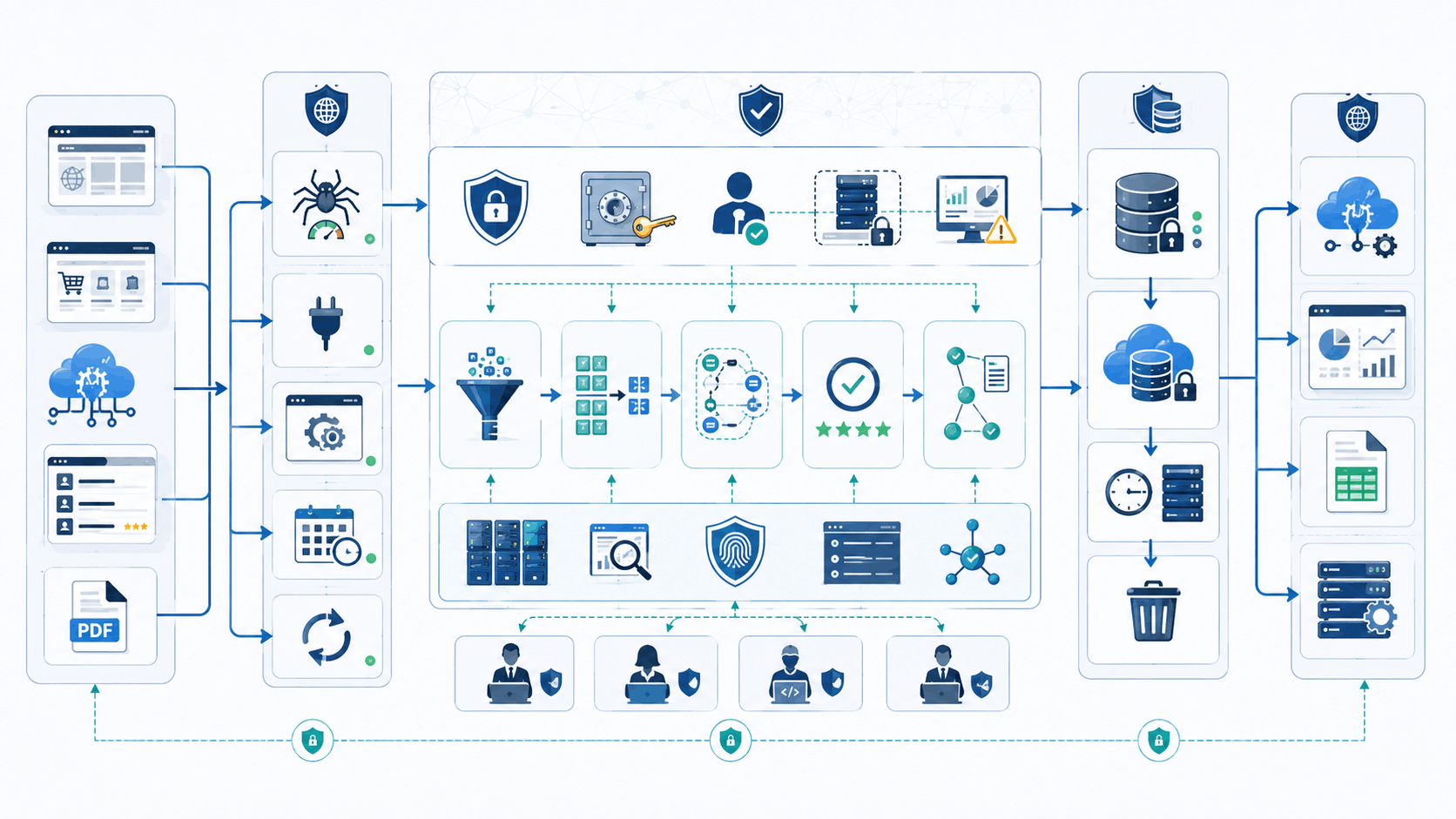
Choose a web scraping vendor that can clearly explain what it will collect, how it will access each source, where it will process and store data, who can access the system, and how incidents will be handled.
The provider should support its answers with architecture documents, security policies, contracts, logs, sample outputs, and a limited pilot; not just reassuring statements.
In short: A web scraping vendor checklist for security and compliance means verifying legal review, data handling, access controls, and contract terms with evidence not vendor assurances alone.
This Article Is Especially Useful For
- CTOs and CIOs evaluating third-party data collection
- Procurement and vendor-risk teams
- Ecommerce companies monitoring products, prices, and stock
- Market research and competitive-intelligence teams
- SaaS companies building data-driven platforms
- Healthcare, finance, insurance, and legal businesses handling regulated information
- Product managers comparing data extraction services
What Is a Web Scraping Vendor?
A web scraping vendor is a company that designs, operates, or maintains automated systems for collecting information from websites, portals, APIs, online documents, marketplaces, or public databases.
The provider may deliver the collected information through Excel, CSV, JSON, an API, a dashboard, cloud storage, or direct database integration.
A vendor may offer anything from a one-time dataset to a fully managed data pipeline with scheduling, monitoring, validation, and maintenance.
Web Scraping Vendor 10 Checklist for Security and Compliance
Use the following checklist during vendor discovery and procurement.
|
Evaluation area |
What a strong vendor should provide |
Common warning sign |
|---|---|---|
|
1. Legal and source review |
Source-by-source access assessment |
“All public data is legal to scrape” |
|
2. Privacy controls |
Purpose, lawful basis, minimization, and retention plan |
Collecting personal data “just in case” |
|
3. Access management |
Role-based access, MFA, and controlled credentials |
Shared passwords or credentials in code |
|
4. Data protection |
Encryption, isolation, backups, and secure transfers |
Unencrypted files sent through email |
|
5. Infrastructure transparency |
Hosting locations, sub processors, and data flows |
Refusal to identify where data is processed |
|
6. Responsible collection |
Rate limits, source-aware scheduling, approved access paths |
Promising to defeat every protection |
|
7. Monitoring and response |
Logs, alerts, escalation, and incident procedures |
Failures discovered only by the client |
|
8. Retention and deletion |
Written retention periods and deletion confirmation |
Keeping raw data indefinitely |
|
9. Quality and provenance |
Validation, timestamps, source references, and audit history |
No way to trace a record to its source |
|
10. Contract and exit terms |
Ownership, confidentiality, liability, and handover terms |
Vendor owns the code or data by default |
A polished proposal is helpful. However, evidence behind the proposal matters more.

1. Require a Source-by-Source Legal and Compliance Review
No responsible provider should describe web scraping as universally legal or illegal.
The risk depends on factors such as:
- Whether the information is publicly accessible
- Whether authentication is required
- The website’s contractual terms
- The type of information being collected
- Applicable privacy and intellectual-property rules
- The collection method
- The intended business use
- The countries involved
Ask the vendor to create a source register that lists each website, access method, requested fields, frequency, known restrictions, and proposed alternative access paths.
For example, an official API, licensed feed, export function, or partner program may be safer and more stable than direct scraping. A hybrid model can use an API for authorized structured records and scraping only for permitted information that the API does not supply. Our guide to web scraping vs. APIs explains this decision in more detail.
Robots.txt should also be reviewed, but it is not a substitute for legal analysis. RFC 9309 defines robots.txt as a protocol for communicating crawler preferences and states that these rules are not access authorization.
Red flag: The provider guarantees that every source can be scraped legally without reviewing the source, jurisdiction, or use case.
2. Check How the Vendor Handles Personal Data
Public visibility does not automatically remove privacy obligations.
A profile, email address, professional history, property record, review, social post, or directory listing may still contain personal data. If the project involves people, the vendor should help identify what information is truly required.
Under GDPR principles, organizations must have a specific purpose, collect only necessary personal data, keep it no longer than needed, and apply appropriate security safeguards.
Ask the web scraping service provider:
- Does the dataset contain personal or sensitive information?
- What is the lawful basis for processing it?
- Can unnecessary fields be excluded?
- How will deletion or correction requests be handled?
- Will data cross national borders?
- Who acts as the controller and processor?
- Is a data processing agreement required?
For higher-risk projects, involve qualified privacy counsel or a data protection officer before collection begins.
3. Review Identity, Credential, and Access Controls
The vendor should follow the principle of least privilege. Each developer, operator, and support person should have only the access required for their role.
Look for:
- Multi-factor authentication
- Role-based access control
- Named user accounts
- Time-limited production access
- Secrets stored in a secure vault
- Regular access reviews
- Immediate offboarding procedures
- Audit logs for privileged activity
Credentials should never sit inside source code, spreadsheets, task comments, or unprotected configuration files.
Also clarify whether the scraper will connect to your database, cloud storage, CRM, ERP, or analytics platform. Direct integration can improve automation, but it also increases the vendor’s access to your environment.
4. Verify Encryption and Data Isolation
A strong vendor should protect information while it moves and while it is stored.
Ask whether the architecture includes:
- TLS for data in transit
- Encryption for databases, backups, and object storage
- Separate environments for development, testing, and production
- Logical or physical separation between clients
- Restricted access to raw HTML, PDFs, screenshots, and logs
- Secure file-delivery methods
- Backup encryption and recovery testing
When several customers share the same platform, determine how tenant data is separated. A multi-tenant system without reliable isolation can expose one customer’s data to another.
5. Map Hosting, Sub processors, and Data Residency
Your direct contract may be with one scraping company, while several other providers process the data.
These may include:
- Cloud hosting platforms
- Proxy networks
- CAPTCHA or browser infrastructure
- OCR and document-processing tools
- AI model providers
- Monitoring platforms
- Database and backup services
- Freelancers or subcontractors
Request a data-flow diagram showing where information enters, moves, and remains stored.
If your organization has geographic restrictions, confirm the location of primary storage, backups, logs, and third-party processing. Also require advance notice when material sub processors change.
6. Evaluate the Vendor’s Collection Practices
A good vendor does not treat maximum request volume as the goal. The goal is dependable data collection with reasonable load, approved access, and controlled risk.
Look for:
- Per-domain rate limits
- Request scheduling
- Retry limits and back off
- API-first evaluation
- Caching of stable data
- Selective browser automation
- Change detection
- Circuit breakers for failing sources
- Clear rules for authenticated content
- Escalation when a source introduces new restrictions
Ask the vendor to demonstrate technical capability as well as compliant behavior: how the system handles JavaScript-heavy pages, its typical concurrency and throughput at your expected volume, and how its pricing model behaves as volume scales — per-record and per-request pricing can look identical at a small sample and diverge sharply at production scale.
A provider that promises to defeat any CAPTCHA, paywall, authentication system, or anti-bot control should trigger additional review.
For difficult sources, the better question is often, “What permitted and maintainable access method can provide this data?” Our guide to PDFs, CAPTCHA, and anti-bot systems explains why aggressive workarounds are usually poor production strategies.
7. Demand Monitoring and an Incident-Response Process
Scraping failures are not always obvious. A website may still return a successful response while serving an empty template, consent page, challenge screen, incorrect currency, or changed field structure.
The vendor should monitor:
- Request and parsing success rates
- Missing required fields
- Sudden changes in record volume
- Duplicate rates
- Data freshness
- Source-specific errors
- Queue backlogs
- Unusual access patterns
- Delivery failures
- Privileged account activity
Ask how the provider classifies security incidents, who contacts you, what information the notice includes, and how quickly escalation begins.
NIST’s cybersecurity supply-chain guidance recommends identifying, assessing, and managing risks throughout the vendor relationship, rather than treating vendor review as a one-time procurement task.
8. Define Retention, Backup, and Secure Deletion
Many scraping systems store more than the final dataset. They may retain raw pages, PDFs, request logs, screenshots, cookies, response headers, and failed records.
Some raw retention is useful for debugging and reprocessing. Unlimited retention is not.
The contract should define:
- What data will be retained
- Why each category is retained
- The retention period
- Backup duration
- Deletion procedures
- Legal-hold exceptions
- What happens when the project ends
- Whether the vendor provides deletion confirmation
The European Commission’s GDPR guidance states that personal data should be stored for no longer than necessary for its intended purpose.
9. Test Data Quality, Traceability, and Provenance
Security protects the data. Quality determines whether the data is useful.
Ask the vendor to provide a sample containing:
- Source URL or source identifier
- Collection timestamp
- Field definitions
- Currency and unit normalization
- Missing-value handling
- Confidence or validation status
- Duplicate-control logic
- Change history
- Error classifications
The system should distinguish a genuine business event from a technical failure. For example, “out of stock,” “page unavailable,” “parser failed,” and “access denied” should not become the same status.
In one multi-source medical-congress project, data came from dynamic websites and inconsistent PDF documents. The practical challenge was not merely extraction. The pipeline also needed structured validation, consistent output, and clear handling of difficult source formats.
The same principle appears in large ecommerce monitoring. Tracking thousands of products requires system-health monitoring and data validation; not only page requests. See the lessons from tracking 50,000 SKUs daily and scaling web scraping to millions of pages.
10. Put Ownership, Liability, and Exit Terms in Writing
The final checklist point is contractual because technical controls alone do not resolve commercial disputes.
Your agreement should address:
- Ownership of collected data
- Ownership of source code and configurations
- Confidentiality obligations
- Approved sub processors
- Security responsibilities
- Service levels
- Incident notification
- Data-retention limits
- Intellectual-property claims
- Regulatory cooperation
- Termination rights
- Code and documentation handover
- Deletion after termination
Confirm whether you will receive the scraper, deployment scripts, schema, credentials, runbooks, and historical data if the relationship ends.
This is also where vendor lock-in risk should be assessed — can you leave with your code, data, and documentation intact, or does the value stay trapped inside the vendor’s platform?
The safest exit plan is the one negotiated before anybody wants to exit.
How to Score a Web Scraping Service Provider
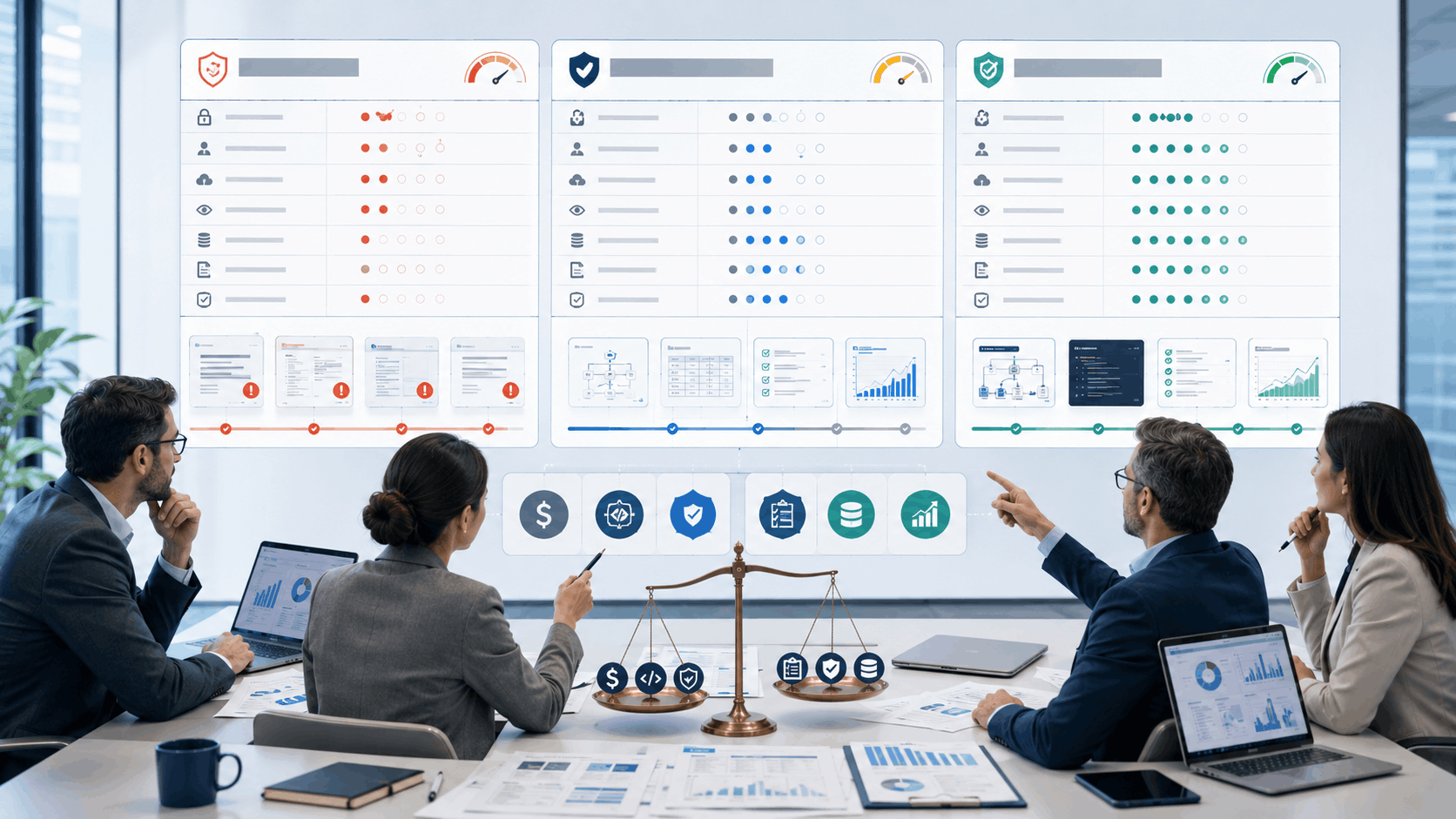
Use a simple evidence-based scoring method:
- 0 points: No clear answer or documentation
- 1 point: Partial answer or informal process
- 2 points: Clear process supported by evidence
With ten checklist areas, the maximum score is 20.
|
Total score |
Practical interpretation |
|---|---|
|
17–20 |
Strong candidate, subject to legal and technical review |
|
13–16 |
Potentially suitable, but contract specific improvements |
| 0–12 |
High vendor risk or insufficient evidence |
This score is a procurement aid, not a security certification. The importance of each item should reflect your data sensitivity, industry, jurisdictions, and internal risk tolerance.
Planning a Secure Data Extraction Project?
Kanhasoft provides custom web scraping and data extraction services for websites, marketplaces, APIs, and document-heavy sources.
A practical engagement can begin with a limited feasibility and risk review. This can document the required fields, approved sources, access methods, expected volume, privacy considerations, data-quality rules, delivery format, and maintenance needs before full development begins.
Businesses evaluating several providers can also use this checklist during a technical discovery call to compare proposals on the same criteria. For project-specific questions, you can discuss your data requirements with Kanhasoft.
Final Words
The best way to choose a web scraping vendor is to evaluate more than extraction speed, sample accuracy, and price.
A trustworthy provider should explain its legal review process, privacy controls, access management, infrastructure, collection behavior, monitoring, retention, quality controls, and contractual responsibilities. It should also be willing to prove those practices through documentation and a controlled pilot.
The cheapest scraping company can become expensive when weak controls lead to unreliable data, emergency redevelopment, contractual disputes, or compliance issues. A careful vendor review reduces those risks before the data pipeline becomes operational infrastructure.