
A scraper can finish without errors and still deliver bad data. It may collect yesterday’s price, miss product variants, misread a discount, or return duplicate listings.
Web scraping data quality therefore depends on more than extraction success. It requires clear controls for accuracy, completeness, freshness, traceability, and exception handling. Gartner research, widely cited across the data industry, puts the average cost of poor data quality at roughly $12.9 million per organization per year — and scraped data inherits every one of those risks the moment it enters a business system.
The business goal is not to collect the largest possible dataset. It is to deliver data that is reliable enough for pricing, research, operations, analytics, or automated decisions.
Key Takeaways
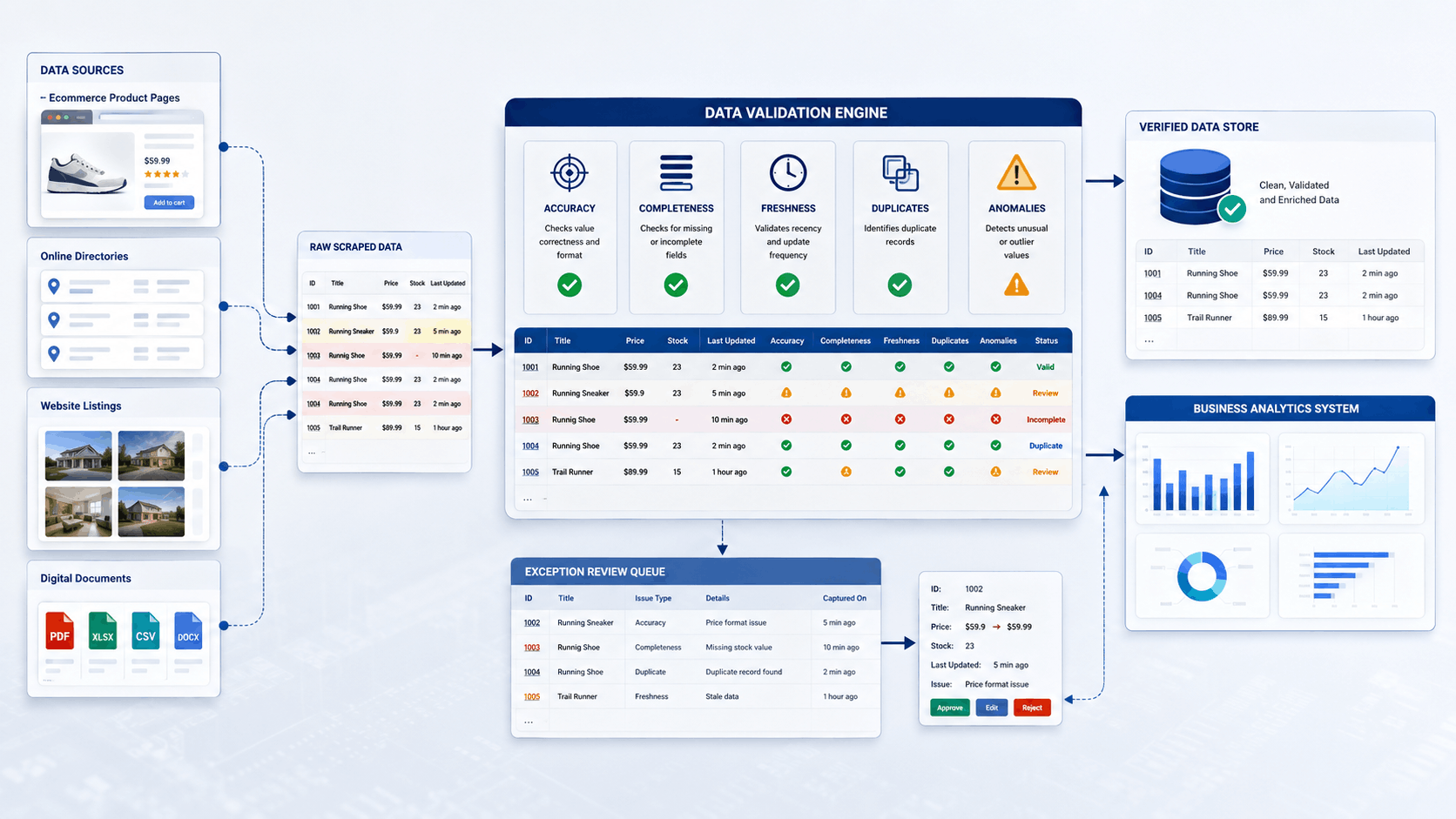
- Web scraping data quality has six dimensions: accuracy, completeness, freshness, consistency, uniqueness, and traceability.
- A scraper finishing without errors proves nothing about whether the data is correct — validate the pipeline, not just the output file.
- A written data contract, defined before scraping starts, is the single highest-leverage fix for most quality problems.
- Automated rules (schema, ranges, duplicates) and human review (edge cases, business logic) are complementary, not substitutes for each other.
- Track a small set of metrics — accuracy rate, completeness, freshness compliance, anomaly rate — rather than inspecting raw logs.
Quick Answer: How Do You Validate Web Scraping Data Quality?
Validate web scraping data quality by defining expected fields, source coverage, and update frequency before collection begins. Then test required values, formats, ranges, duplicates, record counts, timestamps, and unusual changes.
Compare representative samples with the original source. Retain source URLs and extraction times. Most importantly, route suspicious or incomplete records for review instead of silently publishing them.
This article is especially useful for ecommerce teams, data-product companies, market researchers, operations leaders, product managers, and CTOs responsible for recurring web data.
What Does Web Scraping Data Quality Mean?
Web scraping data quality describes whether collected data is fit for its intended business use.
“Fit for use” matters because the same dataset may be acceptable for broad trend analysis but unsuitable for automated repricing, inventory planning, financial reporting, or compliance-related decisions.
Three dimensions deserve particular attention:
| Dimension | Practical meaning |
Typical failure |
|---|---|---|
|
Accuracy |
The extracted value matches the source and is interpreted correctly |
A sale price is stored as the regular price |
|
Completeness |
Required records and fields are present |
Pagination or product variants are missed |
|
Freshness |
Data arrives within the acceptable time window |
Stock information is two days old during a sale |
|
Consistency |
Values follow the same formats and definitions |
“Out of stock,” “OOS,” and blank mean the same thing |
|
Uniqueness |
Duplicate business records are controlled |
The same listing appears several times |
|
Traceability |
Each record can be traced to its source |
A questionable value has no source URL or timestamp |
Accuracy, completeness, and freshness usually determine whether scraped data can support a real business action. The other dimensions help teams maintain and investigate the dataset over time.
Why “The Scraper Ran” Is Not a Quality Check
A successful HTTP response proves only that the scraper received something. It does not prove that it loaded the correct page, captured all dynamic content, interpreted the right field, or covered the full source.
Errors usually enter the pipeline at four points:
- Source access: Redirects, localization, cookie banners, blocked requests, or alternate page versions.
- Extraction: Broken selectors, incomplete JavaScript rendering, or missed pagination.
- Transformation: Incorrect price, date, unit, category, or name normalization.
- Delivery: Duplicate records, delayed files, overwritten data, or incorrect destination mapping.
For that reason, scraped data validation should cover the entire pipeline rather than only checking the final CSV, JSON file, or database table.
Web Scraping Data Quality Checklist: A 7-Step Validation Framework
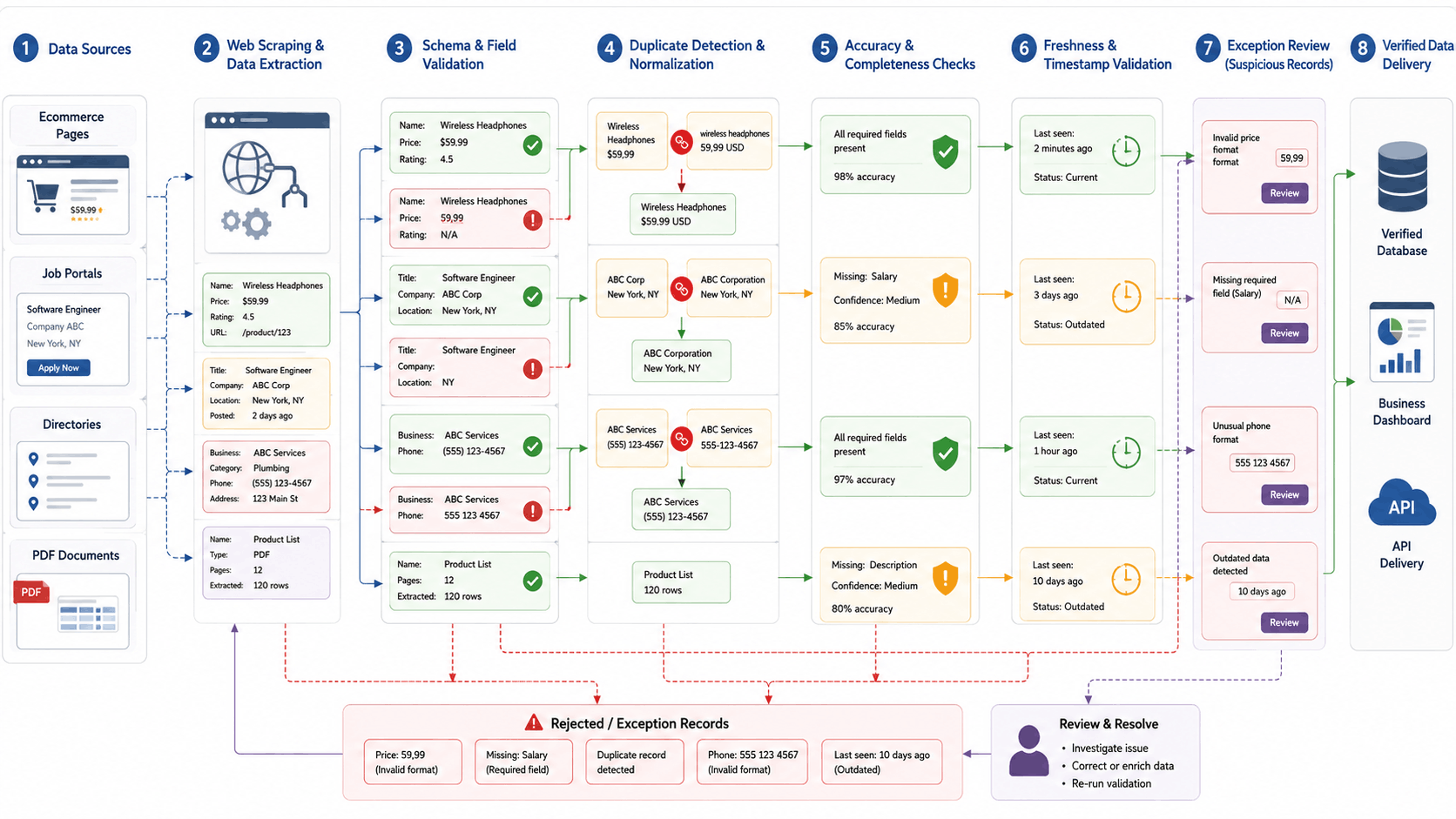
1. Define a Data Contract Before Scraping
A data contract documents what a valid record must contain.
For each field, specify:
- Business meaning
- Required or optional status
- Data type
- Accepted values
- Source location
- Transformation rule
- Update frequency
- Missing-value behavior
- Unique identifier
For example, an ecommerce price record may require a product ID, product name, seller, currency, current price, availability, location, source URL, and extraction timestamp.
Without this agreement, developers can deliver technically valid data that does not match the actual business requirement.
2. Preserve Source-Level Traceability
Store the source URL, extraction timestamp, scraper version, and run ID with each record.
For higher-risk datasets, consider retaining a response hash, raw page snapshot, screenshot, or relevant HTML fragment. These records do not always need to remain forever, but they should be available long enough to investigate errors and disputes.
Traceability helps teams identify whether a problem came from the original source, extraction logic, normalization process, or delivery system.
3. Apply Schema and Field-Level Rules
Schema checks confirm that records have the expected structure. Field-level rules confirm that individual values are plausible.
|
Validation rule |
Example |
|---|---|
|
Required field |
Product ID and source URL cannot be blank |
|
Data type |
Price must parse as a decimal |
|
Accepted value |
Stock status must use approved labels |
|
Range |
Rating must be between 0 and 5 |
|
Pattern |
Currency must use an approved code |
|
Uniqueness |
One record per product, seller, location, and timestamp |
|
Relationship |
Every offer must reference an existing product |
Data-quality platforms can make these checks reusable. Great Expectations describes an “Expectation” as a verifiable assertion about data. AWS Glue Data Quality similarly supports rulesets for evaluating defined quality conditions. However, the tool cannot decide the business definition of “correct” on its own.
4. Measure Completeness Beyond Blank Cells
Completeness is not simply the percentage of non-empty fields.
A dataset can have every field populated while still omitting half the expected products, locations, sellers, documents, or pages.
Measure completeness through:
- Required-field completion
- Expected page coverage
- Category and location coverage
- Pagination completion
- Seller and product-variant coverage
- Record-count variance from previous runs
- Source success rate
Suppose a marketplace normally produces 12,000 offers, but the latest run returns 3,100. Every returned row may look valid, yet the dataset is clearly incomplete.
A volume-drop alert should quarantine the delivery until the cause is understood.
5. Test Web Scraping Accuracy Against Evidence
Web scraping accuracy should be measured against evidence rather than developer confidence.
Useful methods include:
- Manual source-to-output sampling
- Approved golden datasets
- API or data-feed comparisons where available
- Reconciliation with previous runs
- Independent parser comparisons for critical fields
- Business rules, such as sale price not exceeding list price without an explanation
Sampling should include difficult cases, not only clean product pages. Test discounts, out-of-stock products, multiple sellers, localized pages, missing fields, PDFs, and JavaScript-rendered content.
A practical metric is:
Accuracy rate = Verified correct sampled values ÷ Total sampled values × 100
Always explain the sample size, fields tested, sampling method, and validation date. A percentage without this context can create false confidence.
6. Define Freshness as a Business SLA
Freshness is the maximum acceptable age of data for a specific business use.
A hotel pricing feed may need hourly checks. An ecommerce catalog may need daily updates. A supplier directory may remain useful with weekly or monthly verification.
Useful freshness timestamps include:
- Extraction start time
- Extraction completion time
- Last successful source update
- Delivery time
- Data age when consumed
Great Expectations’ freshness guidance recommends defining clear service-level expectations for how current each dataset must remain.
A daily scraper that finishes 18 hours late may be technically successful but commercially stale.
7. Detect Anomalies and Review Exceptions
Fixed rules catch known failures. Anomaly detection helps identify unexpected change.
Useful alerts include:
- Sudden record-count drops or spikes
- Higher null rates
- Unusual price movements
- Category-distribution changes
- Repeated identical values
- New or missing page templates
- Rising block or retry rates
- Longer crawl duration
- Data arriving outside its freshness window
However, not every anomaly is an error. A 40% price drop may come from broken parsing, but it may also be a genuine promotion.
Send uncertain records to an exception queue with the source evidence required for quick review.
Web Scraping Data Quality Tools and Platforms
Automated checks are only as good as the tooling behind them. Teams typically combine several categories rather than relying on one:
|
Category |
Example tools |
Best for |
|---|---|---|
|
Schema and type validation (code-level) |
Pydantic, Cerberus, JSON Schema |
Validating individual records inside a Python scraping pipeline before storage |
|
Reusable data-quality rulesets |
Great Expectations, Soda Core, AWS Glue Data Quality |
Declaring “Expectations” or rules once and running them across every pipeline run |
|
Data observability / anomaly monitoring |
Monte Carlo, Anomalo, Bigeye |
Catching unexpected drift, volume drops, or schema changes without hand-written rules |
|
Spider-level QA monitoring |
Spidermon-style frameworks |
Watching scraper health (bans, retries, item-coverage drops) as data is collected, not just after |
|
General data cleaning |
OpenRefine, Pandas |
Ad hoc profiling, deduplication, and normalization during setup or investigation |
No tool decides what “correct” means for a specific business. Tools enforce the data contract; people still have to define it and review the exceptions the tools cannot resolve.
Core Web Scraping Data Quality Metrics
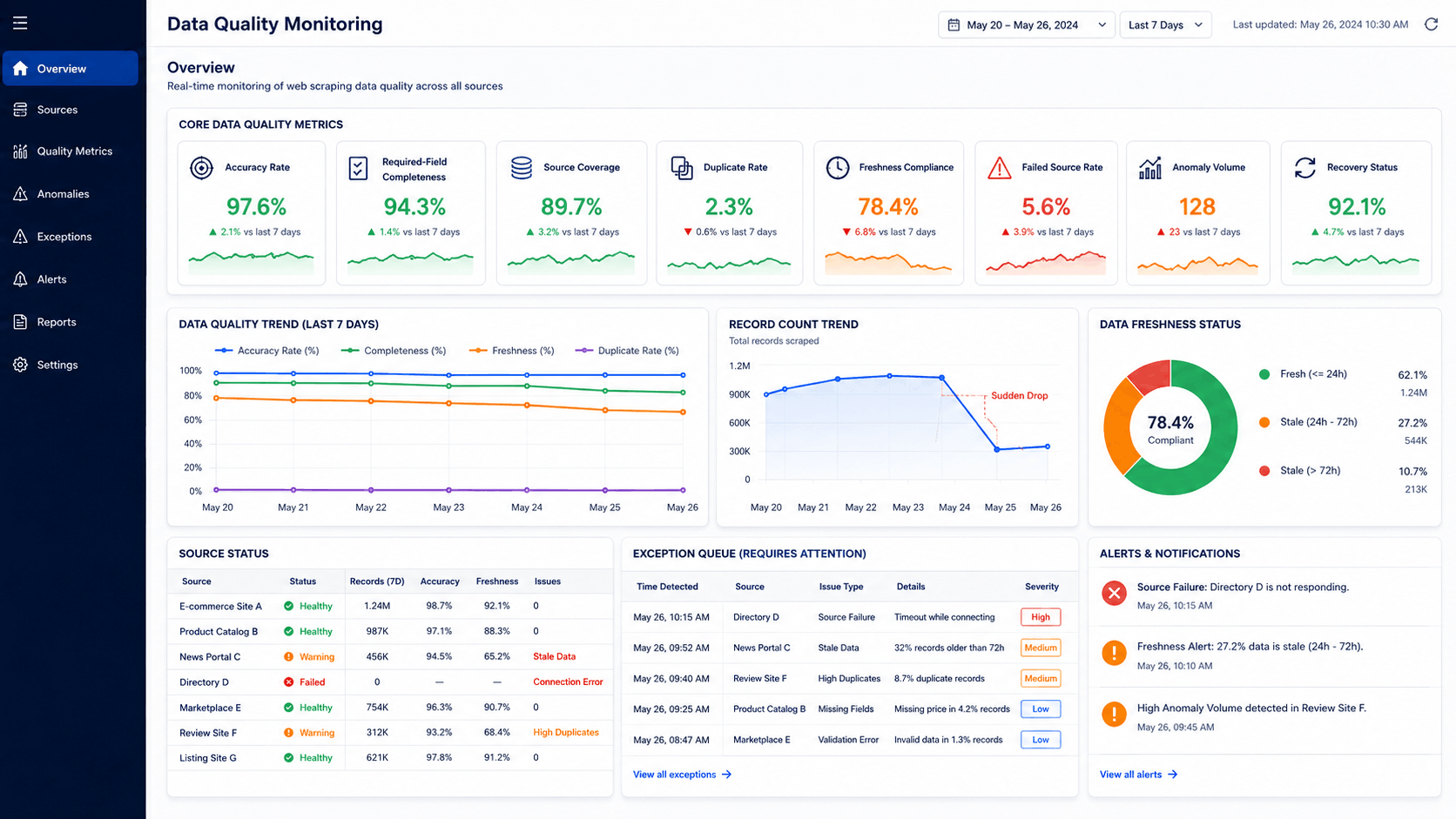
Decision-makers do not need to inspect every technical log. They need a concise quality dashboard.
|
Metric |
What it shows |
|---|---|
|
Accuracy rate |
Correct values in a verified sample |
|
Required-field completeness |
Mandatory values successfully populated |
|
Source coverage |
Expected websites, documents, or pages processed |
|
Duplicate rate |
Repeated business keys |
|
Freshness compliance |
Records delivered within the agreed SLA |
|
Anomaly rate |
Records requiring investigation |
|
Failed-source rate |
Sources that could not be processed |
|
Recovery time |
Time needed to detect and correct a failure |
Avoid copying generic quality targets from another organization.
A missing restaurant description and an incorrect pharmaceutical-event date do not carry the same business impact. Thresholds should reflect the risk of the decision being supported.
Practical Validation Checks by Use Case
|
Business use case |
Priority quality checks |
|---|---|
|
Competitor price monitoring |
Product matching, seller, currency, price type, stock status, timestamp |
|
Job aggregation |
Duplicate jobs, expiry status, location, source URL, posting date |
|
Medical event intelligence |
Dates, speaker-session relationships, PDF coverage, source evidence |
|
Real estate listings |
Property identity, listing status, price, location, last-seen time |
|
Review analysis |
Review identity, rating scale, language, date, duplicate detection |
|
AI training datasets |
Source traceability, duplication, labeling consistency, permissions, coverage |
In one Kanhasoft Walmart rank-tracking project, the pipeline processed about 300,000 keywords daily, covered up to five result pages per keyword, and distinguished organic from sponsored rankings.
The practical lesson is that volume alone was not the outcome. Stable identifiers, consistent ranking logic, repeatable scheduling, and historical records were necessary to make the dataset useful.
Businesses planning similar high-volume systems should consider quality controls alongside queues, retries, browser workers, storage, and infrastructure. Kanhasoft’s guide to scaling web scraping to millions of pages explains these wider architectural considerations.
Automated Validation vs. Human Review
|
Method |
Best use |
Main limitation |
|---|---|---|
|
Automated rules |
Formats, nulls, ranges, duplicates, counts, and timestamps |
Cannot resolve every ambiguity |
|
Manual sampling |
Source interpretation and edge cases |
Expensive at high volume |
|
Cross-source checks |
High-value fields available from multiple sources |
Sources may disagree |
|
Hybrid exception review |
Recurring pipelines with manageable anomalies |
Requires clear review ownership |
Most production systems benefit from a hybrid model.
Automate predictable tests and reserve human attention for exceptions, new templates, ambiguous product matches, unstructured documents, and high-impact changes.
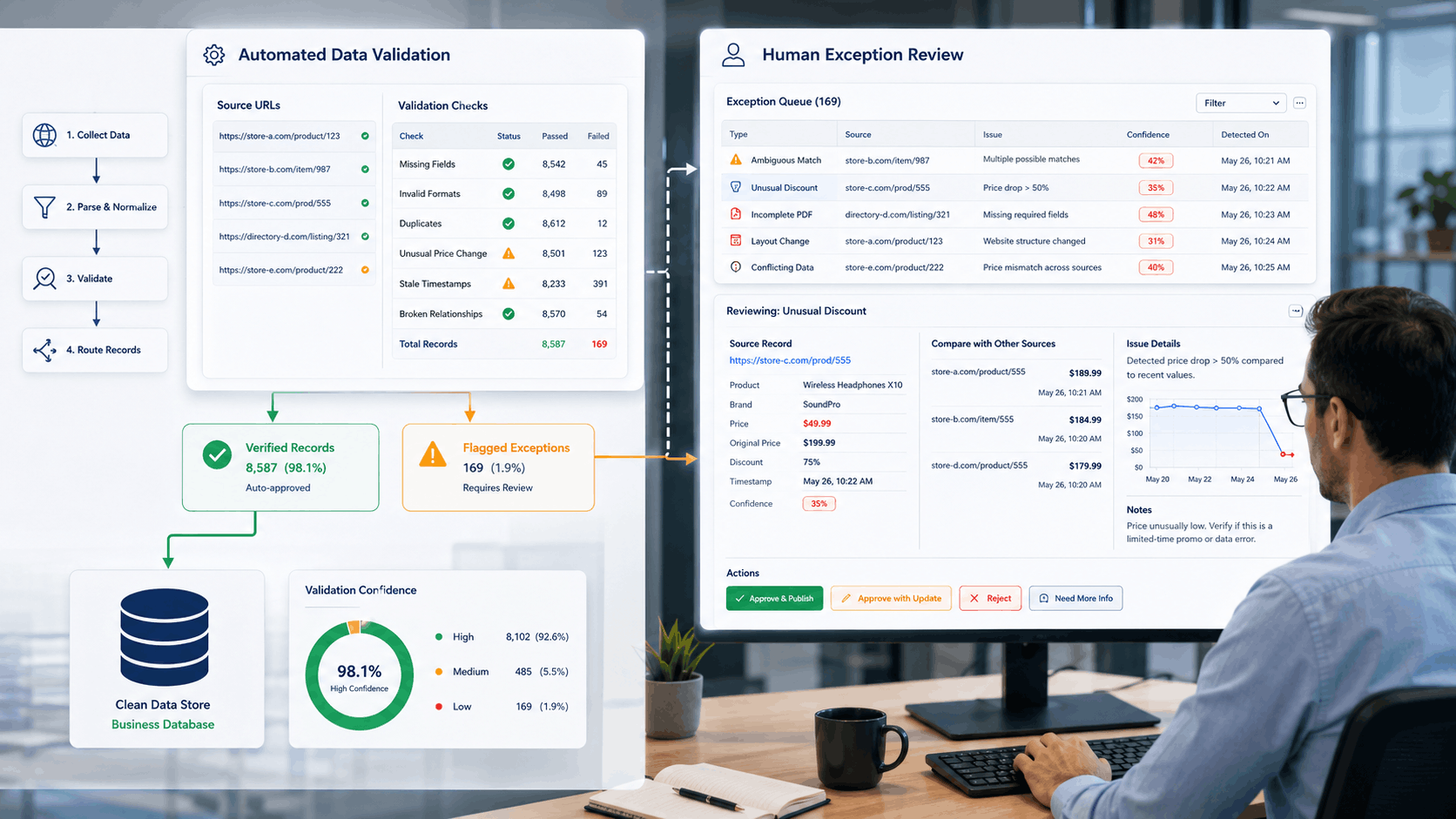
This approach is also more practical than relying completely on manual collection. A comparison of web scraping and manual data collection shows why automation works best when it includes monitoring, validation, and exception handling.
Common Web Scraping Data Quality Mistakes
Several mistakes appear repeatedly in real projects:
- Measuring only row count
- Treating every blank field as an extraction failure
- Updating selectors without regression testing
- Overwriting the last good dataset with a failed run
- Removing duplicates without understanding their cause
- Mixing currencies, units, locations, or time zones
- Publishing partial runs without a visible quality status
- Promising 100% accuracy without a defined testing method
- Using AI extraction without confidence thresholds or review paths
AI can help interpret unstructured pages, tables, and PDFs. However, high-impact fields still need deterministic checks, source evidence, and an escalation process.
A reliable pipeline should fail visibly. Silent corruption is more dangerous than a delayed file because users may act on incorrect information without realizing there is a problem.
What to Ask a Web Scraping Provider About Quality
Ask potential providers the following questions:
- How will accuracy, completeness, and freshness be defined?
- Which fields are considered business-critical?
- How will pagination and source coverage be measured?
- Will every record include source and extraction metadata?
- What samples will be used for acceptance testing?
- How will website and document-layout changes be detected?
- Are failed runs quarantined or automatically published?
- Who reviews exceptions, and how quickly?
- How are corrections versioned and re-delivered?
- Which quality metrics will appear in reports or dashboards?
A limited pilot should include difficult sources and edge cases, not only the easiest pages.
Businesses conducting broader vendor due diligence can also use this web scraping vendor security and compliance checklist.
Conclusion
Reliable web scraping data quality comes from measurable controls, not a one-time visual check.
Define the data contract, preserve traceability, validate fields and source coverage, compare samples with original evidence, set freshness SLAs, monitor anomalies, and prevent failed runs from silently reaching users.
Start by identifying which errors would cause the greatest business harm. Then invest validation effort where the decision risk is highest.
Planning a More Reliable Data Extraction Pipeline?
Kanhasoft’s web scraping and data extraction services can help assess source complexity, required fields, refresh frequency, validation rules, exception workflows, and delivery formats.
A focused pilot can expose data-quality risks early and create measurable acceptance criteria before unnecessary infrastructure or long-term commitments are added.