
An AI knowledge base is only as useful as the information it can retrieve. If product documentation changed yesterday but your vector database was last indexed three months ago, even a powerful language model can answer confidently from outdated evidence. Web scraping for RAG solves this freshness problem by combining automated web data collection with a retrieval-augmented generation pipeline. Businesses can use custom web scraping and data extraction services to collect approved web content, clean and structure it, track changes, and continuously update the knowledge layer used by an AI assistant.
For CTOs, product leaders, support teams, SaaS companies, research platforms, and businesses building AI search tools, the real challenge is therefore not simply “How do we scrape a website for a knowledge base?” It is how to keep that knowledge accurate, current, traceable, secure, and economical after the first ingestion.
Quick Answer: How Does Web Scraping for RAG Work?
Web scraping for RAG automatically collects relevant website content and feeds approved, cleaned information into a retrieval-augmented generation system. The pipeline detects new or changed pages, extracts useful text and metadata, validates the content, creates searchable chunks and embeddings, updates the retrieval index, and lets an LLM answer questions using the latest available evidence.
The important word is pipeline. Scraping alone does not create a trustworthy RAG system.
What Is Web Scraping for RAG?
Retrieval-augmented generation, or RAG, allows a large language model to retrieve information from an external knowledge source before generating an answer. The original RAG research described combining a language model’s internal knowledge with an external, searchable knowledge store. This makes it possible to update accessible information without retraining the entire model whenever the underlying knowledge changes.
Web scraping becomes the collection layer of that system.
Instead of manually uploading a collection of URLs once, a crawler can repeatedly watch approved sources such as:
- Product documentation
- Technical manuals
- Help centers
- Supplier portals
- Public research libraries
- Industry publications
- Government information
- News or event websites
- Competitor product pages where collection and use are permitted
The RAG data pipeline then converts those pages into information the retrieval system can actually use.
A practical distinction matters here:
Scraping acquires information. RAG retrieves information. The LLM explains information.
Treating all three as one AI feature usually creates a system that is difficult to test or maintain.
Why Static RAG Knowledge Bases Become Outdated
A basic RAG project often starts like this:
- Collect some documents.
- Split them into chunks.
- Create embeddings.
- Store them in a vector database.
- Connect the index to an LLM.
- Launch the chatbot.
That works surprisingly well for a proof of concept.
Then real life arrives.
A help article changes. A product is discontinued. Pricing is updated. A policy page moves to another URL. A new release note appears. Three almost identical documents remain in the database, each describing a different version.
The language model has no magical awareness that one chunk is outdated.
That is why a production knowledge base needs a continuous ingestion and refresh process, not merely an initial data import.
Kanhasoft’s existing work on AI-enabled knowledge bases similarly emphasizes automated content ingestion, semantic indexing, feedback, and governance rather than treating the knowledge base as a static document repository.
How a Web Scraping RAG Data Pipeline Works
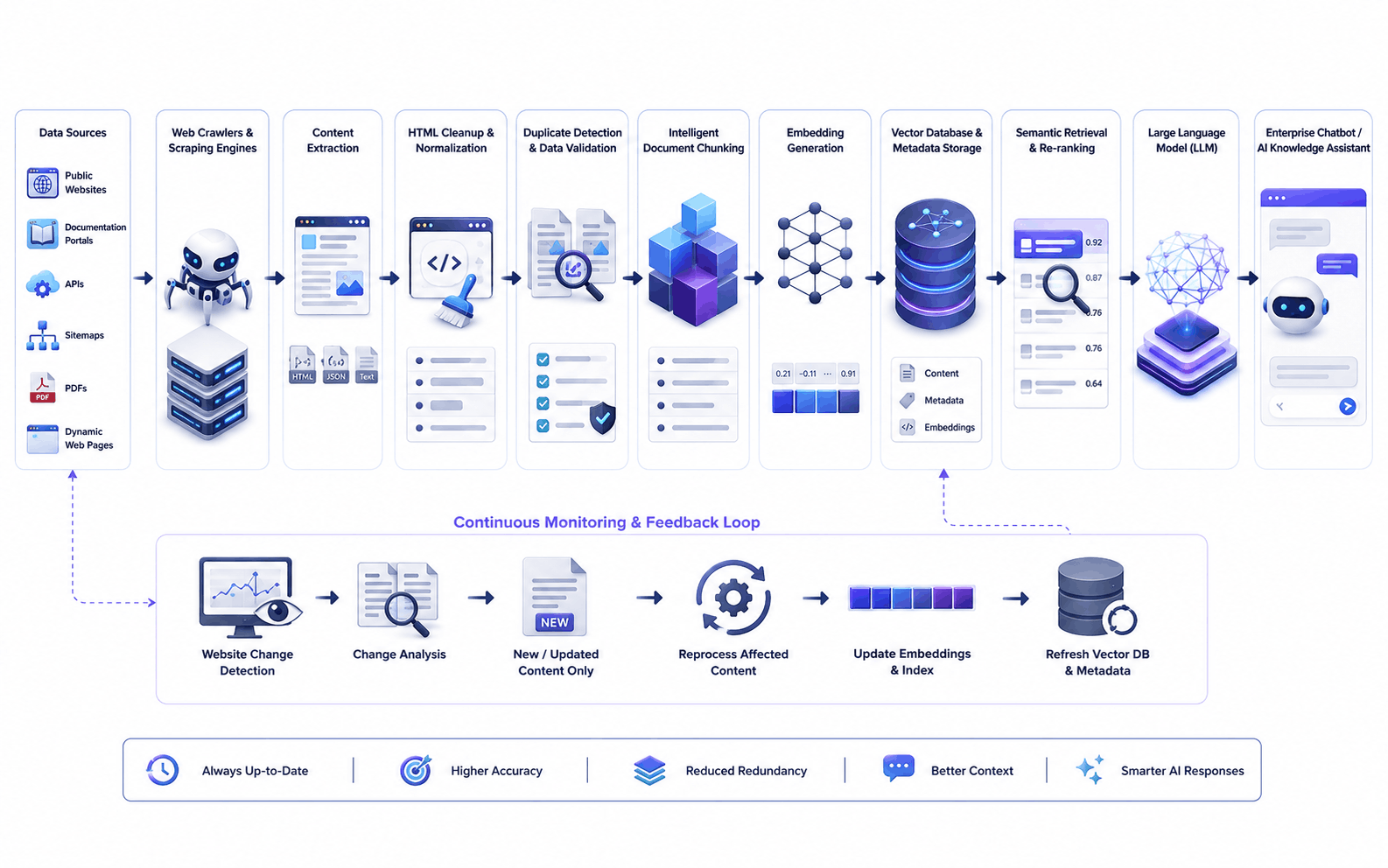
A reliable architecture separates acquisition, processing, indexing, and retrieval.
| Pipeline Stage | What Happens |
Why It Matters |
|
Source discovery |
Approved URLs, sitemaps, feeds, APIs, and documents are identified |
Prevents uncontrolled crawling |
|
Collection |
HTML, JSON, PDFs, or rendered content is retrieved |
Captures source information |
|
Extraction |
Navigation, ads, templates, and irrelevant text are removed |
Reduces noise |
|
Normalization |
Dates, titles, categories, metadata, and formatting are standardized |
Improves consistency |
|
Validation |
Required fields, content integrity, duplication, and source rules are checked |
Protects knowledge quality |
|
Chunking |
Documents are divided into meaningful retrieval units |
Improves search relevance |
|
Embedding/indexing |
Chunks are converted into searchable representations |
Enables semantic retrieval |
|
Retrieval |
Relevant passages are selected for each question |
Grounds the LLM in evidence |
|
Generation |
The LLM answers using retrieved context |
Produces a useful response |
|
Refresh |
Changed or deleted information is detected and reprocessed |
Keeps knowledge current |
This separation makes failures easier to diagnose.
If an answer is wrong, the team can determine whether the problem came from crawling, extraction, chunking, retrieval, ranking, or generation instead of simply blaming “the AI.”
Continuously Updating the Knowledge Base
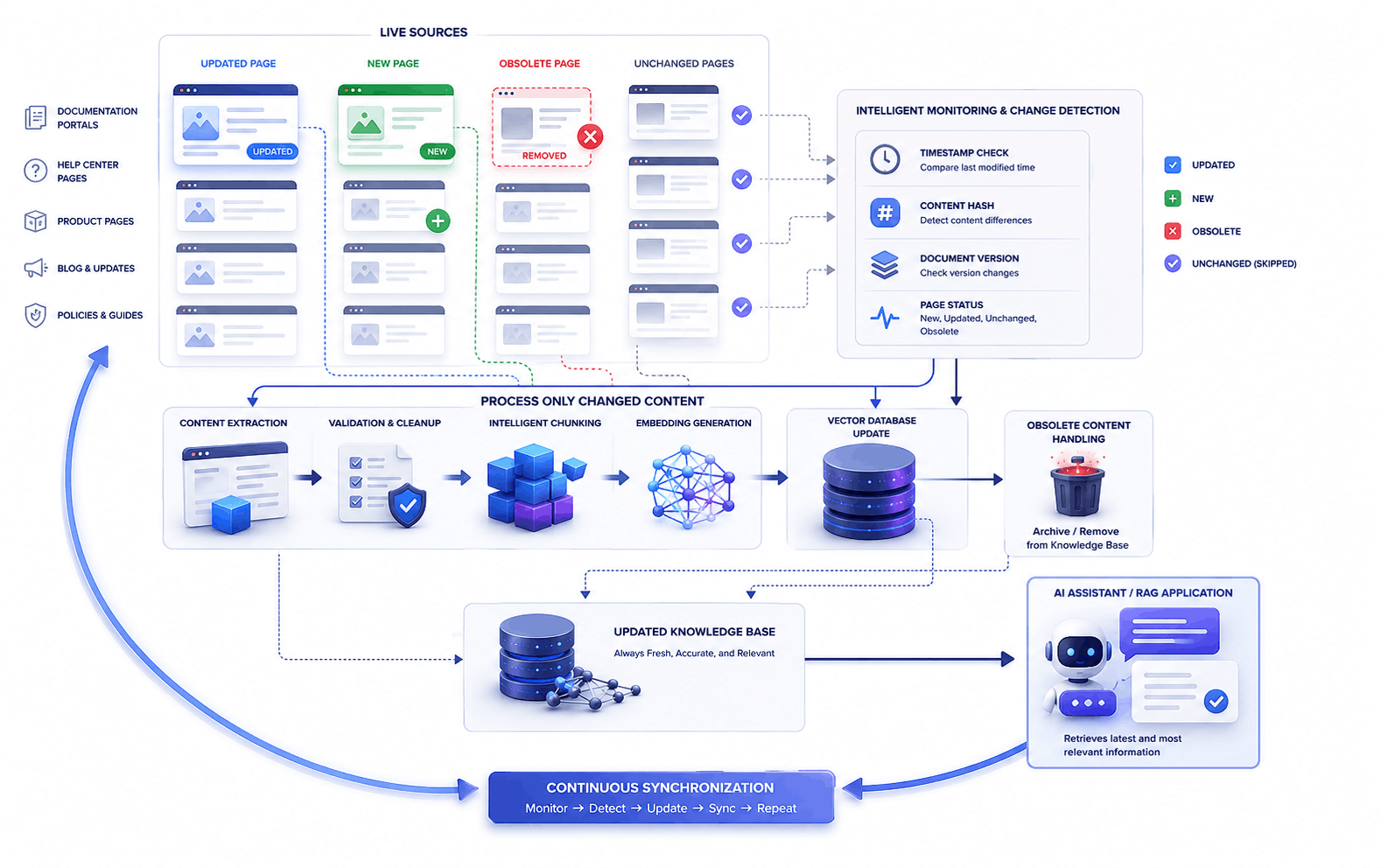
The biggest architectural difference between a demonstration and a production RAG system is how updates are handled.
1. Assign Refresh Frequency by Source
Not every website needs to be crawled every hour.
A sensible schedule might refresh:
- Breaking or rapidly changing sources every few minutes or hours
- Product inventories several times per day
- News and industry information daily
- Documentation when changes are detected
- Stable reference material weekly or monthly
Higher frequency creates more infrastructure cost and source load. Therefore, refresh intervals should match the business value of freshness.
2. Detect Changes Before Reprocessing Everything
A mature system should avoid re-embedding thousands of unchanged pages.
Instead, compare signals such as:
- Last-modified timestamps
- Content hashes
- Document checksums
- Page text differences
- Sitemap updates
- API update timestamps
- Version identifiers
If nothing meaningful changed, the existing knowledge record can remain untouched.
This incremental indexing approach reduces processing cost while keeping frequently changing information current.
3. Handle Deleted Information
Deletion is easy to overlook.
Suppose a supplier removes an obsolete technical instruction. If the RAG system keeps the old embedding forever, users may continue receiving an answer based on information the source no longer publishes.
Each indexed record should retain a stable source identifier. The pipeline can then expire, archive, or remove corresponding chunks when the original information disappears.
Scraping vs. APIs vs. Manual Uploads for RAG
Web scraping is not automatically the best ingestion method.
| Data Source | Best When | Advantages |
Limitations |
|
Official API |
Structured access exists | Reliable schema, clear integration |
May omit useful content or have limits |
|
Web scraping |
Required information lives on web pages | Flexible and broad coverage |
Requires maintenance and source review |
|
RSS/Sitemap |
Publishers expose updates | Efficient change discovery |
Limited content depth |
|
Database integration |
Knowledge already exists internally | Structured and controlled |
Requires secure system access |
|
Manual document upload |
Small, stable knowledge set | Simple implementation |
Becomes stale without ownership |
|
Hybrid pipeline |
Multiple changing sources are involved | Best coverage and control |
More engineering effort |
A practical RAG system frequently uses several methods.
For example, use an API for structured product records, scrape public technical documentation, ingest internal PDFs from cloud storage, and synchronize support articles from a CMS.
The goal is not to maximize scraping. It is to build the most dependable knowledge supply chain.
Clean Web Data Before It Reaches the Vector Database
Many RAG problems blamed on the LLM actually start with poor source preparation.
Imagine indexing this page structure:
Product manual + navigation + cookie notice + footer + related products + repeated legal text + actual instructions.
If each page contains the same navigation and footer, those phrases can appear across thousands of embeddings.
Retrieval quality suffers because irrelevant content competes with useful information.
Before indexing, the pipeline should remove:
- Navigation menus
- Repeated headers and footers
- Advertisements
- Cookie banners
- Unrelated recommendations
- Duplicate pages
- Empty sections
- Tracking parameters
- Obsolete versions when appropriate
Kanhasoft’s guide to web scraping data quality discusses why extraction success alone does not guarantee accurate, complete, or fresh downstream data.
The same rule becomes even more important with RAG: poor data is no longer merely displayed in a spreadsheet. It can directly influence generated answers.
Preserve Provenance, Not Just Text
For each chunk, store metadata such as:
- Source URL
- Document title
- Collection timestamp
- Publication or update date when available
- Section heading
- Content type
- Language
- Version
- Access classification
- Content hash
This information makes source-aware retrieval possible.
For example, a user asking, “What does the current return policy say?” should ideally receive evidence from the latest policy page rather than an older blog post that happens to contain similar wording.
Provenance also makes citations possible. Users can verify important AI answers against the underlying source instead of simply trusting generated text.
Where LLM-Based Extraction Helps
Traditional crawling and deterministic parsing should still handle predictable information.
There is little reason to ask a large language model to identify a product SKU already available in clean JSON.
LLMs become useful when information is inconsistent or unstructured.
Examples include:
- Converting differently formatted help articles into a shared schema
- Extracting topics and speakers from event programs
- Interpreting long PDF documents
- Mapping varied product terminology to common categories
- Identifying requirements inside tender documents
- Classifying news or research content before indexing
This is similar to the hybrid architecture described in Kanhasoft’s article on AI web scraping and LLM data extraction: deterministic software should handle predictable collection while AI handles interpretation where it genuinely adds value.
A Kanhasoft case-study collection also documents a medical-events data project where Python scraping tools handled dynamic websites while Gemini was used to interpret complex unstructured PDF content. That type of mixed approach is directly relevant to RAG pipelines containing both webpages and document-heavy sources.
A Practical Business Example: Product Support Knowledge Base
Consider a SaaS company with hundreds of public help pages, product documentation, release notes, API documentation, and troubleshooting articles.
Customers ask:
- “Does the latest version support SSO?”
- “How do I migrate from the previous API?”
- “Is this integration still supported?”
- “What changed in this week’s release?”
A static knowledge base may answer from an older article.
A continuously updated pipeline works differently:
- The crawler watches documentation and release-note sources.
- Change detection identifies modified pages.
- Only changed content is extracted again.
- The pipeline removes layout elements and duplicates.
- Version and publication metadata are attached.
- New chunks are embedded.
- Superseded chunks are expired.
- Retrieval prioritizes current, authoritative documentation.
- The chatbot provides an answer with source references.
The commercial benefit is not simply “having AI.” It is reducing the distance between information being published and information becoming searchable through AI.
Security: Treat Scraped Content as Untrusted Input
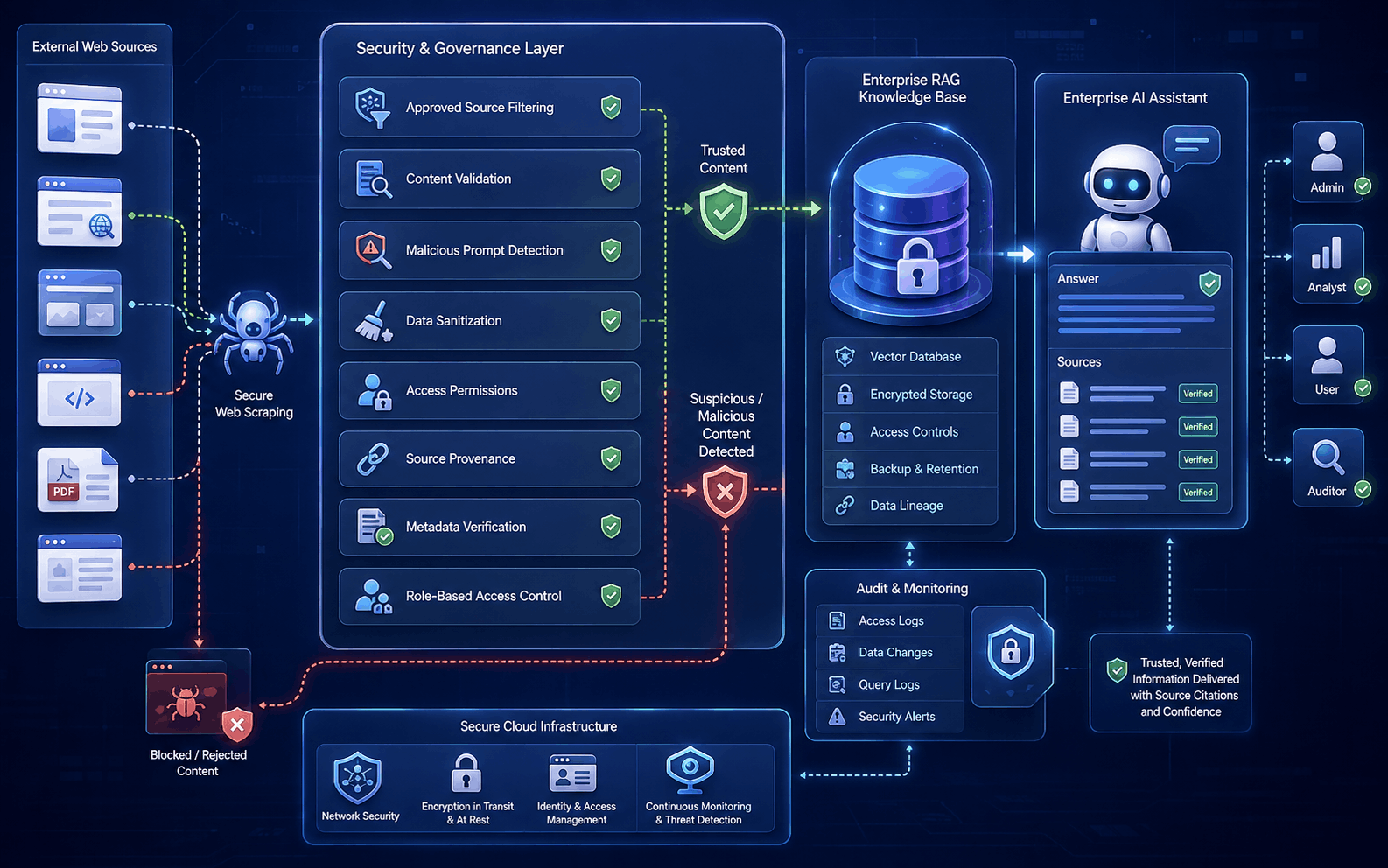
A web-connected RAG system introduces risks that ordinary enterprise search may not face.
One is indirect prompt injection.
A malicious or compromised webpage could contain instructions intended to influence an AI system that later retrieves the text. OWASP specifically identifies RAG poisoning and malicious content inserted into retrieval knowledge bases as threats to LLM applications, under its Vector and Embedding Weaknesses category (LLM08:2025).
Therefore, do not allow raw scraped text to control system behavior.
Practical controls include:
- Separate system instructions from retrieved content
- Sanitize and classify incoming sources
- Restrict trusted source domains
- Apply role-based retrieval permissions
- Detect suspicious instruction-like content
- Log retrieval context
- Limit tool permissions available to the model
- Require human review for high-impact workflows
Remember: RAG can improve grounding, but it does not automatically make an AI application secure or factually correct.
Legal, Privacy, and Source-Governance Considerations
Technical accessibility should not be treated as permission for unrestricted collection or reuse.
Before you scrape a website for a knowledge base, review:
- Website terms
- Copyright and licensing
- Authentication requirements
- Privacy obligations
- Personal or sensitive data
- Intended downstream use
- Retention requirements
- Jurisdictions involved
- Available official APIs or licensed feeds
Google’s crawler documentation describes robots.txt as a mechanism that communicates crawler rules and preferences. It should form part of responsible crawler design, but source governance requires a broader review.
For higher-risk projects, particularly those involving personal information, regulated industries, authenticated systems, or commercial content reuse, involve qualified legal and privacy professionals.
Kanhasoft’s web scraping vendor security and compliance checklist provides additional questions for evaluating collection methods, retention, access control, provenance, and vendor responsibility.
How to Design a Reliable Web Scraping for RAG Architecture
For most business systems, start with seven decisions.
Define authoritative sources
Do not begin by crawling the entire internet. Create an approved source registry.
Define freshness requirements
Ask how quickly each information type becomes commercially outdated.
Establish a canonical data model
Store URLs, titles, versions, timestamps, permissions, and document relationships consistently.
Build incremental ingestion
Reprocess changed information rather than repeatedly rebuilding the entire knowledge base.
Design retrieval before selecting the LLM
Test whether the system retrieves the correct evidence first. A stronger model cannot compensate for consistently retrieving the wrong document.
Build evaluation datasets
Create representative business questions with expected source documents and acceptable answers.
Measure retrieval relevance, answer quality, citation accuracy, stale-answer frequency, latency, and cost.
Add human governance
Someone still needs responsibility for approved sources, access permissions, retention, stale documents, and disputed answers.
Automation reduces manual maintenance. It does not remove accountability.
When Does a Custom RAG Data Pipeline Make Sense?
A custom pipeline becomes more practical when:
- Knowledge changes frequently
- Hundreds or thousands of web pages are involved
- Several data formats must be combined
- Source-level permissions matter
- Answers require citations
- Incremental updates are important
- The business needs control over data retention
- Retrieval quality must be measured
- Existing SaaS connectors cannot reach important sources
A simpler hosted knowledge-base product may be enough when information is limited, stable, and already stored in supported platforms.
This is an important decision. Do not build a custom crawler, ingestion platform, vector infrastructure, and monitoring system merely because the architecture diagram looks impressive.
Expert Observation: Freshness Is a Data Engineering Problem
In practical implementations, teams often spend too much time comparing vector databases and LLMs before deciding who owns the source data.
A better first question is:
“When this information changes, how will our system know?”
If the answer is “someone will probably upload the new PDF,” the knowledge base is still dependent on a manual process.
Reliable RAG starts with source discovery, change detection, validation, metadata, and ownership. The model comes later.
Planning a Continuously Updated AI Knowledge Base?
Kanhasoft works across both sides of this architecture: web scraping and structured data extraction, as well as AI-enabled knowledge-base and RAG development.
A practical starting point is a limited technical discovery exercise. We can review your target sources, update frequency, access methods, data formats, quality requirements, retrieval use cases, security constraints, and expected query volume before recommending whether you need APIs, scraping, existing connectors, or a hybrid RAG data pipeline.
The aim is to choose an architecture you can maintain after launch, not simply produce a chatbot demonstration.
For a look at how AI-assisted scraping applies to a different use case — tracking competitor pricing and market signals rather than powering a knowledge base — see Kanhasoft’s guide to web scraping and AI for market intelligence.
Final Words
Web scraping for RAG turns a static AI knowledge base into a continuously refreshed information system. The strongest architecture does more than crawl pages. It detects meaningful changes, removes noise, validates content, preserves provenance, updates embeddings incrementally, removes obsolete information, protects retrieval from untrusted content, and monitors whether users receive the right evidence.
Businesses should also resist the temptation to apply AI everywhere. APIs and deterministic extraction remain better for many structured sources. LLMs are most useful where interpretation is genuinely difficult.
Build the knowledge pipeline first. Then let the language model make that knowledge easier to use.