
Most companies don’t go looking for an ERP because they love software. They go looking because spreadsheets, disconnected apps and email approvals stopped keeping up. If you’re planning for 2027, it helps to know what an ERP system realistically changes day to day, and whether you’d be better served by a packaged product or an ERP built around your own workflows. This guide focuses on the first question: what you actually gain, and how AI is changing that answer.
Quick answer: The main benefits of ERP for business are one shared source of data, automated routine work, fewer errors, faster financial reporting, better inventory and cash control, stronger security and compliance, easier scaling, and clean data that AI tools can use. In 2027, ERP also acts as the foundation for AI assistants and agents that forecast, flag risks and complete routine tasks.
Where Each Benefit Shows Up
| Area | Benefits covered | First visible signal |
| Operations | 1 to 5 | Fewer re-keyed entries and stock surprises |
| Finance and control | 6 to 10 | Shorter month-end close |
| People and collaboration | 11 to 14 | Fewer “which file is current?” messages |
| Customers and growth | 15 to 17 | Faster, more consistent order handling |
| Intelligence and resilience | 18 to 20 | Dashboards leaders actually trust |
Operations and Efficiency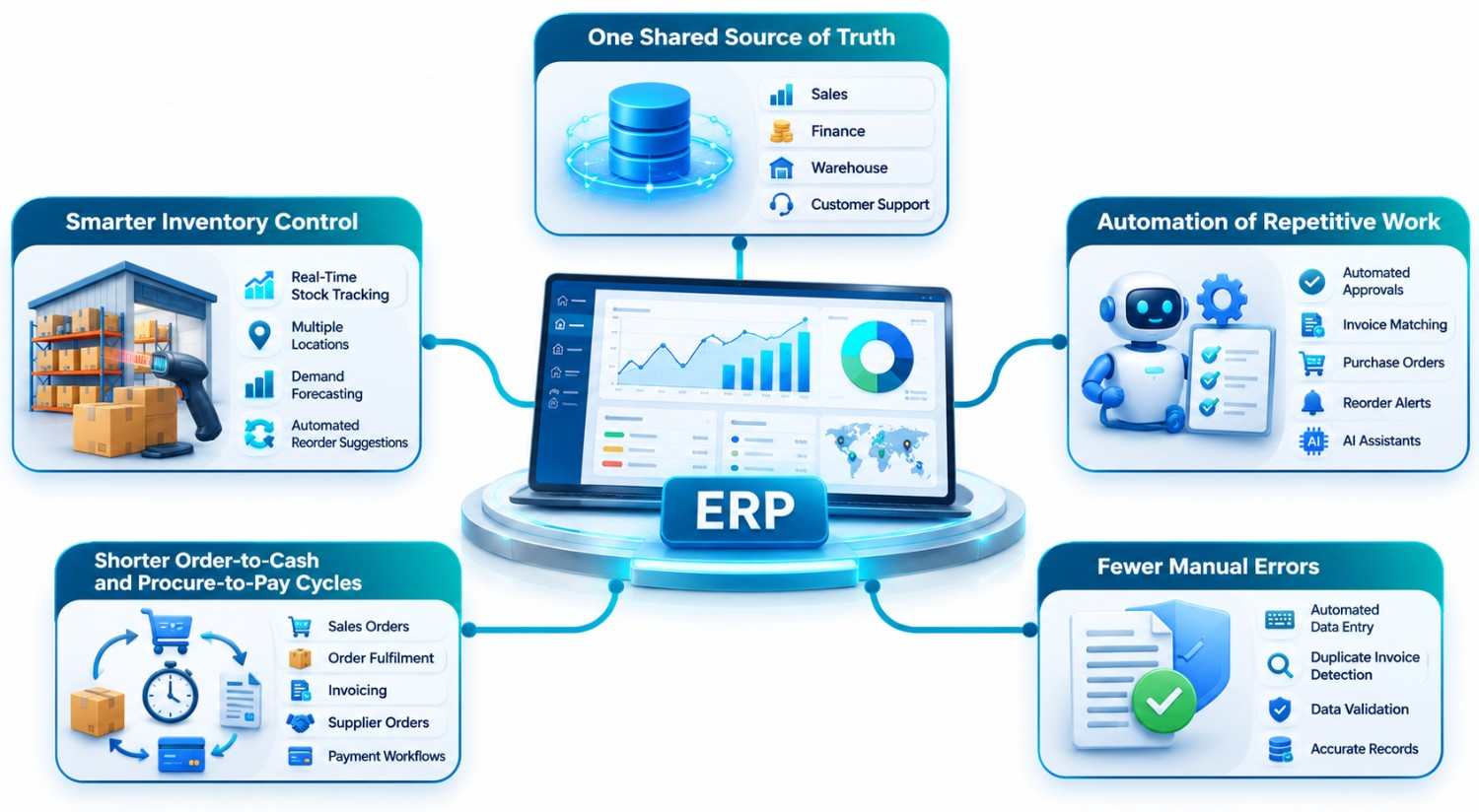
1. One shared source of truth
Sales, finance, warehouse and support all read from the same records. When a price or stock level changes, it changes everywhere at once. Arguments about whose spreadsheet is right mostly disappear.
2. Automation of repetitive work
Approvals, invoice matching, reorder alerts and status updates can run on rules instead of reminders. In 2027, many systems go a step further: AI assistants draft purchase orders, categorize expenses and route exceptions to the right person. Your team keeps the judgment calls and hands off the copy-and-paste.
3. Fewer manual errors
Every time someone retypes a number, a small risk gets added. Entering data once and reusing it removes most of that risk, along with the rework that follows. AI-based validation can also catch odd values, such as a duplicate invoice or an unusual quantity, before they post.
4. Shorter order-to-cash and procure-to-pay cycles
When quoting, fulfilment, invoicing and supplier orders sit in one flow, work stops waiting in inboxes. Delays become visible at the exact step where they happen.
5. Smarter inventory control
Live stock levels across locations help you avoid both overstock and stock-outs. Forecasting models can use sales history, seasonality and supplier lead times to suggest reorder points, so planners start from a recommendation instead of a blank sheet.
Finance and Control
6. Faster closes and cleaner reporting
Reports pull from live transactions instead of manual consolidation. Gartner predicts that finance teams using cloud ERP with embedded AI assistants will close their books about 30% faster by 2028, which shows how much of today’s close time is manual effort.
7. True cost visibility
You can trace cost by product, project, department or customer. That makes it easier to spot jobs that look profitable on paper but quietly lose money.
8. Better cash-flow management
Receivables, payables and purchase commitments appear side by side. Finance can forecast cash from real due dates instead of estimates, and AI-driven forecasts can model what a late payment or a supplier delay would do to the coming weeks.
9. Audit-ready compliance
Role-based approvals, change logs and document trails are recorded as work happens. Preparing for an audit becomes a lookup, not a scramble. Anomaly detection can also flag unusual postings for review during the period instead of after it.
10. More reliable budgeting and forecasting
Planning starts from current actuals instead of last quarter’s export. Scenario modelling lets finance compare “what if demand drops 10%” with “what if costs rise” in minutes, not days.
People and Collaboration
11. Smoother cross-team collaboration
Handoffs between departments happen inside the system, with the history attached. Nobody has to reconstruct a decision from an email chain.
12. Access that matches each role
Staff see what their job requires and nothing more. This protects sensitive payroll, pricing and customer data without slowing down daily work. The same permissions should also govern what an AI assistant is allowed to read and do.
13. Support for remote and hybrid teams
Browser-based and mobile access means a planner, an accountant and a field manager can work from the same records in different time zones.
14. Easier onboarding and training
New hires learn one system and one set of workflows instead of five disconnected tools. Built-in assistants that answer “how do I raise a credit note?” in plain language shorten the learning curve further.
Customers and Growth
15. A more consistent customer experience
When order status, billing and support history are connected, anyone can answer “where is my order?” in seconds. Customers notice the difference.
16. Growth without re-platforming
A well-structured, modular ERP lets you add users, products, warehouses or modules without rebuilding your core processes every time you expand.
17. Easier expansion into new sites and markets
Multi-currency handling, multiple legal entities and local tax rules can be managed in one place. Opening a new location stops being a separate IT project.
Intelligence and Resilience
18. Data that’s ready for AI
AI forecasting and assistants are only as good as the records they read. Deloitte’s view, as reported by CIO, is that ERP is what makes AI valuable in practice rather than something AI replaces. For practical examples, see our piece on how AI is changing modern ERP systems.
19. Stronger security posture
Central permissions, encryption and activity logs are easier to manage in one platform than across a dozen tools. You can answer “who changed this, and when?” without detective work.
20. Operational resilience
Supplier delays, demand swings and staffing gaps are easier to absorb when you can see the whole chain. Leaders react to early signals instead of finding out from a customer.
How AI Is Changing ERP Benefits in 2027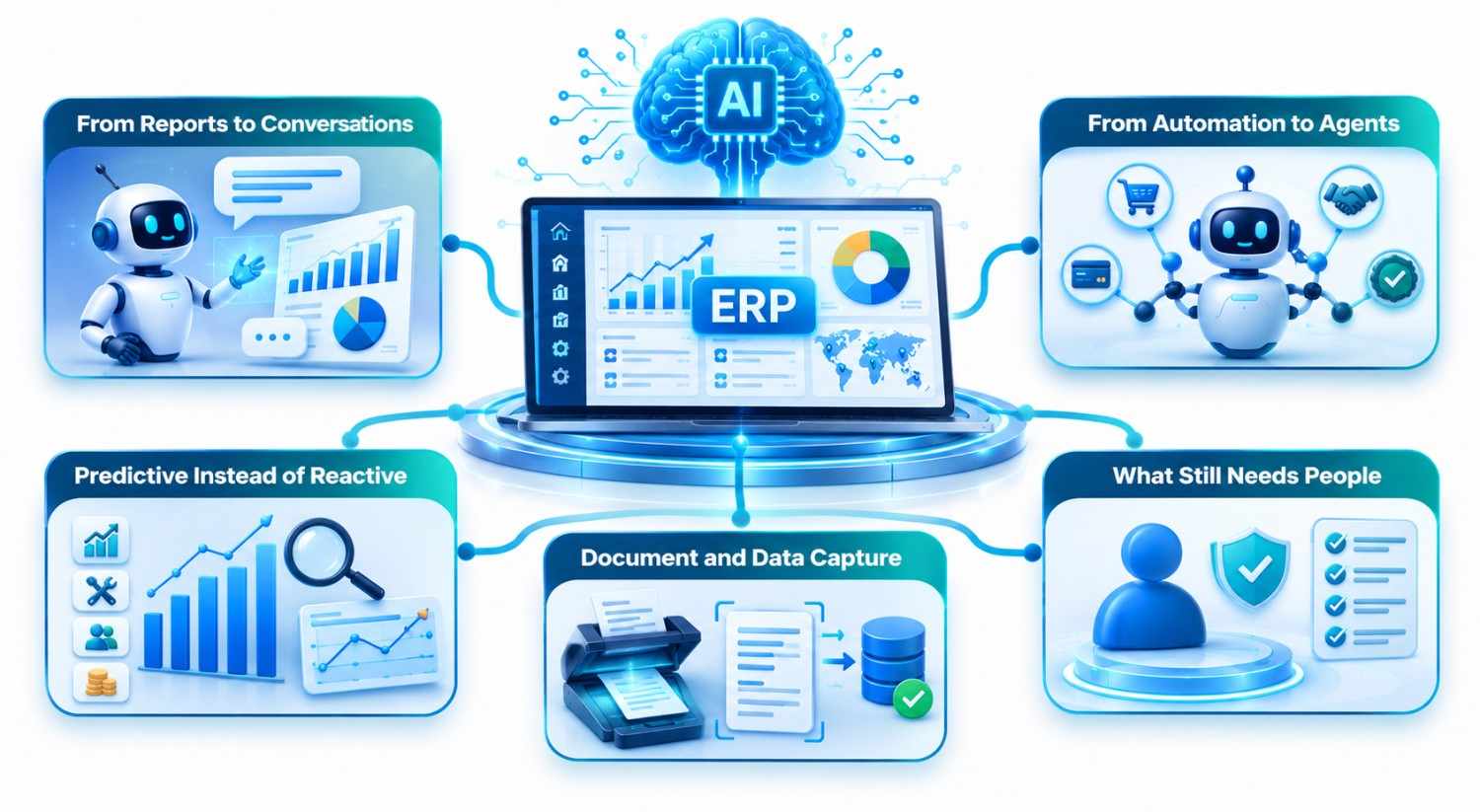
AI is the biggest shift in ERP right now. Gartner forecasts that 62% of cloud ERP spending will go to AI-enabled tools by 2027, up from 14% in 2024. In practice, the older benefits above get faster and more proactive, and a few new ones appear.
From reports to conversations
Instead of building a report, a user can ask, “Which customers are paying more than 15 days late?” and get an answer from live data. This lowers the skill needed to use ERP insights and spreads them beyond the finance team.
From automation to agents
Rule-based automation follows fixed steps. Agentic AI can handle multi-step tasks, such as matching a delivery to a purchase order, spotting a price mismatch, drafting a query to the supplier and holding the payment until it is resolved. Most teams will start with human approval on every action and loosen it only where results prove reliable.
Predictive instead of reactive
Demand forecasting, predictive maintenance, churn signals and cash-flow projections let managers act before a problem becomes visible in the numbers.
Document and data capture
AI can read invoices, delivery notes and contracts and fill in ERP records, cutting manual entry that used to take hours each week.
What still needs people
AI doesn’t fix messy processes. Gartner has warned that many organizations will not have data quality good enough to use advanced AI fully by 2027, and that a large share of purchased AI features sit underused when ownership and post-launch planning are weak. Build the basics first: clean master data, clear process owners and rules for what AI may and may not do.
Other ERP Trends Shaping 2027
- Composable and modular architecture: businesses add capabilities in pieces and connect them through APIs instead of replacing the whole system.
- Cloud and data-residency choices: where data is stored matters more as regional rules tighten, so cloud strategy is now a compliance topic.
- AI governance: logs of what an AI suggested, who approved it and why are becoming standard expectations.
- Real-time integration: ERP connects to e-commerce, logistics, banking and IoT feeds so decisions use current data, not nightly batches.
- Sustainability and ESG reporting: energy, emissions and supplier data are increasingly tracked alongside financial data.
How to Actually Capture These Benefits
An ERP doesn’t deliver value just by being installed. Four habits separate teams that see results from teams that don’t:
- Define outcomes first. Pick three or four measures, such as close time, stock accuracy or order cycle time, and record the baseline before launch.
- Clean the data before moving it. Duplicate customers and outdated item codes will follow you into the new system if you let them.
- Plan for adoption, not only configuration. Train by role, appoint process owners and review usage after launch. Our guide on where to start with ERP system development walks through the early planning decisions.
- Start AI small. Pick one or two high-volume tasks, such as invoice capture or reorder suggestions, prove the result, then expand.
Conclusion
ERP benefits are rarely about a single feature. They come from connected data, fewer handoffs and decisions made on current numbers. In 2027, that connected foundation is also what lets AI assistants and agents deliver something useful instead of something risky. The best starting point is an honest look at where your team loses time today, then choosing the benefits that matter most.
How Kanhasoft can help: If you’d like to talk through which of these benefits matter most for your business, and where AI fits, our ERP team can review your workflows and suggest a practical first phase. Book a free ERP consultation with Kanhasoft.