
As businesses add AI agents to CRM and ERP platforms, a new architecture question is appearing alongside the usual database and API decisions: MCP vs REST API for AI-powered CRM — which should you use? For companies already investing in custom CRM development, the answer is rarely “replace REST with MCP.” In most production systems, the two solve different problems and can work together.
REST APIs remain highly effective for deterministic application-to-application communication. MCP, or Model Context Protocol, gives AI applications a standardized way to discover and use approved tools, resources, and context.
That difference sounds small. Architecturally, it is significant.
Quick Answer: MCP vs REST API for AI-Powered CRM & ERP
REST APIs should usually remain the core integration and business-service layer of a CRM or ERP. MCP can sit above that layer when AI assistants or agents need a standardized, model-friendly way to discover data and perform approved actions.
Use REST when the caller already knows which endpoint to call and what response to expect.
Use MCP when an AI application needs to understand which capabilities are available, inspect their schemas, select an appropriate tool, retrieve context, and act through controlled interfaces.
For many AI-powered CRM and ERP systems, therefore, the practical architecture is:
CRM/ERP business services → REST APIs → MCP server → AI agents and assistants
It is not necessarily MCP or REST. Often, it is MCP and REST. 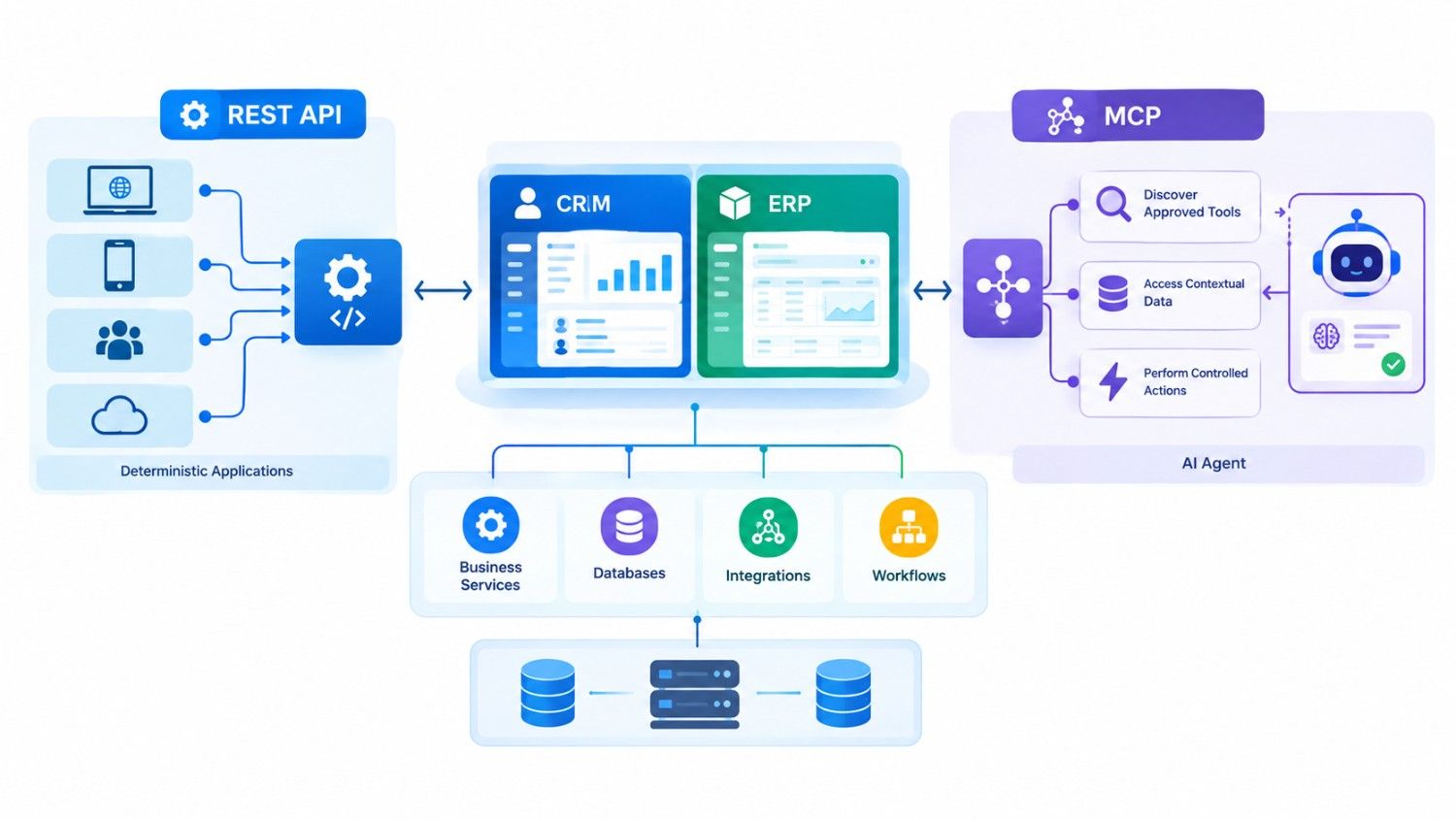
What Is REST API?
REST, or Representational State Transfer, is an architectural style introduced by Roy Fielding for distributed systems. REST emphasizes characteristics such as stateless interactions, a uniform interface, scalability, and independent evolution of components.
In business software, REST APIs commonly expose endpoints such as:
GET /customers/123
GET /opportunities?status=open
POST /purchase-orders
PATCH /invoices/784
A CRM frontend, ERP mobile app, accounting platform, warehouse system, or external partner knows which endpoint to call and what data structure to send.
That predictability is one of REST’s strengths.
REST APIs work particularly well for:
- Web and mobile applications
- Third-party integrations
- Customer and supplier portals
- Data synchronization
- Workflow systems
- Payment providers
- Logistics integrations
- Accounting platforms
- Deterministic system-to-system communication
Modern CRM and custom ERP development still need this foundation even when AI becomes part of the product.
What Is MCP?
Model Context Protocol (MCP) is an open standard for connecting AI applications with tools and data sources.
Instead of giving an AI model a loose collection of custom integration instructions, an MCP server can expose clearly defined tools, resources, and prompts that compatible AI applications can discover and use.
The current stable TypeScript SDK implements the July 28, 2026 MCP specification and supports servers that expose these capabilities to MCP hosts such as AI applications and development tools.
For example, a CRM MCP server might expose tools such as:
- find_customer
- get_customer_activity
- search_open_opportunities
- create_follow_up_task
- draft_quote
- update_opportunity_stage
An ERP MCP server could expose:
- check_inventory
- get_purchase_order
- find_delayed_supplier_orders
- get_production_schedule
- create_purchase_request
- retrieve_invoice
The AI agent does not need every internal implementation detail. It discovers a controlled set of capabilities and their input/output schemas.
MCP has also moved beyond a single AI vendor. The protocol is now an Agentic AI Foundation project under the Linux Foundation, with the broader foundation involving organizations including Anthropic, OpenAI, Google, Microsoft, AWS, and others.
MCP vs REST API: The Practical Difference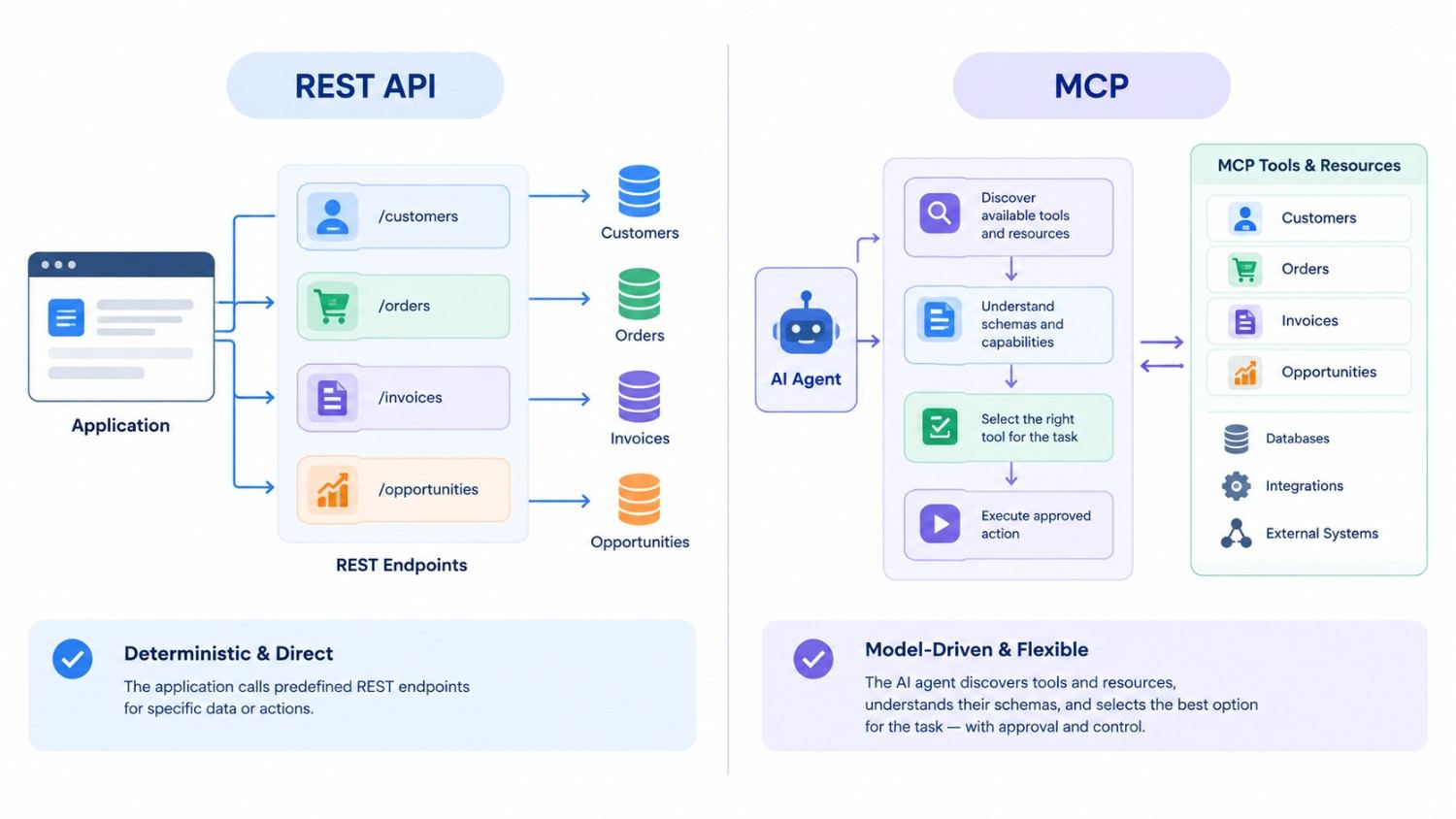
The easiest way to understand the difference is to look at the caller.
A traditional software client is programmed by developers.
An AI agent decides at runtime which available capability may help complete a task.
| Area | REST API | MCP |
| Primary consumer | Applications and developers | AI hosts and agents |
| Interface style | Endpoints/resources | Tools, resources, prompts |
| Capability discovery | Usually documentation/OpenAPI | Built into protocol patterns |
| Best for | Deterministic integrations | Model-driven tool use |
| AI awareness | Not inherent | Designed for AI applications |
| Existing ecosystem | Extremely mature | Rapidly developing |
| Business APIs | Excellent fit | Usually sits above them |
| Human approval | Custom implementation | Can be incorporated into agent/tool workflows |
| Replacement for core APIs | Yes, commonly core architecture | Usually no |
| Suitable for AI interoperability | Requires custom orchestration | Strong use case |
The most important architectural point is this:
MCP does not make your existing APIs obsolete.
Your underlying services still need business rules, validation, authentication, authorization, transactions, audit logging, and predictable contracts.
MCP gives AI systems a better doorway into those capabilities.
Why REST Alone Can Become Awkward for AI Agents
Imagine an AI sales assistant receives this instruction:
“Find my highest-value opportunities that have been inactive for two weeks, summarize what happened, and prepare follow-up actions.”
With REST APIs, developers may need custom orchestration telling the agent:
- Call the opportunities endpoint.
- Apply filters.
- Fetch activity history.
- Retrieve customer details.
- Check open tasks.
- Create a summary.
- Call another endpoint to create the task.
That works.
In fact, many production AI systems work exactly this way.
The problem appears when the AI application must connect with dozens of systems, each using different authentication, endpoint structures, schemas, and integration conventions.
MCP attempts to standardize the AI-facing interaction layer.
An MCP-enabled agent can discover that search_opportunities, get_activity_history, and create_task exist, understand their schemas, and select them when appropriate.
This can reduce custom connector logic at the AI orchestration layer.
Why MCP Should Not Replace Your CRM or ERP Service Layer
A tempting architecture is:
AI → MCP → Database
For serious enterprise software, that is usually the wrong direction.
The safer model is:
AI Agent → MCP Server → CRM/ERP Domain Services → REST/Internal APIs → Database
Why?
Because the rules that protect business data should not depend on what the model decides.
Suppose an AI sales agent requests:
changeOpportunityStage(123, “Won”)
The ERP or CRM backend should still verify:
- Does this user have permission?
- Is the opportunity eligible for this stage?
- Are mandatory fields completed?
- Does an approval need to happen first?
- Should an audit record be created?
- Does the change trigger another workflow?
The model can request the action.
The business layer decides whether the action is allowed.
This principle also appears in Kanhasoft’s guide to building an agentic CRM with Next.js, Node.js and AI agents: reasoning and authority should remain separate.
That distinction becomes even more important in finance, procurement, inventory, HR, and compliance workflows.
CRM Example: AI-Assisted Opportunity Management
Consider a CRM used by a 100-person sales organization.
A sales manager asks:
“Which enterprise deals need attention this week?”
The AI assistant could use MCP tools to:
- Search open enterprise opportunities.
- Retrieve recent calls, emails, tasks, and stage history.
- Identify inactive or delayed opportunities.
- Summarize the evidence.
- Recommend next actions.
- Prepare follow-up drafts.
For low-risk activity, the system might let the agent create an internal task automatically.
Changing pricing, approving discounts, sending contractual commitments, or deleting customer records could still require human approval.
The existing REST APIs remain useful for CRM screens, mobile applications, HubSpot synchronization, SMS integrations, and other deterministic workflows.
MCP becomes the controlled AI-facing layer.
ERP Example: Procurement and Production Agent
The same model becomes even more useful in ERP.
Imagine a production manager asks:
“Which supplier delays could affect next week’s production?”
An ERP agent could access controlled MCP tools to:
- Read production schedules.
- Identify required BOM materials.
- Check inventory availability.
- Review open purchase orders.
- Find overdue expected-delivery dates.
- Identify affected production orders.
- Draft supplier follow-ups.
The AI is coordinating information across modules rather than merely querying one API endpoint.
However, automatically changing a purchase order quantity or approving a new supplier order carries financial consequences.
Those actions should pass through existing ERP permission and approval rules.
This is why the Next.js and Node.js ERP architecture discussed in Kanhasoft’s broader ERP guidance remains relevant even after MCP is introduced. MCP changes how AI interacts with the system; it does not remove the need for solid ERP architecture underneath.
Real Implementation Lesson: Build the Foundation First
One documented Kanhasoft franchise CRM uses React/Next.js, Node.js, PostgreSQL, AWS Lambda, Twilio, HubSpot, and REST APIs to centralize lead management, deal tracking, messaging, and multi-location workflows.
The project was not described as an MCP implementation, so it should not be presented as one.
However, it illustrates an important prerequisite for MCP adoption: the underlying CRM already needs well-defined workflows, permissions, data models, and service interfaces.
Adding MCP to chaotic backend logic does not make the application intelligent.
It simply gives AI faster access to the chaos.
Where REST API Is Still the Better Choice
MCP should not be added simply because AI is involved.
REST remains preferable when:
- A mobile app needs customer data.
- Shopify sends an order webhook.
- An ERP synchronizes invoices with accounting software.
- A warehouse scanner updates stock.
- A customer portal submits service requests.
- A scheduled integration exports transactions.
- A partner application needs a stable public API.
These are deterministic interactions.
The application already knows what it needs to do.
Adding an AI-oriented protocol would create unnecessary complexity.
Where MCP Becomes Valuable
MCP becomes more interesting when an LLM or agent must dynamically decide which business capability to use.
Strong scenarios include:
AI CRM Assistants
An assistant can search customer history, inspect pipeline records, retrieve documents, create tasks, or prepare communications through standardized tools.
ERP Copilots
Users can ask operational questions spanning procurement, inventory, manufacturing, finance, and projects.
Cross-System Agents
An agent may need CRM data, ERP inventory, Google Drive documents, Slack conversations, and another enterprise application during one workflow.
Multi-Model Environments
A standardized tool interface can reduce coupling between internal business capabilities and one specific model provider.
OpenAI, for example, supports remote MCP servers through its Responses API, illustrating how the protocol can provide tools to different AI platforms rather than remaining tied to one model ecosystem.
Security: MCP Adds Capability, Not Automatic Safety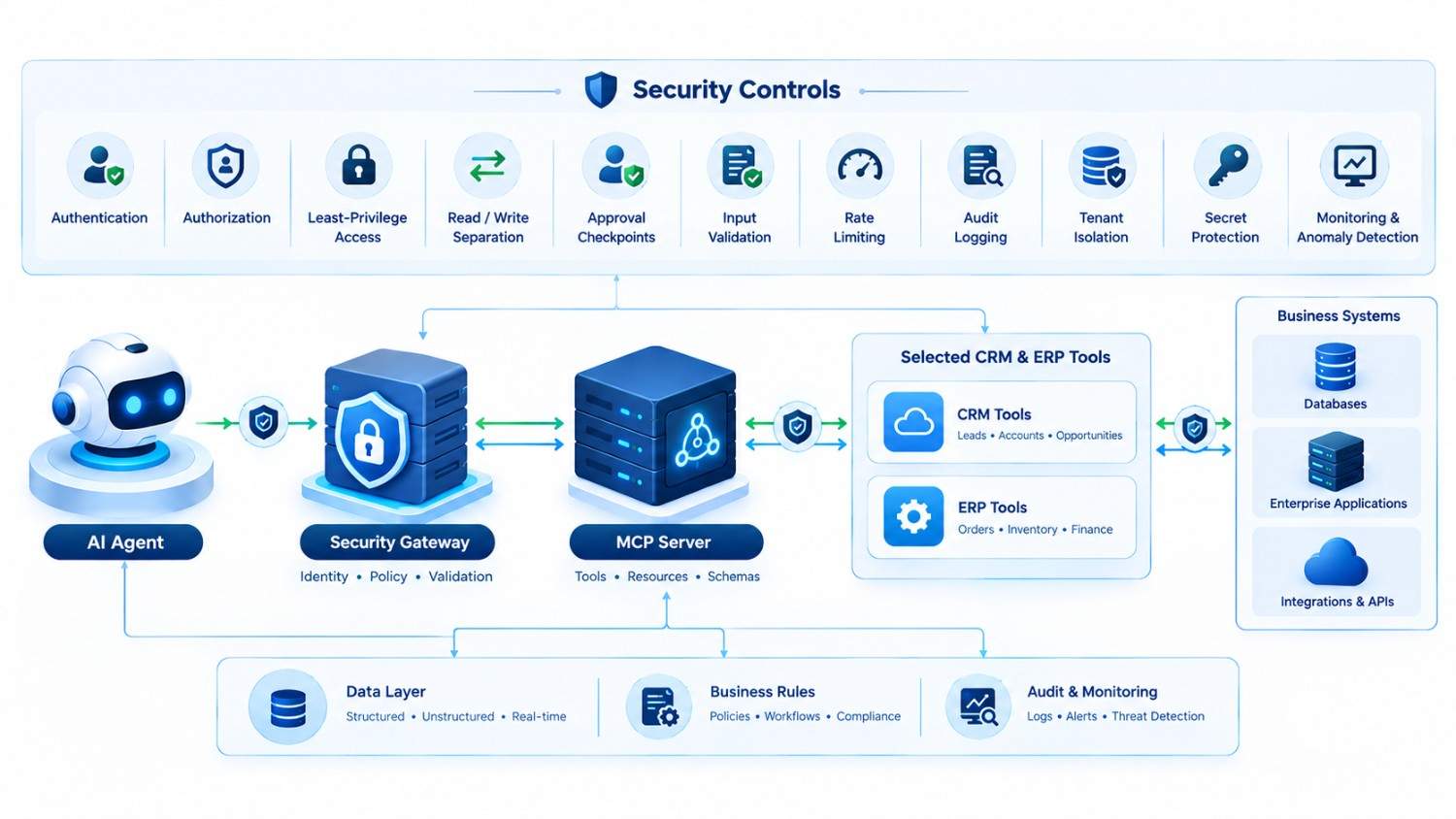
An MCP tool that can create an invoice is still a tool that can create an invoice.
Giving an AI agent more context and actions increases the need for governance.
Production CRM and ERP implementations should consider:
- Least-privilege tool access
- Separate read and write capabilities
- User-level authorization
- Explicit approval for sensitive actions
- Tool input validation
- Rate limiting
- Audit logs
- Allowlisted MCP servers
- Token and secret protection
- Tenant isolation
- Monitoring and anomaly detection
MCP supports OAuth-based authorization patterns, including protecting entire servers or individual tools.
Still, authentication alone is insufficient.
Prompt injection is particularly relevant because an agent may process emails, documents, customer notes, or external content before deciding which tool to call. Anthropic’s guidance on agent safety specifically identifies prompt injection and unauthorized tool behavior as risks that require permissions, authentication, and other controls.
For regulated or sensitive CRM/ERP environments, security and data-privacy specialists should review the architecture before autonomous actions are enabled.
MCP vs REST API for AI-Powered CRM: Which Should You Choose?
For most established businesses, use this decision framework:
| Business Situation | Better Approach |
| Existing CRM with mature REST APIs | Keep REST; add MCP selectively |
| New AI CRM | Build domain services first, then REST/MCP interfaces |
| Standard third-party integration | REST |
| AI assistant querying multiple CRM capabilities | MCP can help |
| Mobile or web frontend | REST/GraphQL |
| AI agent coordinating several systems | MCP is a strong candidate |
| High-risk financial transactions | Existing backend APIs + strict approval controls |
| AI proof of concept | Limited MCP tools or existing APIs |
| No stable business-service layer | Fix the backend before adding MCP |
For a mature CRM or ERP, rebuilding the integration architecture solely around MCP usually makes little sense.
Expose selected capabilities through MCP while preserving the existing API and domain layers.
The Architecture We Would Usually Recommend
For an AI-enabled enterprise application, a practical pattern is:
Web/Mobile Apps → REST APIs
External Integrations → REST APIs/Webhooks
AI Assistant → MCP Client → MCP Server
MCP Server → Existing CRM/ERP Services
Business Services → Database, queues, integrations, and audit systems
This creates one important boundary:
AI does not bypass the application.
The same rules governing a human user, mobile client, or integration continue to protect the system.
That makes the architecture easier to test, monitor, and evolve.
Conclusion: MCP Complements REST More Often Than It Replaces It
The MCP vs REST API for AI-powered CRM discussion should not be framed as a technology contest.
REST remains an excellent foundation for stable application APIs, portals, mobile applications, webhooks, integrations, and predictable system-to-system communication.
MCP solves a different problem. It standardizes how AI applications discover and interact with approved tools, resources, and context.
For modern CRM and ERP platforms, the strongest architecture will often use both.
Keep your business logic and permissions inside trusted application services. Keep REST where deterministic integrations work well. Then expose carefully selected capabilities through MCP when AI agents genuinely benefit from tool discovery and cross-system orchestration.
That gives the AI more useful access without handing it unrestricted authority.
Evaluating MCP for Your CRM or ERP?
Kanhasoft can help assess where MCP fits into an existing or planned AI-powered CRM or ERP architecture.
A useful first step is to map your current APIs, workflows, user permissions, integration points, AI use cases, and high-risk actions. From there, you can decide which capabilities should remain traditional APIs, which may be exposed as MCP tools, and where human approval or stronger governance is required.
The objective is not to add another protocol. It is to create a cleaner and safer way for AI to work with the systems your business already depends on.