-

Custom Software · USA
-

Data Pipeline · USA
-

Data Integration · USA
-

Logistics Software · USA
-

Healthcare Technology · USA
-

Amazon Data Intelligence · USA
-

Data Extraction · USA
-

Web Application · USA
-

Enterprise Software · USA
-

Environmental Data · France
-

Workflow Automation · Norway
-

Mobile Application · USA
-

Travel Data Scraping · Switzerland
-

Insurance Software · USA
-

Data Intelligence · USA
-

Custom Platform · Norway
Built by a Team Experienced in Data-Heavy Business Systems.
Kanhasoft is an experienced software development company serving clients worldwide, combining web scraping services with data quality and cloud architecture.

500+
Projects Completed

13+
Years of Experience

350+
Happy Client
85+
Specialist


5 star Rating Reviews


18,875 Working Hours $500K+ Earned
Let’s connect

100K+
Products Scraped for Amazon eCommerce Clients

1,000+
Healthcare Websites Covered Across the USA

80K+
Amazon/Walmart Reviews Extracted with 95%+ Accuracy

50+
Platforms Tracked for Dental Product Intelligence

35+
Job Listing Websites Scraped for Recruitment Intelligence

50K+
Hotel Records Extracted for Travel & Hospitality Clients
What our clients say
Working with Kanhasoft has been fantastic. They exceeded our expectations with fast responses, clear communication, and technical expertise. They handled last-minute changes with ease and delivered tailored solutions. Their automation skills helped us streamline processes and save time. Kanhasoft truly felt like part of our team. If you need reliable web developers, Kanhasoft is a partner you can trust.


Kanhasoft helped the client build a successful product, enabling them to record a client NPS of 75% with about 1,250 customers. They also supported the client to achieve a 100% growth rate. Moreover, the vendor delivered clean code and architecture, resulting in a reliable app with minimal downtime.

Kanhasoft delivered the first full version of the MVP in less than four weeks. The team communicates seamlessly and responds to queries promptly. They know how to fill the blanks in a not-so-ideal specification with minimal direction.

What Is Competitor Price Monitoring?
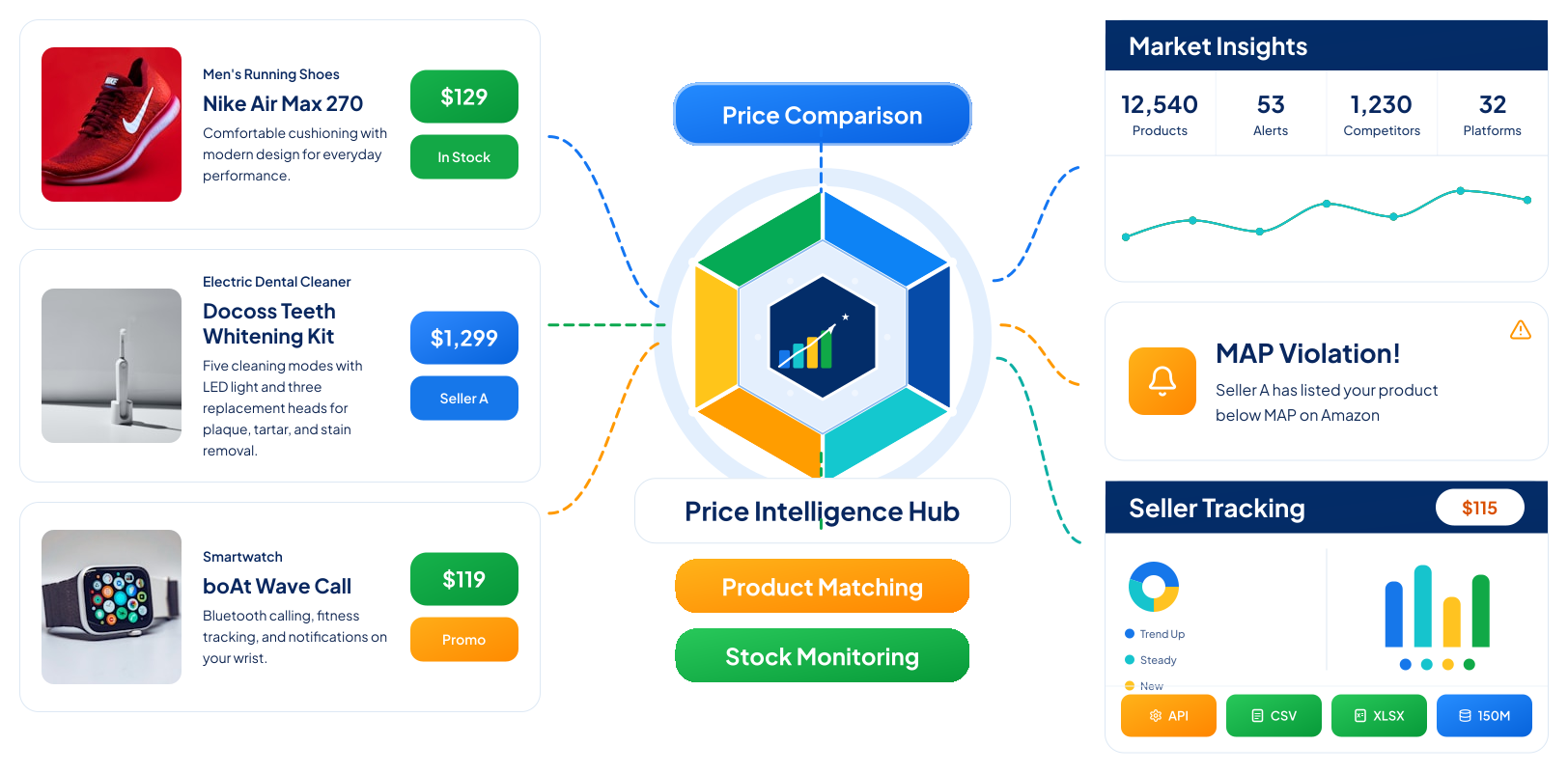
Our competitor price monitoring services cover the signals that affect how a customer sees and evaluates an offer. The exact scope depends on the source websites, product categories, geography, and decisions your team needs to make.
Competitor price intelligence adds interpretation to that data. It shows where your products sit in the market, how often competitors change prices, which sellers repeatedly advertise below policy thresholds, and whether a price difference is real after stock, shipping, pack size, or product variant is considered.
In practice, this matters because a price alone can be misleading. A competitor may appear cheaper, but the item may be out of stock, sold in a smaller pack, tied to a coupon, or offered with higher delivery costs. A useful monitoring system captures enough context to support a sound decision; not just a number in a spreadsheet.
Term
- Price tracking
- Price monitoring
- Price intelligence
What It Means
- Records price changes for selected products over time.
- Runs scheduled checks and alerts when a defined change occurs.
- Combines monitoring with comparison, context, and analysis.
Typical Output
- Historical price logs and change history.
- Current price feed, alerts, dashboards, and reports.
- Market position, trend analysis, compliance signals, and decision support.
Why Choose Kanhasoft for Competitor Price Monitoring?
A price monitoring project succeeds only when the data can be trusted. The difficult part is rarely collecting one visible price. The real work is maintaining product matches, handling variant and seller differences, collecting prices from changing websites, and presenting the result in a form that pricing, sales, and operations teams can use.
We approach competitor price monitoring as a data product, not a one-time scraping script. That means the project includes source analysis, catalog mapping, validation rules, monitoring logic, delivery architecture, error handling, and ongoing maintenance planning from the beginning.
Catalog-specific matching logic
The matching process is configured for your identifiers, product taxonomy, variant rules, and known exceptions.
Custom source coverage
The system can support marketplaces, reseller websites, regional stores, and unusual custom websites that many template tools do not cover
Business-ready price context
We capture the fields needed to understand the real customer offer, including availability, pack size, promotions, shipping, and seller identity where accessible.
Layered quality control
Deterministic matching comes first, AI assists with ambiguous products, and low-confidence matches can be routed for human review.
Flexible data delivery
Pricing data can flow into your existing BI tool, CRM, product information system, data warehouse, or a dedicated dashboard — and if you don't yet have a system in place, our custom ERP development team can build the ERP workflow that receives and acts on this pricing data.
Long-term maintainability
Monitoring, alerts, logs, and scraper maintenance are planned around the reality that eCommerce sites change over time.
Turn Competitor Pricing Data into Faster, Better Decisions
Manual price checks usually begin as a manageable task. A few team members review competitor websites, update a spreadsheet, and share a weekly report. As the catalog grows, the process becomes inconsistent. Products are matched differently, discounts are missed, out-of-stock items are treated as valid offers, and the report is already old by the time someone acts on it.
A custom price monitoring service replaces that fragmented process with a repeatable data pipeline. It gives pricing teams one view of the market while preserving the rules that make sense for the business. For example, a brand can monitor only authorized sellers, a distributor can compare landed prices by region, and a marketplace seller can track Buy Box and seller-level changes by SKU.
The goal is not to change prices every time a competitor moves. The goal is to provide timely, reliable evidence so your team can protect margin, respond to genuine market changes, and avoid unnecessary discounting.
Custom Competitor Price Monitoring Services Built Around Your Catalog
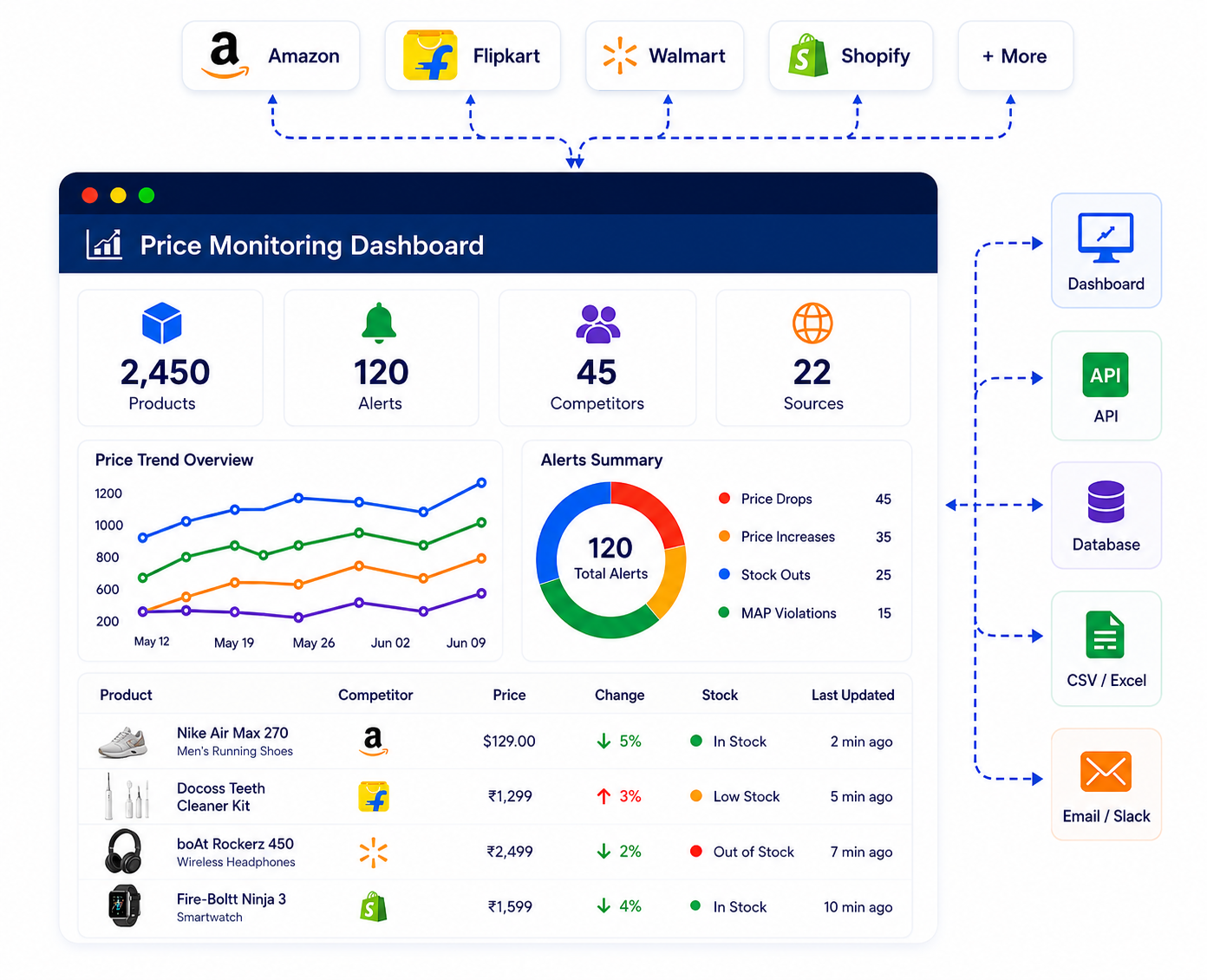
Our competitor price monitoring services cover the signals that affect how a customer sees and evaluates an offer. The exact scope depends on the source websites, product categories, geography, and decisions your team needs to make.
Promotion, Coupon, and Bundle Monitoring
A listed price does not always reflect the amount a customer pays. We capture public promotion signals such as coupon text, bundle pricing, quantity offers, and limited-time discounts whenever available.
- Coupon and promotional labels
- Bundle and multi-buy offers
- Limited-time sale periods
- Pack-size normalization for fair comparison
MAP, MSRP, and Reseller Monitoring
Brands and manufacturers can monitor public advertised prices across approved and unauthorized sellers. The system flags listings below configured pricing thresholds, preserves evidence, and routes exceptions for review.
- Seller and reseller identification
- Configured MAP or MSRP comparison
- Violation evidence with timestamp and source
- Repeat-offender and exception reporting
Stock and Availability Intelligence
A lower price is less relevant when the item is unavailable. We combine pricing with inventory availability signals to provide complete competitive insights.
- In-stock and out-of-stock status
- Availability by location or delivery region where supported
- Backorder and preorder indicators
- Stock-change alerts alongside price changes
Marketplace Seller and Buy Box Monitoring
Marketplaces often display multiple sellers for the same product. We monitor seller-level pricing, fulfillment details, availability, and Buy Box visibility where publicly available.
- Seller-level offer tracking
- Buy Box or featured-offer visibility
- Fulfillment and delivery information
- Marketplace and direct-retailer comparison
Regional, Currency, Shipping, and Variant-Level Pricing
Price comparisons become unreliable when product variants, pack quantities, currency, or shipping costs differ. We define normalization rules that reflect the way your team evaluates a competitive offer.
- Size, color, model, pack quantity, and other variants
- Region-specific and currency-specific prices
- Shipping cost and estimated delivery time
- Unit-price or normalized-pack comparison where required
AI-Assisted Product Matching and Price Intelligence
Product matching is often the largest source of error in competitor pricing data. Two websites may describe the same product with different titles, image order, unit format, SKU structure, or pack quantity. Therefore, we use a layered process rather than relying on one matching method.

Identifier-first matching
use UPC, EAN, GTIN, ISBN, MPN, manufacturer SKU, or other stable identifiers whenever available.

Attribute-based matching
compare brand, model, size, color, pack quantity, material, specification, and category.

AI-assisted similarity scoring
use text and, where appropriate, image similarity to identify likely matches when identifiers are missing.

Confidence thresholds
approve high-confidence matches automatically while routing uncertain matches to review.

Exception learning
preserve approved mappings and known exclusions so accuracy improves as the catalog evolves.

Bundle and variant handling
separately validate multi-packs, bundles, and size or color variants, so a 3-pack isn't matched against a single unit at a different price point.
Our Competitor Pricing and Marketplace Data Portfolio
Kanhasoft has built data-intensive systems for price comparison, marketplace analytics, product tracking, and large-scale eCommerce monitoring. The examples below show the types of technical and business problems our team has handled.
Dental Product Inventory & Stock Intelligence Scraper  Brazil
We built an advanced scraping ecosystem to monitor dental product inventory across 8+ platforms with variant-level tracking. The system captures stock details like specific product variations to size, type, pricing dynamically. By syncing data to PostgreSQL, it automates 30,000+ collection and reporting. Advanced proxy rotation ensures high accuracy despite anti-bot protections. This enabled real-time inventory insights and competitive advantage.
INDUSTRY

Healthcare /E-commerce
TECH STACK

Python, Django, Celery, PostgreSQL, ScrapiOps, Zyte
Data Points Collected

Product variations, stock levels, pricing, availability
Scale

8+ websites, variant-level tracking

Challenge
Tracking real-time stock across multiple websites with complex product variations and strong anti-bot protections.

Solution
We built an advanced scraping ecosystem that:
- Tracks stock at variant level (size, type, etc.)
- Uses proxy rotation and anti-block tools
- Automates daily data extraction and reporting
- Cleans and structures data for analysis
Amazon Product & Pricing Scraper  USA
USA
For Amazon, we developed a scalable web scraping solution to extract product listings, pricing, and customer reviews across thousands of items. The system efficiently handled pagination, filtering, and dynamic content to ensure accurate data collection. All data was structured and stored in a centralized database for analysis. This enabled businesses to monitor competitors, optimize pricing strategies, and improve decision-making. The solution significantly reduced manual effort while delivering real-time insights.
INDUSTRY

E-commerce
TECH STACK
Python, Scrapy, Selenium, PostgreSQL, AWS
Data Points Collected
Product titles, prices, reviews, ratings, seller info
Scale
100k+ products
Challenge
Managing high-volume product data across multiple pages with dynamic loading, filtering, and sorting.
Solution
We built a robust scraper that:
- Handles pagination and dynamic content
- Extracts structured product and review data
- Manages proxy rotation and anti-bot handling
- Stores clean data in a centralized database
Hotel Revenue Management Scraper (Booking.com) USA
We built a data scraping system for Booking.com to help hotels track competitor pricing and availability. The tool collected room rates, types, and availability for multiple competitors from 365-day booking windows. Data was organized into structured formats and made accessible via APIs for reporting and forecasting. This allowed hotels to make data-driven pricing decisions. As a result, businesses improved revenue optimization and gained a competitive edge.
INDUSTRY

Hospitality / Travel
TECH STACK
Python, BeautifulSoup, Selenium, JSON APIs, AWS Lambda
Data Points Collected
Room types, prices, availability, competitor ratings
Coverage
30+ competitors per hotel, 365 days
Challenge
Collecting accurate competitor pricing data across multiple dates and locations.
Solution
We developed a system that:
- Scrapes booking data across date ranges
- Tracks competitor pricing trends
- Structures data into JSON for API access
- Integrates with hotel dashboards for reporting
See a relevant data sample or walk through a case study close to your use case.
Request a Data Sample or Case StudyBenefits of Custom Competitor Price Monitoring Services
A well-designed monitoring system does more than reduce manual work. It improves the quality, speed, and context of pricing decisions while giving the business control over how data is collected, matched, stored, and used.

Faster Response to Real Market Changes
- Detect important price movements without waiting for a weekly manual report.
- Set different monitoring frequencies for high-priority and long-tail products.

Better Margin Protection
- Avoid discounting simply because one competitor appears cheaper.
- Compare price together with stock, pack size, shipping, and promotion context.

Consistent Product Comparison
- Apply one set of matching and normalization rules across the catalog.
- Reduce spreadsheet errors and inconsistent manual SKU mapping.

Stronger MAP & Reseller Visibility
- Identify public listings below configured policy thresholds.
- Keep time-stamped evidence and seller history for internal review.

Promotion & Stock Intelligence
- See when competitors use coupons, bundles, flash sales, or stock-led promotions.
- Use out-of-stock signals to support campaign timing and inventory decisions.

Multi-Marketplace Visibility
- Bring marketplace, retailer, reseller, and direct-store data into one structure.
- Compare the same product across sources without switching between dashboards.

Flexible Alerts & Reporting
- Send high-priority changes to email, Slack, dashboards, APIs, or internal systems.
- Filter alerts by product, brand, category, region, seller, or change threshold.

Data Ownership & Integration Control
- Use a data model that fits your BI, ERP, PIM, or pricing workflow — including a custom CRM development build if reseller and account-level alerts need to live inside your sales team's system.
- Avoid being limited to the exports and plan tiers offered by a generic tool.

Scalable Monitoring Architecture
- Expand product, source, and geography coverage as the business grows.
- Schedule workloads and infrastructure around actual business priorities.

Long-Term Operational Value
- Preserve historical pricing data for trend analysis and planning.
- Maintain and adapt the pipeline as websites, catalogs, and rules change.
Our Custom Competitor Price Monitoring Process
We use a structured process to reduce uncertainty before full-scale development. The first goal is to confirm that the target sources, product matches, and required fields can be collected reliably. The second is to build a maintainable monitoring system that fits your team’s workflow.

Discovery, Source Review, and Success Criteria
We begin by understanding the pricing decisions the data must support. We review your catalog, competitor list, source websites, regions, monitoring frequency, alert rules, delivery requirements, and known edge cases.
- Review product catalog structure and available identifiers
- Confirm target websites, marketplaces, sellers, and locations
- Define required price, stock, promotion, shipping, and variant fields
- Set accuracy, freshness, and exception-handling expectations
- Identify integration, security, and access requirements

Product Mapping and Sample Data Validation
Before building the full pipeline, we create a representative sample. This stage tests source accessibility, field coverage, matching logic, and output format using real products from your catalog.
- Create identifier and attribute-based matching rules
- Test ambiguous products, bundles, variants, and pack sizes
- Review low-confidence matches with your team
- Validate sample data and expected monitoring cadence
- Confirm final scope, milestones, infrastructure, and maintenance plan

Pipeline, Intelligence, and Integration Development
We build the scraping, matching, normalization, storage, alerting, and delivery components. The technology is selected per source rather than forcing every website through the same crawler.
- Build API, Scrapy, Playwright, Selenium, or hybrid collectors
- Implement scheduling, retries, logs, and error handling
- Develop matching, normalization, and data-quality rules
- Configure alerts, dashboards, exports, APIs, or database sync
- Apply access controls, encryption, and environment separation

Quality Assurance, Deployment, and Ongoing Maintenance
The system is tested against real-world price changes, missing fields, layout changes, duplicate products, and delivery failures. After deployment, we monitor pipeline health and maintain source-specific collectors as websites evolve.
- Functional, data-quality, performance, and security testing
- Coverage and accuracy review against approved samples
- Production deployment and user onboarding
- Monitoring dashboards, run logs, and failure alerts
- Ongoing source maintenance, rule updates, and scale optimization
Competitor Price Monitoring Data Points and Features
Every implementation is configured around the commercial questions your team needs to answer. A retailer may need daily market position by SKU. A brand may care more about reseller compliance. A marketplace seller may prioritize Buy Box, shipping, seller, and stock changes. The system can combine the relevant fields into one normalized record.
Core data can include product title, brand, model, identifiers, product URL, image URL, category, seller, marketplace, variant, pack quantity, regular price, sale price, coupon, currency, shipping cost, delivery estimate, availability, stock signal, MAP threshold, scrape timestamp, match confidence, and change history.
The platform can also support workflow features such as saved filters, exception queues, approval notes, evidence snapshots, role-based dashboards, scheduled reports, alert subscriptions, webhook delivery, and API access. For teams that already use Power BI, Tableau, Looker Studio, a custom BI platform, or an internal data warehouse, we can deliver the normalized feed directly rather than creating another standalone dashboard.
Technology Stack for Competitor Price Monitoring
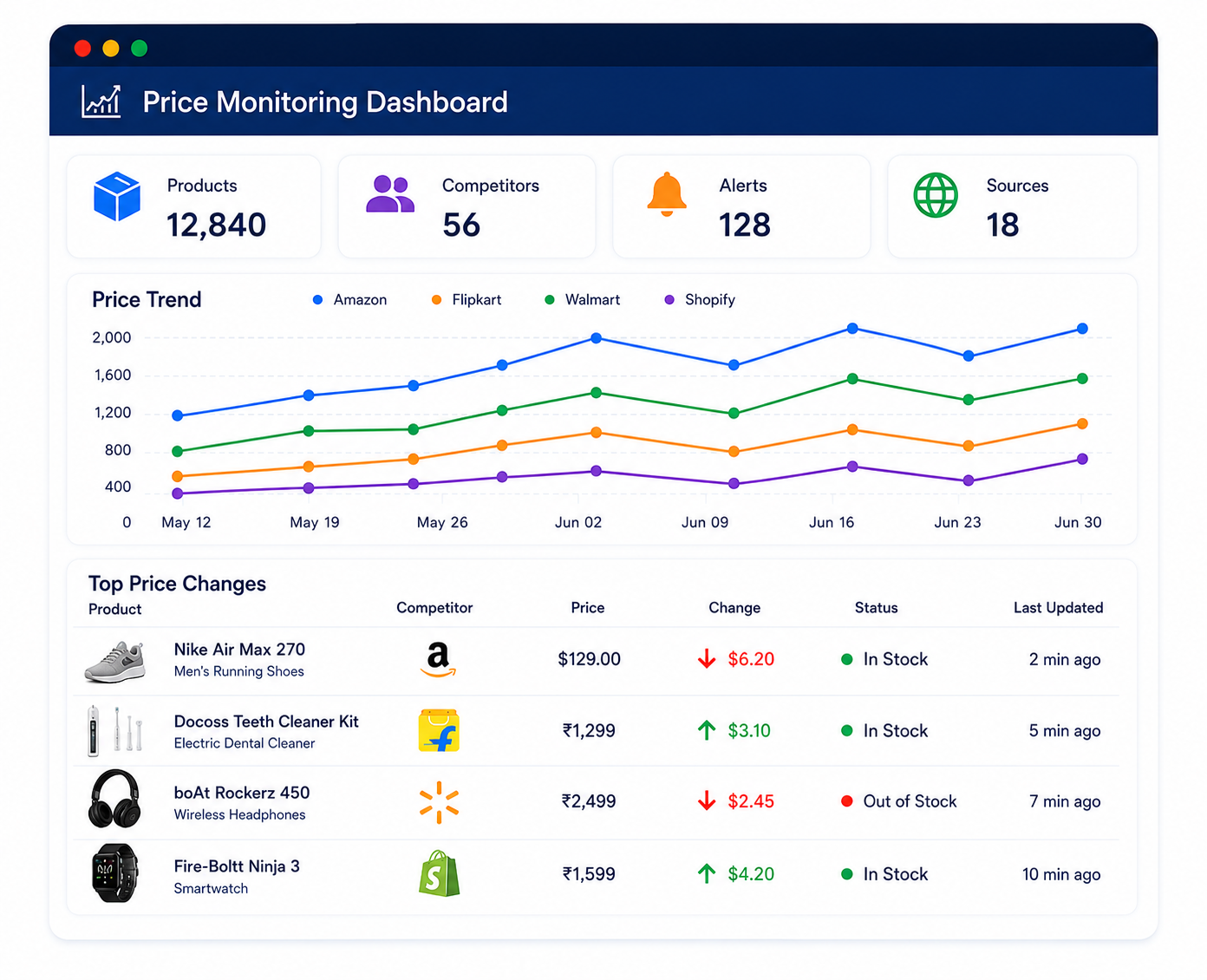
We select tools based on website behavior, data volume, refresh frequency, and integration needs. Static pages, JavaScript applications, marketplaces, and protected websites often require different collection methods.

Data Collection
Python, Scrapy, Requests, BeautifulSoup, lxml, Playwright, Selenium, browser automation, approved APIs

Scheduling and Processing
Celery, Celery Beat, cron-based jobs, queues, parallel workers, retry and failure handling

Product Matching and Intelligence
Identifier rules, text similarity, attribute matching, image similarity where appropriate, LLM-assisted review, confidence scoring

Backend and APIs
Python/Django, FastAPI, Node.js, REST APIs, GraphQL where required

Databases and Storage
PostgreSQL, MySQL, MongoDB, Amazon S3, data warehouses, client-managed databases

Cloud and DevOps
AWS, Azure, GCP, Docker, CI/CD, monitoring, logging, secure secrets management

Delivery and Reporting
Excel, CSV, JSON, API, webhook, email, Slack, dashboards, Power BI and other BI integrations
Key Features of a Custom Price Monitoring System
Core Monitoring Capabilities
- Scheduled price, discount, promotion, and availability checks
- Historical price and stock-change records
- Variant-, seller-, location-, and marketplace-level monitoring
- Configurable frequency by product or source
Product Matching & Data Quality
- UPC, EAN, GTIN, MPN, SKU, model, and attribute matching
- AI-assisted similarity checks for missing identifiers
- Confidence scores, manual review queues, and approved mapping history
- Duplicate detection, normalization, validation, and exception rules
Alerts & Price Intelligence
- Price drop, price increase, MAP threshold, stock-out, and seller-change alerts
- Thresholds by amount, percentage, brand, category, or competitor
- Trend views, market position, and recurring promotion analysis
- Optional recommendation workflows with human approval
Integration & Data Delivery
- Dashboard, API, database, Excel, CSV, JSON, email, Slack, or webhook delivery
- ERP, CRM, PIM, BI, data warehouse, and internal pricing-system integration
- Scheduled reports and role-specific views
- Custom schemas and client-owned data environments
Security, Reliability & Governance
- Role-based access, audit logs, encrypted credentials, and secure environments
- Pipeline logs, run monitoring, retry logic, and failure alerts
- Data retention controls and backup planning
- Change management and source-maintenance workflows
Adoption & Ongoing Support
- Sample validation and user acceptance testing
- Documentation and team onboarding
- Ongoing source maintenance and product-mapping updates
- Performance tuning as volume and frequency increase
Industries We Serve
Our competitor price monitoring solutions are suitable for businesses that manage large catalogs, fast-moving prices, reseller networks, marketplace exposure, or region-specific offers. The monitoring logic is adapted to the pricing realities of each sector.

eCommerce and D2C Brands
Track competitors, promotions, stock, and category-level market position across direct stores and marketplaces.

Retail Chains and Multi-Brand Stores
Compare store, region, channel, and competitor prices while supporting large catalogs and scheduled reporting.

Manufacturers and Brand Owners
Monitor public reseller pricing, MAP-related exceptions, unauthorized sellers, and product availability.

Amazon, Walmart, and Marketplace Sellers
Track seller offers, Buy Box or featured-offer changes, stock, rankings, and cross-marketplace prices.

Electronics and Consumer Goods
Match model- and specification-heavy catalogs while monitoring fast price changes and reseller activity.

Automotive Parts and Accessories
Handle manufacturer part numbers, fitment-related variants, brand aliases, and distributor pricing.

Healthcare, Dental, and B2B Product Suppliers
Compare distributor and retailer prices across specialized catalogs, pack sizes, and regional sellers.

Grocery, CPG, and Packaged Goods
Normalize pack quantities, promotions, bundles, and location-specific availability.

Travel and Hospitality
Monitor rate, availability, room or package attributes, and date-specific competitor offers.

B2B Distributors and Wholesalers
Track public product prices, stock, seller networks, and market position across fragmented supplier websites.
Custom-Built vs. SaaS Price Monitoring Tools
SaaS price tracking tools can be a sensible choice for smaller catalogs, standard marketplaces, and teams that need a quick start. A custom system becomes more relevant when product matching is complex, source coverage is unusual, data must integrate with internal systems, or per-SKU licensing becomes restrictive.
| SaaS Tool |
|---|
| Faster, standard sites only. |
| Per product, competitor, or refresh rate. |
| Standardized, limited customization. |
| Limited to supported sites/tiers. |
| Vendor's predefined fields. |
| Limited connectors/APIs. |
| Stays on vendor platform. |
| Handled by vendor. |
| Small-medium, standard catalogs. |
| Factor |
|---|
| Time to start |
| Pricing model |
| Product matching |
| Source coverage |
| Data model |
| Integration |
| Data control |
| Maintenance |
| Best fit |
| Custom System |
|---|
| Needs discovery; built for your workflow. |
| Scoped by project and maintenance needs. |
| Identifiers, AI, custom rules, human QA. |
| Marketplaces, custom sites, regional sources. |
| Built around your catalog and needs. |
| ERP, CRM, PIM, BI, databases. |
| You control schema, storage, data use. |
| Managed via agreed support model. |
| Complex catalogs, custom integrations. |
A custom system does not mean “zero ongoing cost.” Hosting, proxies where required, source maintenance, support, and higher-frequency processing create operating costs. The advantage is that the architecture and commercial model can be aligned with your real requirements instead of a generic plan.
Not sure whether a SaaS tool or a custom build fits your catalog and workflow better?
Security, Compliance, and Responsible Data Collection
Competitor monitoring projects should be designed with technical, contractual, privacy, and governance risks in mind. We scope each project around the type of data being collected, how the source makes it available, the access method, the collection frequency, the client’s intended use, and the applicable jurisdiction.

Public Business Data Focus
collect product and pricing information that is publicly accessible or available through approved APIs and feeds.

Access-Control Review
Avoid accessing private accounts, bypassing authentication, or collecting data behind authorization barriers without permission.

Privacy-by-Design
Exclude personal data unless there is a documented lawful purpose, clear business requirement, and appropriate privacy review.

Rate and Load Controls
Use scheduling, caching, and request management to reduce unnecessary website load while improving monitoring reliability.

Secure Engineering
Apply role-based access, encrypted credentials, environment separation, audit logs, and controlled data retention throughout the solution.

Client Governance
Define acceptable use, source scope, output ownership, retention policies, and escalation responsibilities for long-term governance.
Frequently Asked Questions — Competitor Price Monitoring Services
Build a Price Monitoring System Around Your Commercial Rules
The right competitor price monitoring system should reflect how your business evaluates price—not force your catalog into a generic template. Kanhasoft can help you define the source coverage, product-matching logic, monitoring schedule, alerts, integrations, and maintenance model needed for a reliable long-term solution.
Share a sample catalog and the competitor websites you want to monitor. We can review the sources, identify likely matching challenges, and prepare a practical sample-data plan before you commit to full development.
your catalog and target competitor sites — we'll map the matching challenges before you commit.
Talk To Us
About Your Project