AI-Powered WhatsApp Customer Support Platform for eCommerce
Customer support for an online store can become repetitive very quickly.
Customers ask where their order is, whether an item is available, how returns work, when a shipment will arrive, or what to do when something goes wrong. The questions are often simple, but answering the same ones throughout the day takes time away from conversations that genuinely need an experienced support person.
We developed an AI-powered WhatsApp customer support platform for eCommerce businesses to handle that repetitive workload while keeping support teams in control.
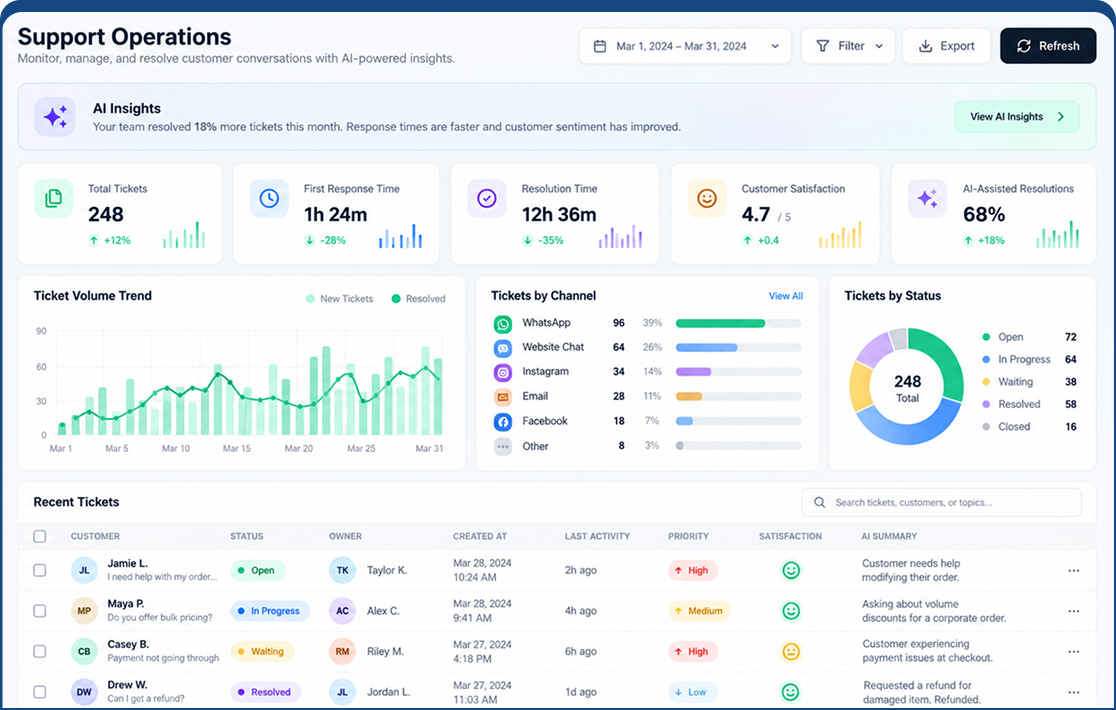
The platform answers customers using business-approved FAQs, support guidelines, product information, and live commerce data when current information is required. It can understand text, images, and voice notes, organize conversations, create support tickets, summarize resolved cases, and hand a conversation to an agent whenever human attention is needed.

7 Months

Europe
What Is an AI-Powered WhatsApp Customer Support Platform?
An AI WhatsApp customer support platform helps eCommerce businesses answer customer questions through WhatsApp using approved business knowledge and connected store data.
It can handle routine questions from FAQs, retrieve live order or shipment details when needed, understand images and voice notes, and hand the conversation to a human agent if the AI cannot answer reliably.
Project Brief
The client wanted to reduce the amount of repetitive WhatsApp support handled manually without losing visibility or control over customer conversations.
The system needed to work around the business's existing support process rather than forcing teams into a completely separate AI workflow.
From one connected environment, the support team needed to:
- Create and maintain an AI knowledge base
- Add approved FAQs
- Define response guidelines
- Set communication tone and response rules
- Organize conversations automatically
- Synchronize relevant product information
- Let AI handle routine WhatsApp questions
- Retrieve current order information only when required
- Check shipment and delivery information
- Answer suitable stock and product questions
- Understand customer images
- Process voice notes
- Monitor AI-generated responses
- Pause AI for individual conversations
- Take over a conversation immediately
- Improve AI knowledge from real support chats
- Convert conversations into support tickets
- Track ticket status and responsibility
- Generate summaries when cases are resolved
- Review common support topics and conversation trends
The main requirement was straightforward: automate the predictable parts of support without making customer service unpredictable.
Technologies
-

React
-

Node.js
-

Express
-

Bun
-

WebSockets
-

Python
-

FastAPI
-

LangChain
-

Google Vertex AI
-

Gemini
-

WhatsApp Business API
-

eCommerce API Integration
-

AWS Lambda
-

AWS API Gateway
-

AWS Cognito
-

Amazon SQS
-

Amazon S3
-

EventBridge Scheduler
-

MongoDB
Client's Need
The client needed a customer-support system that went beyond sending automated replies.
Business-Specific AI Answers
The AI had to follow the store's own communication style, response rules, escalation guidelines, preferred language, and topics it should avoid.Controlled Knowledge
Policies around returns, shipping, payment, warranty, product usage, and customer service needed to come from information approved by the business.Product Information
The support assistant needed access to relevant catalog information so it could answer suitable product and availability questions.Live Order Data
Questions about order status, delivery, or shipment tracking required current information rather than a pre-written answer.Text, Image & Voice Support
Customers do not communicate in one format. They may send a typed message, screenshot, product image, or voice note.Reliable Fallback
When there was not enough approved information to answer safely, the AI needed to stop and follow the configured fallback process.Human Control
Agents needed to see what AI was saying and take over whenever a conversation became sensitive, complex, or simply better handled by a person.Simple AI Improvement
Support staff needed a practical way to improve future responses without asking developers to modify prompts every time.Ticket Management
Customer conversations needed to become trackable cases rather than remain disconnected WhatsApp threads.Management Visibility
Managers needed a quicker view of support activity, common questions, resolved conversations, and how AI and agents were being used.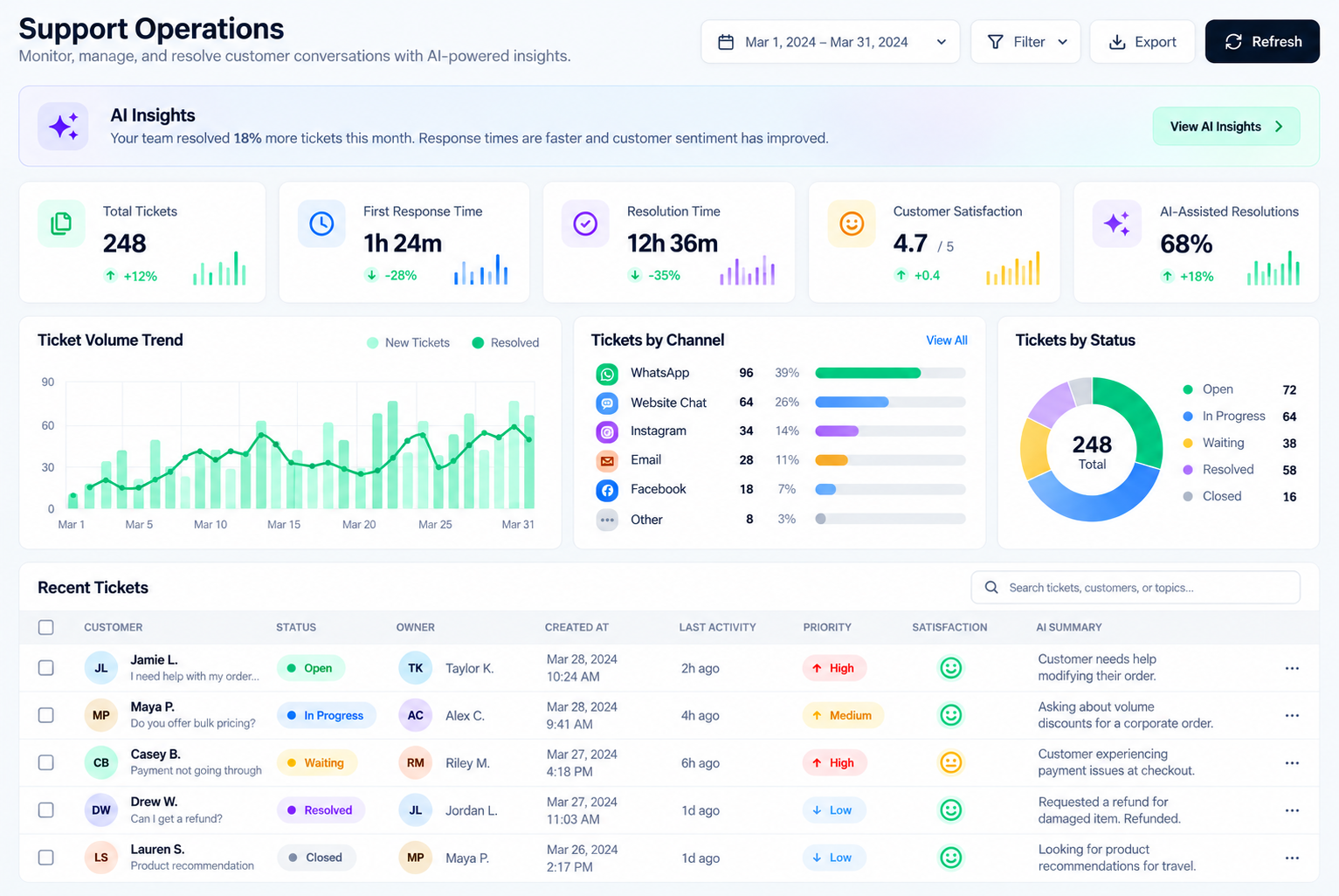
Build AI-Powered WhatsApp Support Around Your eCommerce Operation
The most useful customer-support automation is not the one that tries to replace every conversation with AI.
It is the one that understands which questions are repetitive, which answers require current business data, and which conversations should go directly to a person.
That is the approach behind this platform.
AI handles suitable questions using approved knowledge and connected commerce information. Support employees remain visible throughout the process and can take control whenever the situation calls for human judgment.
For businesses planning similar functionality, Kanhasoft can help with AI-powered application development, AI Knowledge Base solutions, custom business software, WhatsApp Business integrations, real-time support systems, and eCommerce application integrations.
Discuss your AI customer-support requirements with Kanhasoft.

Challenges
The Same Questions Kept Returning
Order status, delivery, stock, return, and product questions consumed a meaningful part of the support team's daily work.
A General AI Model Did Not Know Store Policies
Without controlled knowledge, an AI assistant could provide an answer that sounded convincing but did not match the business's actual rules.
Not Every Question Needed Live Data
Calling external commerce APIs for basic policy questions would add unnecessary processing and dependency.
Current Information Could Not Come From Static FAQs
Order and shipment status changes. These questions needed data from the operational system at the time the customer asked.
WhatsApp Conversations Were Not Text-Only
Screenshots, images, and voice messages were part of normal customer behavior.
AI Could Not Be Allowed to Compete With Agents
Once a support employee entered a conversation, the automation needed a clear way to step aside.
Conversation History Could Become Difficult to Manage
Long WhatsApp threads are useful for communication but are not always ideal for tracking support workload and case status.
AI Improvement Had to Be Practical
A support team should not need a developer every time it discovers a better answer to a common question.
Managers Needed Context, Not More Chat Logs
Reading hundreds of messages is not the same as understanding what customers are asking.
The harder problem was therefore not sending an automated WhatsApp reply.
The real challenge was deciding what the AI should know, when it should retrieve live information, when it should stop, and when a person should take over.
Solutions
Business-Managed AI Knowledge Base
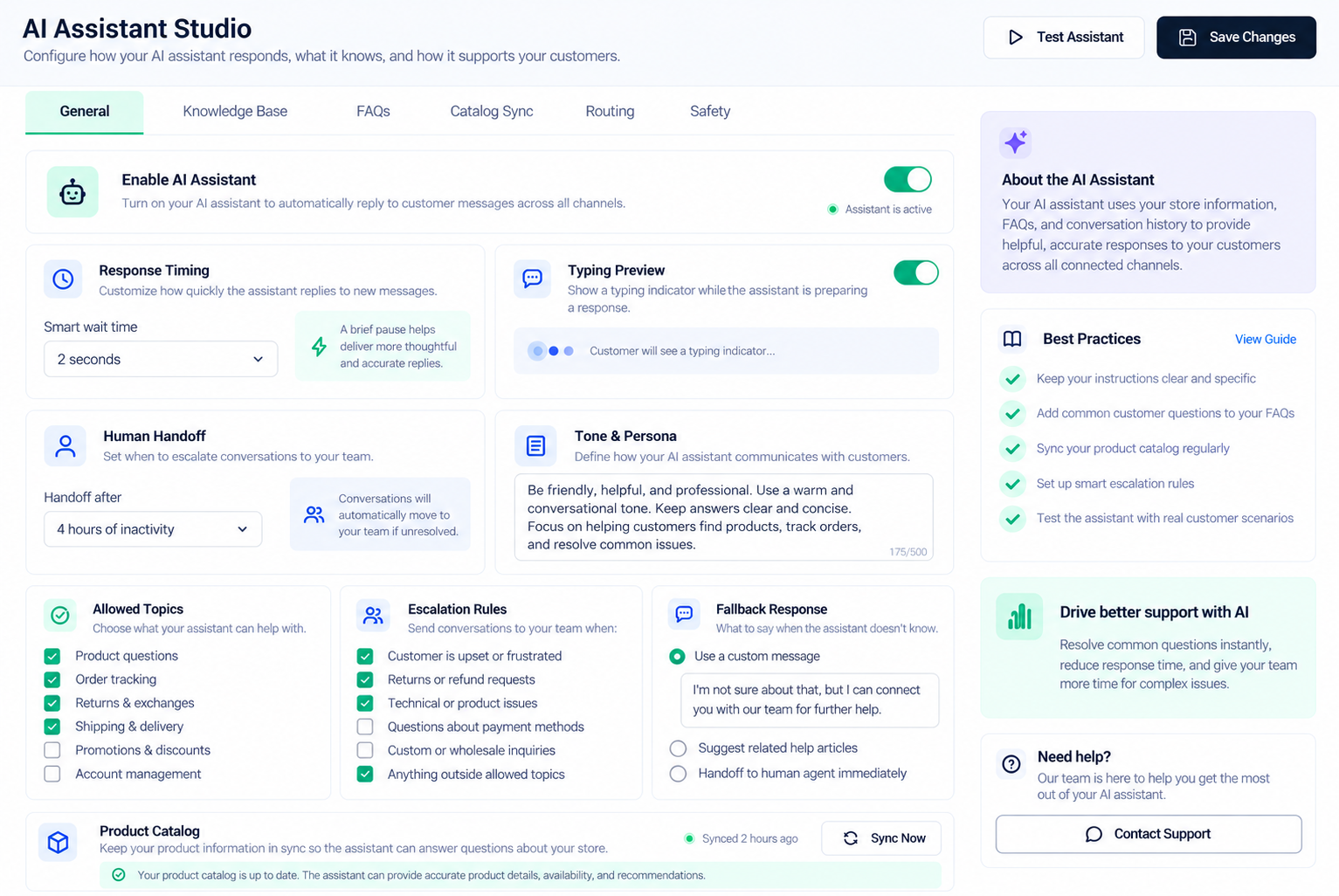
The support team can maintain FAQs, communication guidelines, conversation rules, labels, and relevant store information used by AI.
Knowledge-First Responses
Routine questions are answered using approved business information rather than unrestricted model knowledge.
Selective Real-Time Data Retrieval
The AI requests live commerce information only for questions that actually depend on current data.
Order & Shipment Lookup
Current order or tracking information can be fetched when customers ask about an existing purchase.
Product & Availability Context
Synced commerce data gives the assistant useful product context for appropriate customer questions.
Image & Voice Understanding
Customer images can be processed for relevant information, while voice messages can be transcribed before entering the AI workflow.
Controlled Fallback
If the available information is not enough, the system can return the configured fallback rather than invent an answer.
Automatic Conversation Classification
Conversations can be tagged according to support categories such as Order Status, Refund Request, Shipping Question, Product Query, or Payment Issue.
Shared AI & Human Support
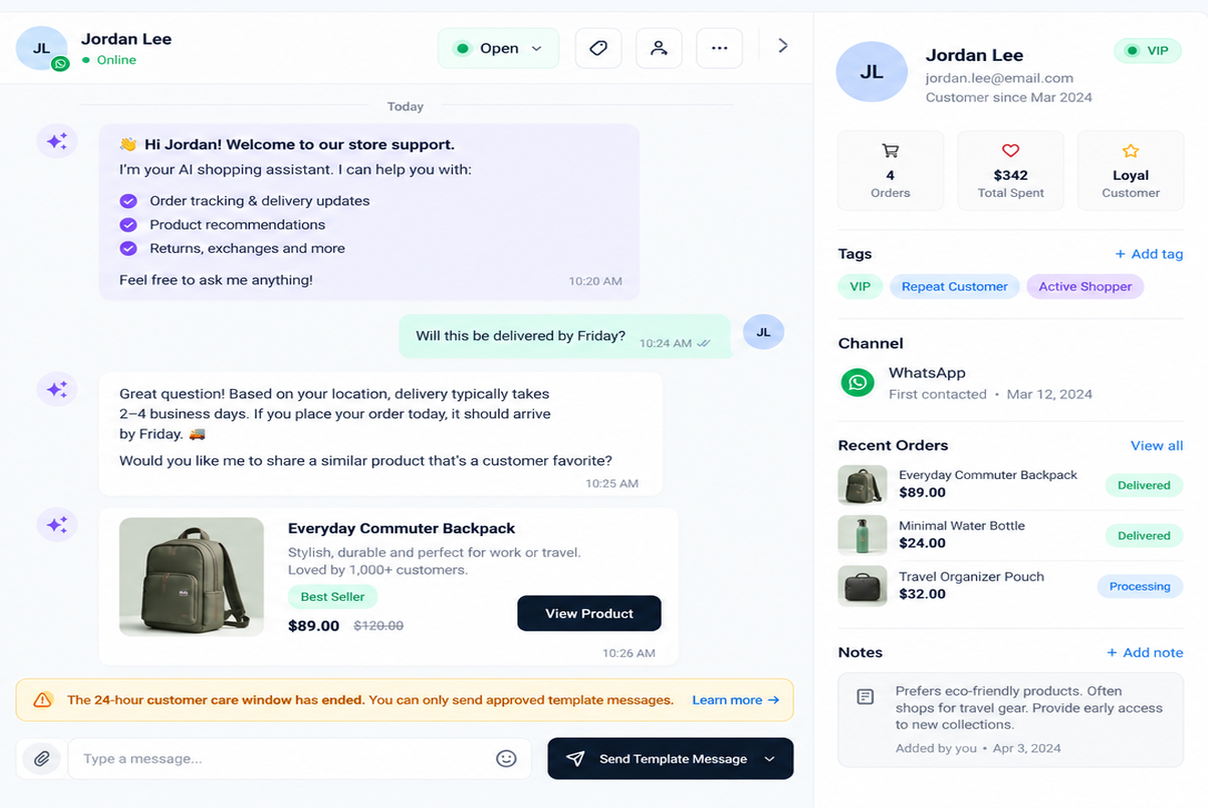
Agents see the same conversation history and can pause automation or take over immediately.
AI Training From Real Conversations
Useful agent responses or corrected AI answers can become part of future knowledge.
Automatic Ticket Creation
WhatsApp conversations can become structured support tickets with status, responsibility, timestamps, and conversation history.
AI Ticket Summaries
Closed tickets can be summarized so managers do not have to reread every customer message.
Support Insights
Recent conversations can be analyzed to highlight repeated questions, common topics, satisfaction patterns, and the balance between AI and human support.
AI-Powered WhatsApp Support, Knowledge Management
The platform combines AI support, approved business knowledge, live eCommerce data, human agents, and ticket management in one workflow.
Business-Controlled Knowledge
The support team manages FAQs, tone, language, escalation rules, and topics the AI should avoid.
Knowledge-First Replies
General questions are answered from approved business information, while live eCommerce data is used only when current order, shipment, or stock details are needed.
Multimodal Support
The system can process text, images, screenshots, and voice notes within the same support flow.
Automatic Labels
Conversations can be categorized by topics such as order status, shipping, refunds, payments, product questions, and availability.
Controlled Fallback
If the AI cannot answer reliably, it uses the configured fallback response and allows a human agent to take over.
Human Takeover
Agents can monitor AI replies, pause automation, respond manually, assign chats, and continue from the same conversation history.
AI Learning
Useful agent responses and corrected AI replies can be reused to improve future answers.
Natural Reply Timing
A configurable delay helps combine multiple short customer messages into one relevant reply.
Support Tickets
Conversations can become tickets with status, ownership, timestamps, and linked chat history.
AI Summaries & Insights
Resolved tickets can be summarized, while recent conversations can be analyzed for common questions, support topics, AI-versus-human replies, and customer patterns.
Key Features
AI-powered WhatsApp customer support
Customer-support guidelines
Escalation rules
WhatsApp Business API integration
Shipment and tracking lookup
Image text extraction
Human escalation
Multiple-message grouping
Instant agent takeover
AI improvement from real chats
Ticket timestamps
AI ticket summaries
Frequently asked question analysis
eCommerce system integration
Tone preferences
Topics-to-avoid configuration
Real-time AI responses
Product-information lookup
Voice-note transcription
Automatic conversation labels
Real-time agent chat
Pause AI per conversation
Automatic support tickets
Ticket filtering
Support conversation insights
Support handling overview
Business-managed AI knowledge base
Response-length rules
Product-data synchronization
Selective live-data retrieval
Stock and availability support
Multimodal customer support
Custom support categories
WebSocket updates
Conversation assignment
Ticket status tracking
Ticket metrics
AI-versus-human interaction analysis
FAQ management
Language configuration
AI enable / disable controls
Order-status lookup
Image understanding
Multilingual fallback handling
Configurable AI reply timing
AI response monitoring
Direct agent replies
Ticket assignment
Ticket export
Customer-topic analysis
Architecture & Scalability
The platform is organized around three main technical components.
eCommerce Administration & Configuration Application: Built with React, Node.js, and Express. This interface allows business teams to manage the AI knowledge base, response guidelines, conversation labels, synced commerce information, fallback behavior, and other support settings.
Live Support Application: Built with React, Bun, Express, and WebSockets. Agents use this workspace to view customer conversations, monitor AI replies, take over chats, assign work, and manage related tickets.
AI Service: Built with Python and FastAPI using LangChain and Google Vertex AI with Gemini. It prepares customer responses from approved business knowledge, conversation history, and relevant commerce information.
The AI service also coordinates image and audio processing and decides when live operational information is needed.
AWS serverless services support incoming-message processing, real-time updates, queued work, scheduled processing, and other background tasks.
MongoDB stores application information. Amazon SQS supports asynchronous workloads, while Amazon S3 provides object storage where required.
Product and other suitable store information can be synchronized ahead of time. This means routine questions do not depend on a live external API call.
Current information-such as an order status, shipment update, or stock value-can still be requested when the question requires it.
This separation helps the platform remain responsive as support volume grows without making every customer message dependent on multiple real-time external calls. The source architecture similarly separates the live support application, AI service, and asynchronous AWS processing.
User Roles
- eCommerce Business / Store Administrator: Maintains support knowledge, response rules, product information, conversation classifications, fallback behavior, and AI configuration.
- Support Agent: Monitors conversations, checks AI responses, communicates directly with customers, takes over from AI, assigns conversations, and contributes useful support knowledge.
- Support Manager: Reviews open and closed tickets, workload, conversation summaries, common support topics, and broader service insights.
- Customer: Contacts the business through WhatsApp using text, images, or voice notes and continues within the same conversation whether the response comes from AI or a human agent.
Results & Business Impact
The platform creates a practical balance between support automation and human service.
Key outcomes include:
- Routine customer questions can be handled without waiting for an agent
- Support employees can focus more attention on cases that require judgment
- AI answers are based on business-controlled knowledge
- Current order information can be retrieved when required
- Live commerce calls are avoided for questions that do not need them
- Product information can support customer queries
- Images and voice messages become part of the same support workflow
- Unknown questions follow a controlled fallback path
- Agents can see what AI has said before taking over
- Human takeover does not break the conversation history
- Support teams can improve future AI answers from real interactions
- Customer chats can become structured support tickets
- Ticket summaries reduce the need to reread long conversations
- Conversation insights highlight recurring customer needs
- Managers gain better visibility into how AI and agents share the workload
- The business retains control over knowledge, escalation, and final responses
These are operational benefits supported by the design of the platform. The project source does not provide verified percentage improvements in response time, support cost, or customer satisfaction, so the case study avoids inventing those metrics.
Use Cases
This type of AI WhatsApp support platform can work well for:
- Fashion and apparel businesses
- Beauty and personal-care stores
- Electronics retailers
- Furniture and home-goods businesses
- Jewelry and accessories stores
- Health and wellness eCommerce brands
- Food and specialty-product businesses
- Direct-to-consumer brands
- Multi-product online stores
- Multilingual eCommerce businesses
- Online retailers receiving frequent order questions
- Businesses with small customer-support teams
- Companies handling customer service primarily through WhatsApp
- Stores that need AI automation without removing human support
Frequently Asked Questions
Talk To Us
About Your Project