
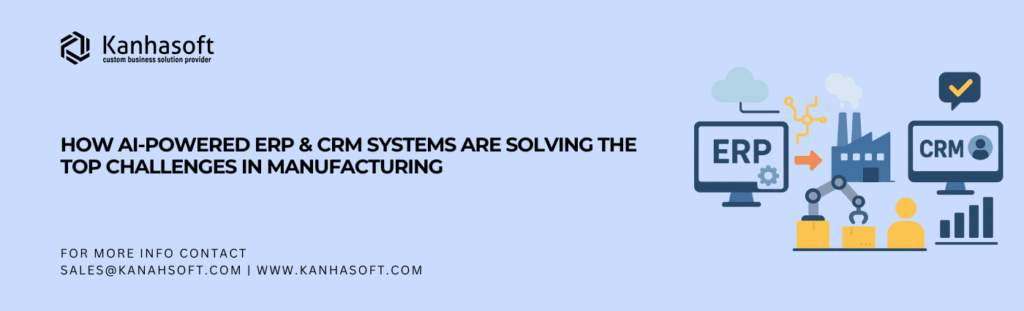
We’ve seen more manufacturing operations than we can count (yes—we still count, out of habit), and one thing keeps coming up: when production slows, when supply chains fragment, when quality slips, spreadsheets and last‑year’s software don’t cut it. The future is clear: AI-powered ERP and CRM systems are not just improvement projects — they are transformation levers. This is especially true for manufacturers in the USA, UK, Israel, Switzerland, and UAE, where global footprints, complex production lines, remote teams, and regionaAnecdote from the KanhaSoft Workshop differences make the case for intelligent, integrated systems.
So hang on (and pour the coffee)—we’re going to walk you through the big manufacturing pain‑points, show how AI‑enhanced ERP/CRM systems make a difference (we’ve lived this), sprinkle in an anecdote (because yes—real stories matter), and end with the practical “what to do next” map. After all.
The Manufacturing Context: What Keeps You Up At Night
First things first: what are the top challenges manufacturers face—especially when you operate globally or across regions like UAE, Switzerland, or Israel? Because unless we map the terrain, the tech talk just becomes vocabulary. Here are the recurring issues:
-
Volatile demand & forecasting inaccuracy – Markets shift quickly; yesterday’s data doesn’t guarantee tomorrow’s needs.
-
Supply chain disruption & inventory mis‑alignment – Suppliers ghost you, shipments reroute, lead times blow out.
-
Quality lapses & production downtime – When a machine breaks, or defects appear, the ripple hits everyone.
-
Disconnected customer & operational data – CRM isolated from production, ERP isolated from sales—so what the factory sees isn’t what the customer expects.
-
Legacy systems, silos & manual data workarounds – Ugh, the spreadsheets. They still exist. We know because we’ve cleaned up the mess (multiple times).
-
Global/regional regulatory complexity & varying standards – Operating in the UK/USA is one thing; add in Switzerland or UAE and you’ve got languages, currencies and compliance stacking.
-
Workforce and change‑management issues – New tech means new processes. Resistance is real.
When you layer all these together, manufacturing becomes a juggling act. And unless the systems you rely on are built to juggle, you risk dropping the balls (and yes—they tend to break things when they drop).
Enter AI‑Powered ERP & CRM: The Game‑Changer
So what happens when you combine ERP and CRM with AI—especially for manufacturing? The capabilities suddenly shift from “react and survive” to “predict and thrive”. Sources tell us that AI in ERP is now automating tasks, delivering predictive insights, and reshaping supply chains. We’ve seen this shift across live ERP/CRM implementations in manufacturing.
Here’s what the combo unlocks:
-
Predictive maintenance and quality control: AI models ingest sensor data, detect anomalies, trigger alerts before defects escalate. (Manufacturing ERP use‑case: improved uptime)
-
Demand forecasting & inventory optimisation: No more “how many units did we sell last year” simulations. AI considers external signals, regional shifts, supply‑lead changes and gives you near‑real‑time forecasts.
-
Integrated customer & operations insights: CRM data (customer demands, returns, complaints) feeds into the ERP, AI spots patterns (“these customers return product X more when lead time >10 days”) and triggers workflows.
-
Automated workflows and decision‑support: From order routing to supplier selection to production scheduling—AI suggestions reduce decision lag.
-
Multi‑region/global readiness: AI models can handle region‑specific data, language variants, compliance flags (which manually would be heavy lift).
-
Real‑time visibility & adaptive systems: While traditional software sits in “batch mode”, AI‑powered platforms ingest streams, adapt, refine. Manufacturing can finally act in hours—not weeks.
And yes—this is exactly what we build with clients. The difference is palpable. One manufacturing client (global footprint) told us: “It’s like our system finally grew a brain.” We smiled. Because that’s the kind of outcome that matters.
A Real-World Example: Predictive Maintenance in Action
And in the body of that section, change:
- “Let’s step back into one of our actual engagements” → “Consider this real-world example.”
- “We deployed an AI‑powered ERP/CRM solution” → “An AI-powered ERP/CRM solution was deployed:”
- “We simply replied: ‘That’s why we brought it in.'” → Delete this whole sentence.
- “And yes, we got more than one high‑five. (We accept virtual ones too.)” → Delete entirely.

Top Manufacturing Challenges and How AI‑Powered ERP/CRM Solve Them
Let’s match the major pain‑points to the tech solutions—so your business can see exactly what’s on offer.
1. Demand volatility & forecasting
Challenge: Traditional ERP uses historical averages and can’t adapt to sudden shifts (holiday demand, region‑specific surge).
Solution: AI models ingest external signals (weather, economic data, local events), combined with internal sales/CRM data to give more accurate forecasts. Result: reduced stockouts, lower inventory cost.
2. Supply chain disruptions & inventory mis‑alignment
Challenge: When lead time shifts, supplier reliability drops, transport cost rises—traditional systems lag.
Solution: AI‑enhanced ERP monitors supplier data, flags risk, recommends alternate suppliers or adjust production schedule. Inventory auto‑adjusts.
3. Maintenance & quality issues
Challenge: Machine breakdowns and defects cost time, money, reputation. Legacy ERP reacts, doesn’t predict.
Solution: AI‐powered predictive maintenance models detect anomalies (via sensors or operational data). CRM data about complaints loops back into production system. Quality control becomes proactive.
4. Disconnected customer insights & operations
Challenge: Sales/CRM may not link to production issues; operations doesn’t know about return‑triggers.
Solution: AI connects CRM and ERP data, surfaces insights (“customers returning due to late delivery in region UAE/Israel”), triggers workflows (adjust production, reroute shipment).
5. Region & operational complexity
Challenge: Multiple countries, languages, currencies, compliance rules. Standard systems become bottlenecks.
Solution: AI‑enhanced systems can adapt to data in different formats, flag region‑specific anomalies, standardise across operations.
6. Legacy systems/Manual workarounds
Challenge: Old software, spreadsheets, manual end‑runs = error‑prone, slow, brittle.
Solution: The ERP and CRM platform becomes the backbone; AI automates the heavy‑lifting; business can shift focus from “update Excel” to “take action”.
Why Manufacturing Needs Both ERP and CRM with AI
You may ask: can’t we just focus on ERP? Or just on CRM? The real power lies in integration.
-
The customer experience (CRM) drives demand, drives complaints, drives return flows—these impact manufacturing planning and production schedules (ERP).
-
The manufacturing reality (ERP) influences sales promise, customer communication, lead conversion (CRM).
-
AI thrives when it has broader data: CRM + ERP = richer signals = better insights.
-
For global manufacturers (hello UAE/UK/Switzerland/USA/Israel) you’ll have remote sales/field teams, service alerts, production lines—and the system that links them is far more valuable.
So think end‑to‑end. Because when CRM and ERP systems talk with AI in the middle—you stop running separate silos and start running a unified intelligence engine.
Key Metrics & Business Value (Because Finance Teams Ask ‘Show Me the Numbers’)
Measurable outcomes matter. Here are the metrics worth tracking:
-
Reduction in machine downtime (hours saved)
-
Reduction in defect / reject rates (%)
-
Inventory cost savings (%), stockouts avoided
-
Forecast accuracy improvement (%)
-
Lead‐time reduction for supplier delivery
-
Customer complaint rate decline
-
Sales conversion uplift due to integrated data
-
Manual effort hours eliminated (spreadsheets, manual reports)
-
Time to decision (hours vs days)
-
ROI period (months until value exceeds cost)
Industry data shows that AI‑powered ERP systems in manufacturing deliver 30 ‑ 40 % efficiency gains in some cases. That’s not hype—it’s real, when applied correctly.
Implementation Considerations & Pitfalls (Yes, We’ve Been There)
Because while the future is bright, the path isn’t always smooth. We’ve encountered (and fixed) these issues:
-
Data quality & integration: AI only works if the data is clean and consistent. Legacy systems often have duplicates, missing values.
-
Change management: Operators, sales teams, production leads may resist new workflows. Training essential.
-
Scope creep: Trying to solve everything in first phase delays results. Focus on key use‑case, then expand.
-
Region‑specific complexity: Currency, language, regulatory differences (Switzerland vs UAE vs UK) raise cost/time.
-
Maintenance & model drift: AI models degrade without refresh. You need governance.
-
Cost vs value clarity: Ensure you have business metrics before embarking.
-
Vendor choice & fit: Ensure vendor understands manufacturing, region, multi‑country demand. A useful rule: if a vendor asks you to change your process to fit their tool — walk away.
How to Start: A Practical Roadmap for Manufacturers
Here’s a practical step‑by‑step roadmap we use:
-
Discovery phase
-
Map your biggest pain‑points (e.g., downtime, returns, forecasting errors)
-
Gather data sources: production logs, machine sensors, CRM complaints, supplier lead time data
-
Define business outcome (reduce downtime by X% in Y months)
-
-
MVP Build
-
Select one domain (e.g., predictive maintenance)
-
Integrate ERP and CRM systems, feed data to AI model
-
Launch dashboard & alerts, pilot with one line or region
-
-
Expansion & Integration
-
Add additional modules: inventory optimisation, demand forecasting, quality control
-
Expand across factories/geographies (UAE, Switzerland, UK, etc)
-
Add mobile/remote access for field teams
-
-
Continuous Improvement
-
Monitor key metrics, model performance, adoption
-
Train teams, embed new workflows—move from “we have new tech” to “we act differently”
-
Maintain governance: data pipelines, compliance, regional readiness
-
-
Scale & Future‑proof
-
Add modules: AI‐driven scheduling, autonomous decision support, digital twins
-
Expand to more sites, regions, languages
-
Ensure system is ready for Industry 4.0/5.0 era
-
This blueprint has been applied successfully in Israel, UAE, UK and Switzerland move from legacy systems to AI‑enabled manufacturing operations.
Case Snapshot: Region‑Aware Implementation
A manufacturing client operating across UAE and Switzerland was struggling with cross-region lead-time variability and regional standards. The deployed solution was a unified AI-powered ERP and CRM platform with modules for inventory optimisation, supplier performance monitoring, and customer complaint loop-back to operations. Regional dashboards were configured — one for UAE operations (AED, Arabic/English) and one for Switzerland (CHF, German/French). The result: lead-time variability dropped by 18%, quality rejects dropped by 23% in the first six months, and the UAE sales team gained live visibility into Swiss line issues before customers even called.
Conclusion
Manufacturing today doesn’t have to be about scrambling to keep up — it can be about pulling ahead. With AI-powered ERP and CRM systems, operations move from reactive chaos to predictive, integrated workflows. Whether you’re running lines in the UK, dealing with suppliers in Israel, managing inventory in Switzerland, or serving clients in the UAE, the path is clearer: unify your operations and customer data, embed real-time intelligence, and let the system work while your team focuses on strategy.
If you’d like to discuss your manufacturing operations, book a 30-minute discovery call